
Some fires never really go out. Coal seams, gas seeps and buried peat can smolder or blaze for decades, centuries, even millennia, driven by chemistry rather than any match or lightning strike. Here are nine places on Earth where the ground itself has been quietly burning for years, decades or thousands of years.
1. Centralia mine fire: A Town Emptied By Fire Underground

Pennsylvania’s environment department traces the blaze to May 1962, when trash burning at an old strip pit ignited exposed coal in the Buck Mountain seam beneath Centralia. According to state mine-fire records, the fire has spread across roughly 400 acres of underground workings, and engineers concluded decades ago that it was too extensive and too deep to put out.
Ground temperatures rose high enough to buckle Route 61 and fill basements with carbon monoxide, and by the 1990s the state had bought out nearly every home and revoked the borough’s charter. A handful of residents still live there today, and the coal seam below their empty streets is expected to keep smoldering for well over a century.
2. Darvaza gas crater: The Gateway To Hell Still Burns

The crater opened after a Soviet drilling rig collapsed into a gas-filled cavern in Turkmenistan’s Karakum Desert in the early 1970s, and geologists reportedly lit the escaping methane to stop it from poisoning the area. The crater’s Wikipedia profile notes the gas was expected to burn out in weeks; instead the pit, nicknamed the Gateway to Hell, has kept flaming for more than fifty years.
Turkmenistan’s government has ordered the fire put out more than once, citing the gas field’s lost value, but every attempt has failed. The pit now draws tourists who camp on its rim after dark to watch the flames glow against the desert sky.
3. Burning Mountain: Earth’s Oldest Known Coal Fire

NSW National Parks manages the reserve at Wingen, home to what researchers believe is the world’s oldest known coal-seam fire, burning for an estimated 6,000 years. The NSW parks agency says the underground front creeps roughly a metre a year, baking the sandstone above it into hard, reddish clinker and venting sulfurous smoke through cracks in the hillside.
Because the seam sits deep underground, there is no visible blaze at the surface, only baked white and orange rock, faint heat and thin wisps of smoke drifting from fissures along the ridge. At the current crawl, the fire has already outlasted human memory and is expected to keep advancing southward for thousands of years to come.
4. Jharia coalfield: A Coalfield That Swallowed Its Towns

Underground fires have burned through India’s richest coking-coal reserves in Jharkhand’s Jharia coalfield since 1916, when poor mining practices let air reach exposed seams. The coalfield overview page puts more than seventy fires still active across the field, some burning less than a hundred feet beneath houses, roads and rail lines in the Dhanbad district.
The ground has opened into sudden fissures and sinkholes under entire neighborhoods, and authorities have spent decades trying to relocate residents to a purpose-built township, with mixed success. Land subsidence, toxic gas and heat close to the surface make parts of the coalfield uninhabitable even as mining and daily life continue around the burning ground.
5. Yanartas: Flames Born From Ancient Legend

Turkey’s culture ministry documents dozens of small flames flickering from cracks in the rock on a Lycian hillside above the village of Cirali, fed by methane seeping up through the limestone. The Turkish culture portal notes the fires have burned for millennia, long before anyone understood the gas beneath the mountain, and gave rise to the legend of the fire-breathing Chimaera.
Ancient sailors reportedly used the flames as a natural lighthouse, and visitors today can still walk up at dusk to watch dozens of individual jets burning at once across the bare slope. The flames need no fuel beyond the gas itself, so wind or rain can knock one out only for it to relight again within minutes.
6. Baba Gurgur: A Flame Older Than The Bible

An oil field just outside Kirkuk in northern Iraq is ringed by a natural gas flame that locals say has burned continuously for thousands of years, fed by gas escaping from the same reservoir that made Baba Gurgur one of the world’s earliest major oil discoveries. The field’s background notes link the fire to the biblical account of a fiery furnace.
The site sits above one of the largest oil reservoirs ever found in Iraq, and no record survives of exactly when the flame first ignited. Engineers who developed the surrounding oilfield in the twentieth century left it burning rather than cap it, and it still lights the night sky near Kirkuk today.
7. Ijen: The Volcano That Burns Blue

At Kawah Ijen in East Java, sulfurous gases escape through cracks near the crater at temperatures approaching 600 degrees Celsius and ignite the instant they meet open air, producing electric-blue flames that can stretch roughly five metres above the vents. The glow is visible only after dark, which draws hikers up the crater rim overnight to see it.
The blue light is often mistaken for lava, but it is burning sulfur gas, not molten rock; Ijen’s actual lava never glows like this. Miners still descend into the crater by hand to break off chunks of the cooled yellow sulfur and haul it up the trail in baskets for sale.
8. Eternal Flame Falls: A Flame Behind A Waterfall
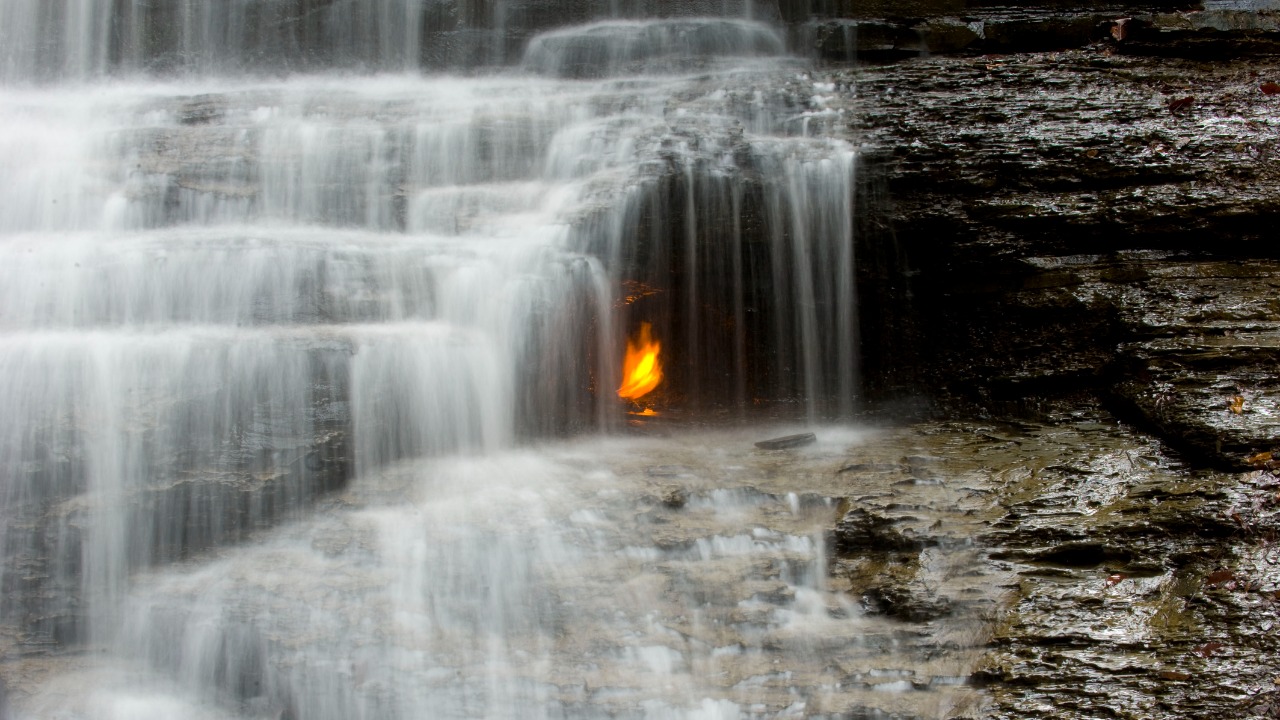
A small flame burns inside a grotto tucked behind a waterfall at Chestnut Ridge Park in western New York, fed by a natural gas seep that is roughly a third ethane and propane. Live Science reporting on Indiana University research found the shale directly beneath the flame is far too cool to be generating gas at that rate on its own.
Geologists suspect the gas is instead migrating up from a much deeper, hotter source than typically feeds this kind of seep, making the flame something of a small mystery even to the scientists who study it. Hikers who reach the grotto often relight the flame themselves after wind or spray from the falls snuffs it out.
9. Brennender Berg: The Hillside Goethe Once Visited

A coal seam beneath a hillside in Germany’s Saarland region, near Dudweiler, has been burning since 1668, most likely sparked by a lightning strike or a shepherd’s fire that found its way into exposed coal. The site’s historical account records that Johann Wolfgang von Goethe walked up to the smoking clefts himself in 1770 and wrote about the visit.
More than three and a half centuries later, the hillside still exhales warm, sulfurous vapor through cracks in reddish, heat-baked rock, and the ground nearby stays noticeably warm even in winter. The fire has slowed to a crawl through the depleted seam, but geologists have found no evidence that it is close to burning itself out.
More from Morning Overview
- Card skimmers hidden on gas pumps are draining accounts, and there’s a quick way to spot them
- The NSA warns one messaging setting can clone your texts to a stranger
- Security experts still urge phone owners to switch off one location-tracking setting
- Automakers are quietly dropping the stop-start feature many drivers love to hate
