
Astronomy’s reach is set by aperture, altitude and wavelength, and the past three decades have pushed all three to extremes. The instruments below span mountaintop arrays, orbiting observatories and radio dishes wide enough to swallow a stadium, each built to pull faint signal out of an almost empty sky. Here are eight giants that redrew the limits of what can be seen.
1. James Webb Space Telescope: Infrared Eyes on the Cosmic Dawn
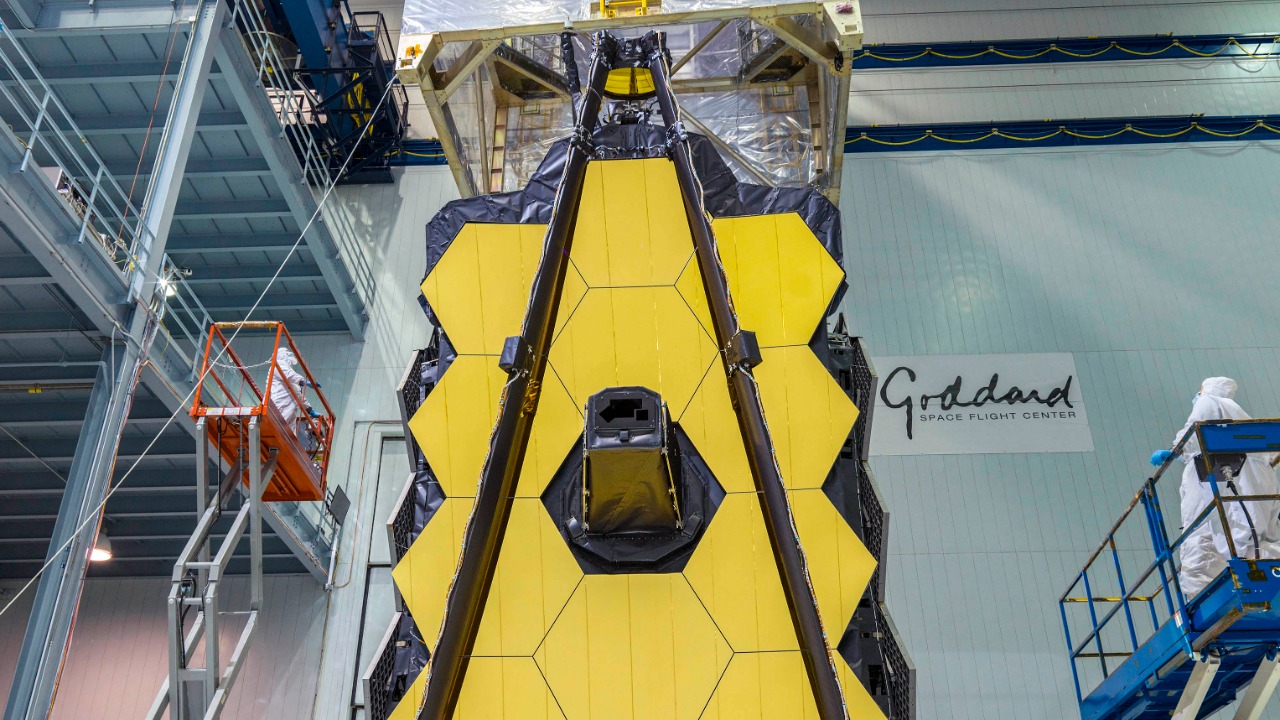
The James Webb Space Telescope gathers light with 18 hexagonal beryllium segments coated in gold, forming a primary mirror 6.5 meters across and roughly six times the collecting area of Hubble’s. A five-layer sunshield the size of a tennis court keeps the optics near 40 kelvin, cold enough for the detectors to register infrared photons without drowning in the observatory’s own heat.
Sensitivity at those wavelengths is the whole point, because expansion stretches the light of the earliest galaxies out of the visible range entirely. Working from the Sun-Earth L2 point, about 1.5 million kilometers away, buys thermal stability at a permanent cost: no servicing mission can reach it, so the mission ends when the propellant does.
2. Hubble Space Telescope: Three Decades of Deep Fields

Carried to orbit aboard Discovery in April 1990, the Hubble Space Telescope works with a 2.4-meter mirror at an altitude near 540 kilometers, above the turbulence that smears ground-based images. A flaw in that mirror’s figure crippled early observations until astronauts fitted corrective optics in 1993, and five shuttle servicing missions, the last in 2009, kept swapping in newer cameras, gyroscopes and spectrographs.
Those upgrades explain the longevity. Long stares at apparently blank sky produced the Deep Field and Ultra Deep Field images, resolving thousands of galaxies inside a patch narrower than a grain of sand held at arm’s length. Ultraviolet and visible coverage remains scarce from orbit, so the data complement infrared work rather than being made redundant by it.
3. Very Large Telescope: Four Mirrors Acting as One
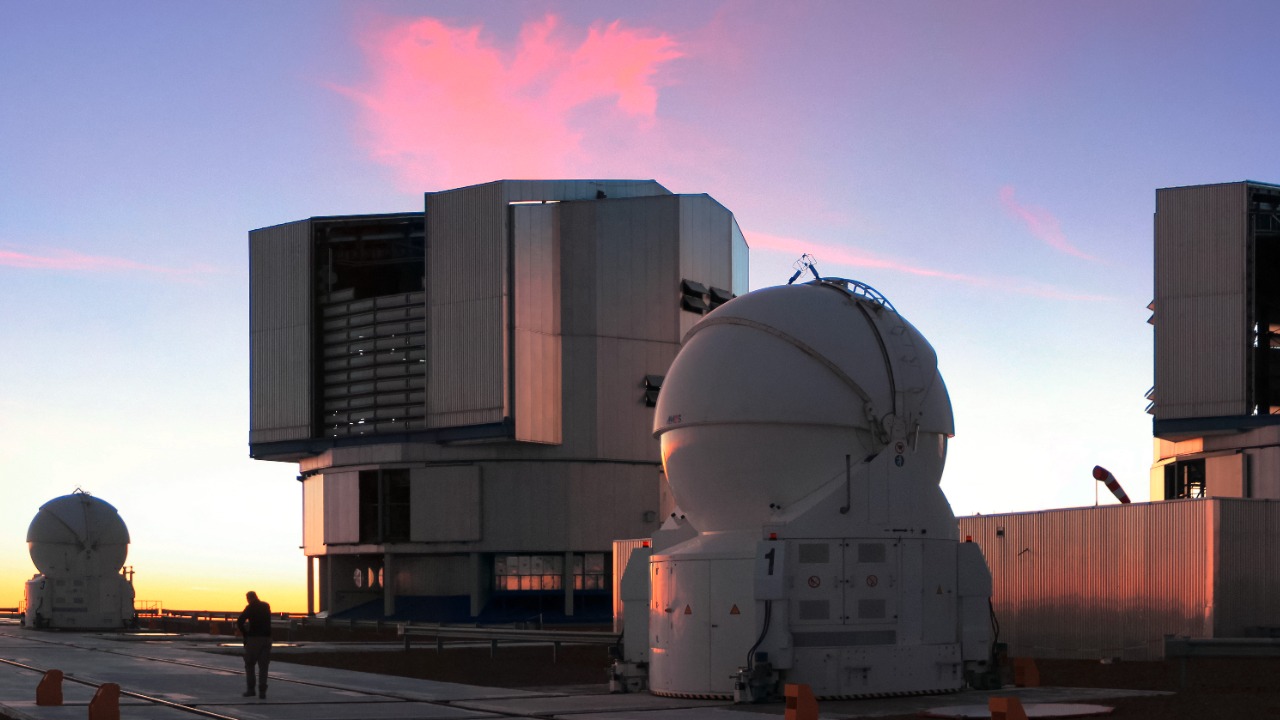
Perched above 2,600 meters on Cerro Paranal in the Atacama Desert, the Very Large Telescope is not one instrument but four 8.2-meter Unit Telescopes, backed by four movable 1.8-meter Auxiliary Telescopes. Most nights each unit observes alone. Linked as an interferometer, the beams combine to deliver angular resolution far beyond what a single 8-meter mirror could reach.
That flexibility produced results no lone dish could: the first direct image of a planet outside the solar system, and decades of astrometry tracking stars whipping around the Milky Way’s central black hole, observations that fed the 2020 Nobel Prize in Physics. Adaptive optics correct atmospheric distortion hundreds of times a second, narrowing the gap with orbiting instruments.
4. Atacama Large Millimeter Array: Sixty-Six Dishes on a High Plateau
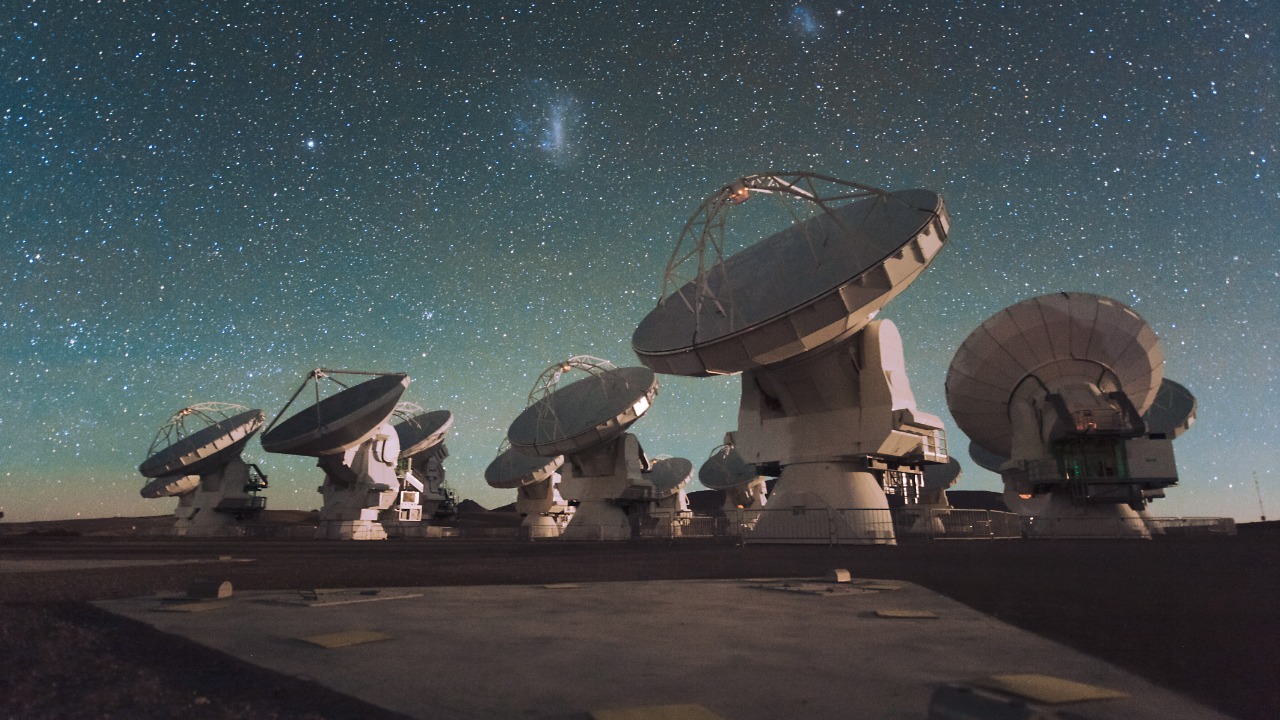
At roughly 5,000 meters on the Chajnantor plateau, the air holds little enough water vapor for millimeter and submillimeter wavelengths to survive the trip to the ground, which is why the Atacama Large Millimeter Array sits there. Sixty-six antennas, fifty-four of them 12 meters wide and twelve of them 7 meters, are hauled into new configurations by purpose-built transporters, with baselines stretching to about 16 kilometers.
Spacing sets the trade-off: wide configurations buy resolution, compact ones buy sensitivity to faint extended emission. Cold material is the specialty, including protoplanetary disks, molecular clouds and dust-choked galaxies at high redshift that optical telescopes miss entirely. An image of concentric gaps carved into the disk around the young star HL Tauri reset assumptions about how quickly planets assemble.
5. Extremely Large Telescope: A 39-Meter Mirror Taking Shape
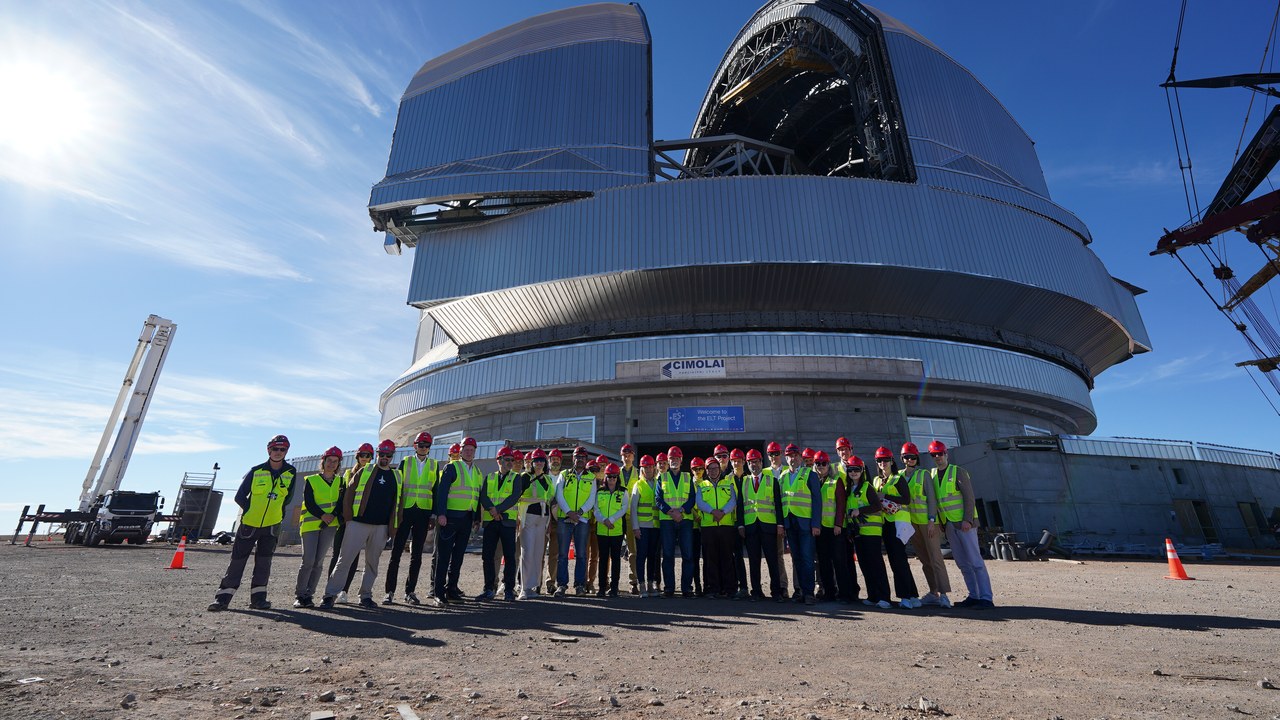
Rising on Cerro Armazones, the Extremely Large Telescope will carry a segmented primary mirror 39.3 meters wide, assembled from 798 hexagonal segments and fed through a five-mirror optical train that includes a deformable mirror for adaptive correction. Scale is the argument: collecting area grows with the square of diameter, so the finished instrument will gather many times the light of any telescope operating today.
European Southern Observatory schedules place first light toward the end of the decade, and construction milestones on a structure this size have slipped before. Should the optics perform as designed, direct imaging of rocky planets and spectroscopy of their atmospheres move within reach of a ground-based site rather than remaining an orbital problem.
6. Vera C. Rubin Observatory: The Whole Southern Sky, Over and Over
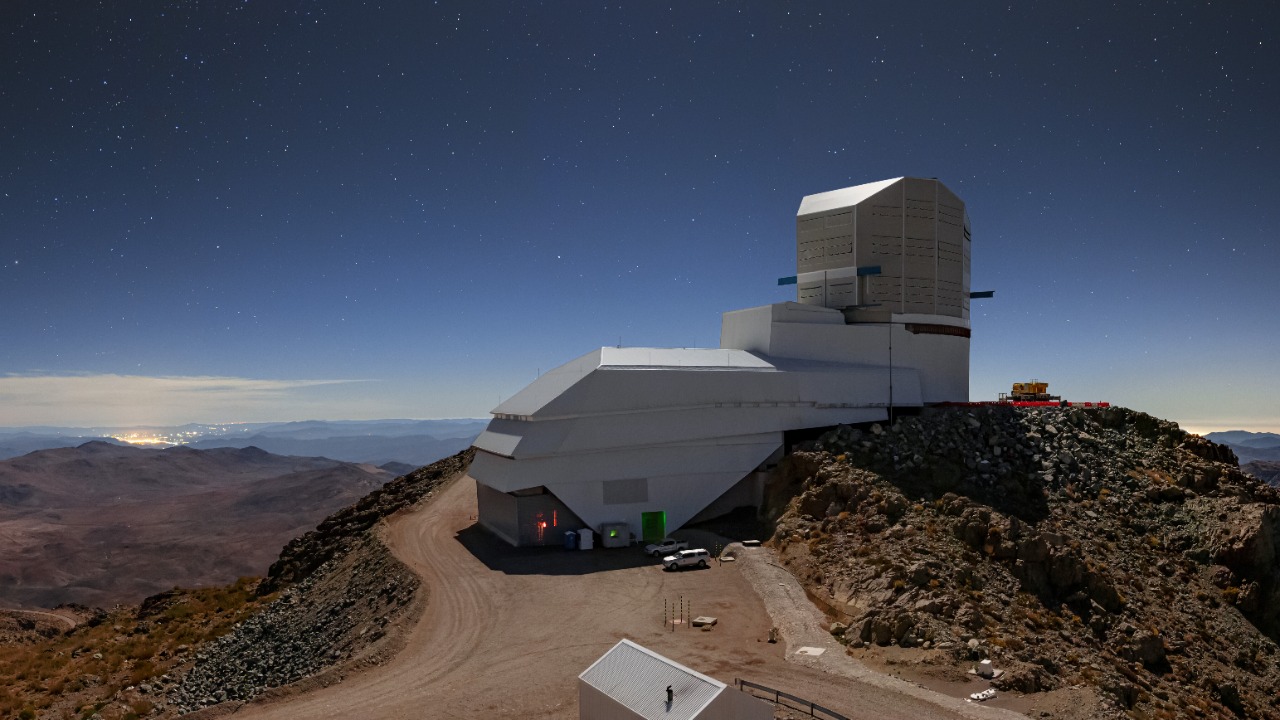
On Cerro Pachon, the Vera C. Rubin Observatory pairs an 8.4-meter three-mirror telescope with the 3,200-megapixel LSST Camera, the largest digital camera ever built for astronomy. The compact optical design opens a field of view spanning several square degrees, and the squat mount slews and settles in seconds, which is what makes surveying the entire visible southern sky every few nights arithmetically possible.
Its decade-long Legacy Survey of Space and Time is projected to produce tens of terabytes a night and millions of alerts flagging objects that moved or changed brightness. That volume shifts the bottleneck from observing to software, since supernovae, asteroids and variable stars have to be sorted automatically before any astronomer can chase them.
7. Green Bank Telescope: The Largest Steerable Dish on Earth

In rural West Virginia, the Green Bank Telescope presents an unblocked collecting surface measuring 100 by 110 meters, the largest fully steerable radio dish anywhere. More than two thousand surface panels are nudged by actuators to hold the parabola’s shape as gravity warps the structure at different elevations. It entered service in 2000, replacing a 300-foot dish that collapsed without warning in 1988.
Location counts as much as size here. The site lies inside the National Radio Quiet Zone, where transmitter power is restricted across thousands of square miles, letting receivers register signals measured in vanishingly small fractions of a watt. Pulsar timing and the hunt for complex molecules drifting between the stars make up much of its routine output.
8. Arecibo Telescope: The Dish That Rewrote Radio Astronomy

For 57 years the Arecibo Telescope held a 305-meter reflector inside a natural sinkhole in Puerto Rico, its receivers hanging from cables on a platform weighing some 900 tons. It pinned down Mercury’s rotation period, mapped Venus through cloud by radar, and caught the binary pulsar whose decaying orbit gave the first indirect proof of gravitational waves, work honored with the 1993 Nobel Prize in Physics.
Cable failures in August and November 2020 preceded the platform’s plunge into the dish that December, ending observations for good. The methods it proved out, from planetary radar to precision pulsar timing, now run at newer facilities, and its archive is still being mined by researchers who never worked on the mountain.
More from Morning Overview
- The NSA is again telling phone owners to switch off one location setting
- A handful of car transmissions are so tough mechanics say they almost never fail
- A handful of SUVs keep hitting 300,000 miles, and they share one engine trait
- Supplements now rank as the fifth-leading cause of death from liver disease.
