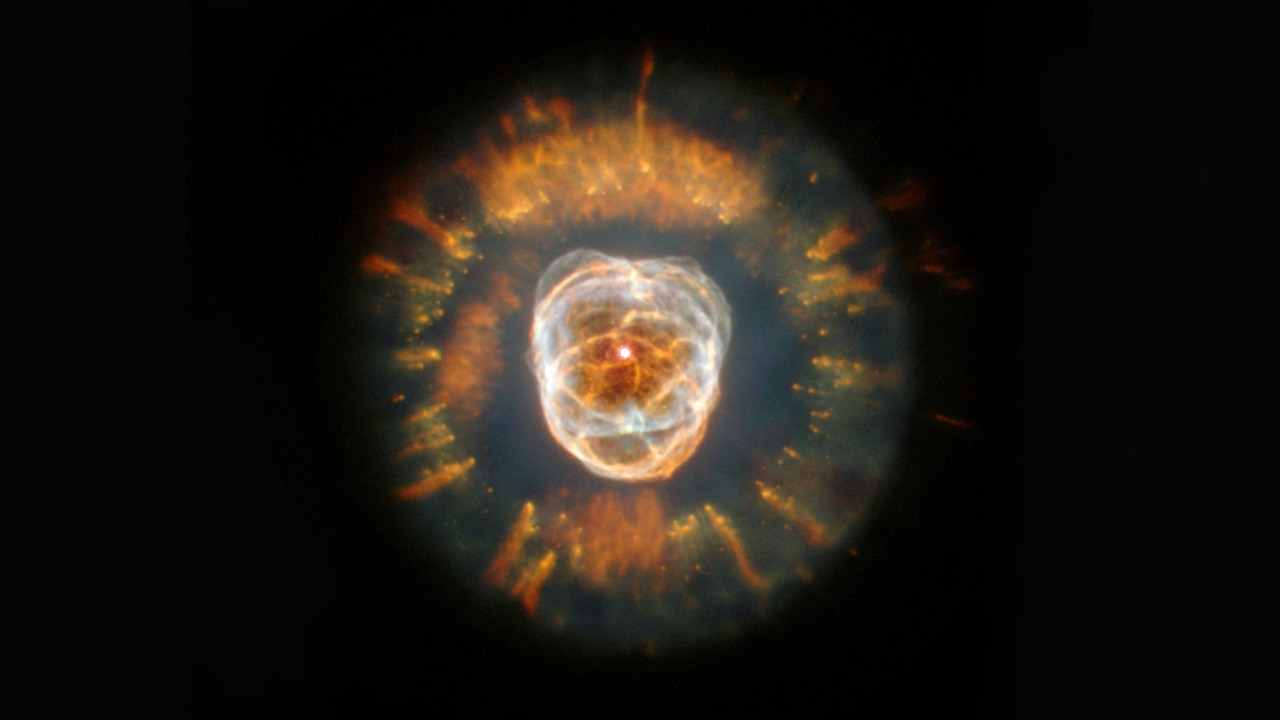

The latest generation of astronomy algorithms is not just cataloguing stars and galaxies, it is learning the hidden rules that shape the cosmos. By fusing telescope images, physics based simulation and new kinds of “world models,” these systems are starting to build an internal picture of reality that is very different from a human night sky, closer to the scaffolding of dark matter and energy that actually governs the Universe.
When I talk about how the universe looks through artificial eyes, I am really talking about how these models encode structure, from the clumpiness of dark matter to the chemistry of the first galaxies, and then project that understanding back onto the data we see. The result is a view that is at once alien and deeply physical, a universe rendered as high dimensional geometry, probability fields and evolving networks rather than constellations and constancy.
Inside an AI’s cosmic “world model”
At the core of modern space focused AI is a simple idea: instead of memorising pictures, the system learns a compact internal model of how the universe behaves. In cosmology, that often starts with vast suites of numerical simulations that track how matter and radiation evolve from the Big Bang to the present. By ingesting these synthetic universes, one model learned how cosmological parameters correlate with small scale structure, effectively compressing billions of years of expansion and clustering into a set of internal weights.
That approach is part of a broader shift in the field toward so called world models, a trend that AI pioneers like Yann LeCun has argued will matter more than language models. Instead of treating each galaxy image as an isolated input, these systems learn the underlying laws of motion, interaction and material properties, a research thrust that one analysis describes as a push toward ever more hyper realistic and physically grounded environments. In practice, that means an AI’s “view” of the universe is a dynamic internal sandbox it can roll forward or backward in time, not a static photo album.
From noisy images to a clear universe
On the observational side, the universe that reaches our telescopes is messy, blurred by gravity, atmosphere and instrumental noise. To recover what is really out there, astronomers now train networks on artificial data sets where every parameter is known, then deliberately corrupt those images and ask the model to reconstruct the truth. One team added realistic noise to perfectly known mock skies and taught an AI to statistically recover weak gravitational lensing signals, showing how They could peel back distortions that have long limited precision cosmology.
Another group built a new algorithm to model the evolution of large scale cosmic structures, with Researchers from the Instituto de Astrof, Canarias and the IAC focusing on how filaments and voids grow over time. In parallel, astronomers have trained a separate network to remove the effect of gravity on cosmic images altogether, revealing the intrinsic shapes of distant galaxies and clarifying the large scale structure of the universe in a way that a traditional pipeline could not, as shown by work on true shape recovery.
Teaching AI the universe’s “settings”
Beyond cleaning up images, cosmologists are using AI to infer the fundamental numbers that define our universe. One project trained a model on thousands of simulated universes where the underlying cosmological parameters were known in advance, so the network could learn the mapping from visible structure to invisible settings. Importantly, the team knew exactly which values went into each simulation, which meant the AI always had a correct answer to aim for and could be rigorously tested on how well it recovered those hidden dials.
When that approach was applied to real survey data, the method was able to determine the parameter that describes the universe’s “clumpiness” with less than half the uncertainty of previous techniques, sharpening our picture of how dark matter clusters on cosmic scales, according to work highlighted in Aug. A complementary analysis framed these efforts as using AI powered insights to probe the universe’s fundamental settings and even address puzzles like the Hubble tension, with one study again relying on large suites of simulation runs to map how small scale patterns encode global expansion history.
Seeing webs, dust and stellar bubbles instead of stars
When I look at how these systems represent structure, what stands out is that they prioritise the invisible scaffolding over the bright points of light. Observations show that dark matter forms a vast cosmic web of clusters and filaments that guide where galaxies live, a picture summarised by the idea that Our measurements point to an unseen framework. Direct high definition images of this web now reveal filaments where gas flows into galaxies, confirming that this network acts as the scaffolding on which all visible structures in the Universe are built, as shown in recent Universe mapping.
AI models trained on such data learn to treat galaxies as tracers of this deeper pattern, and even to account for subtle influences like magnetic fields weaker than a fridge magnet that still helped shape the early cosmic web, a point underscored by work showing that the cosmic web is a dominant feature whose magnetisation has long puzzled scientists. Within our own galaxy, similar tools have revealed that The Milky Way is not as well mapped as we assumed, with AI uncovering hidden stellar bubbles that reshape our understanding of star formation, as highlighted in reports on The Milky Way and its mysterious cavities.
At smaller scales, the James Webb Space Telescope is feeding these models with ultradeep infrared views of the first galaxies. The JWST, described as a Cosmic Power Couple with AI, peers deeper into space than any previous telescope, and its data show that grains made of diamond like dust can form in the first billion years of cosmic time, according to analyses of JWST data from the James Webb Space Telescope. Separate work in Astrochemistry has found that early universe analog galaxies have an Unexpected Talent For Making Dust, with JWST observations showing that even very young systems can still forge solid dust grains, as detailed in reports on Astrochemistry and how JWST Finds Early a Universe Analog with an Unexpected Talent For Making Dust.
How AI “sees” compared with us
Technically, an AI’s view of the sky is not an image at all but a cloud of points in a high dimensional space. According to work from Google DeepMind, vision models map inputs to internal coordinates so that related concepts sit close together, while very different ones, like a dog and a cake, are far apart, a process described in research that begins with the phrase According to Google. In cosmology, that means galaxies with similar environments or evolutionary histories cluster together in representation space, even if they sit billions of light years apart on the sky.
Some researchers have even argued that AI “hallucinations” can be useful, treating them not purely as errors but as a feature that sparks new hypotheses, much like the microdosing of human hallucinogens, a perspective captured in commentary that begins with the word Yet. In practice, astronomers are cautious, but they are also starting to treat AI as a transparent partner rather than a black box, with one co author of a recent transient detection study saying that we are entering an era where discovery is accelerated by such algorithmic collaborators that can spot rare cosmic events from just a handful of examples.
More from Morning Overview