The James Webb Space Telescope has reportedly identified an atmosphere on the intriguing lava planet TOI-561 b, a discovery that marks a significant milestone in astronomical research. This planet was initially discovered by NASA’s TESS Planet-Hunting Space Telescope, which completed its primary mission in 2020. The identification of an atmosphere on such a volatile planet opens new avenues for understanding the complexities of exoplanetary environments.
Background on TOI-561 b

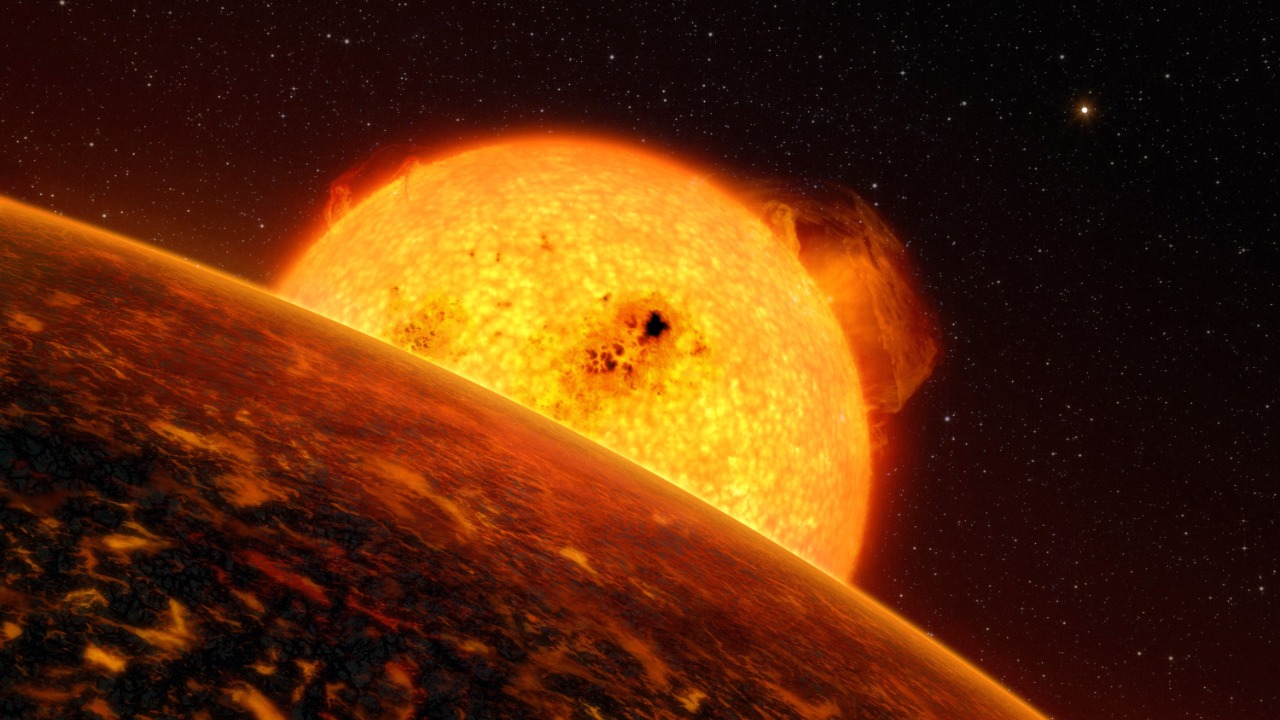
TOI-561 b was first discovered by NASA’s TESS Planet-Hunting Space Telescope, a mission designed to identify exoplanets by monitoring the brightness of stars. The telescope’s primary mission concluded in 2020, having successfully cataloged thousands of potential exoplanets, including TOI-561 b. This planet is categorized as a “lava planet” due to its extreme proximity to its host star, resulting in surface temperatures high enough to melt rock.
The discovery of TOI-561 b is significant in the context of exoplanet research because it represents a class of planets with extreme conditions that challenge our understanding of planetary formation and survival. Lava planets like TOI-561 b provide a unique opportunity to study the effects of intense stellar radiation on planetary atmospheres and surfaces, offering insights into the diversity of planetary systems beyond our own.
TOI-561 b orbits its star at an incredibly close distance, completing an orbit in less than a day. This proximity results in extreme tidal forces that can influence the planet’s geological activity, potentially causing volcanic eruptions and surface renewal. The planet’s density suggests it may have a rocky composition, similar to Earth, but the intense heat from its star likely creates a molten surface, earning it the classification of a lava planet. Understanding such planets is crucial as they represent one of the most extreme environments in the galaxy, providing a natural laboratory for studying planetary dynamics under intense stellar radiation.
Moreover, the study of TOI-561 b and similar exoplanets helps scientists refine their models of planetary system evolution. The presence of a planet in such a harsh environment challenges existing theories about planet formation and migration, suggesting that planets can form and survive in a wider range of conditions than previously thought. This expands the potential for discovering diverse planetary systems and understanding the mechanisms that allow planets to maintain stability in extreme environments.
The Role of the James Webb Space Telescope

The James Webb Space Telescope is a powerful tool designed to study the universe in unprecedented detail, particularly focusing on the formation of stars and planets. Its advanced instruments allow scientists to analyze the atmospheres of distant exoplanets by observing the light that passes through them. This capability is crucial for detecting atmospheric components and understanding the chemical composition of these distant worlds.
In the case of TOI-561 b, the James Webb Space Telescope utilized its spectroscopic capabilities to identify the presence of an atmosphere. This discovery is particularly significant because it suggests that even planets with extreme conditions, such as lava planets, can retain atmospheres. This finding challenges previous assumptions about atmospheric retention and loss in harsh environments, paving the way for future research into the atmospheric dynamics of similar exoplanets.
The James Webb Space Telescope’s ability to detect atmospheres on exoplanets like TOI-561 b is a testament to its advanced technology, which includes a suite of instruments capable of capturing infrared light. This capability is essential for identifying molecular signatures in the atmospheres of distant worlds. By analyzing the light spectrum, scientists can determine the presence of elements such as hydrogen, helium, and potentially more complex molecules. This information is vital for assessing the potential habitability of exoplanets and understanding the chemical processes occurring in their atmospheres.
The telescope’s success in identifying an atmosphere on TOI-561 b also highlights its role in complementing other space missions. While TESS identifies potential exoplanets, Webb provides the detailed follow-up observations necessary to characterize these worlds. This synergy between missions enhances our ability to explore the universe and underscores the importance of continued investment in space exploration technologies.
Implications of the Discovery
The detection of an atmosphere on TOI-561 b has profound implications for our understanding of atmospheric conditions on lava planets. It raises questions about the composition and stability of such atmospheres and how they interact with the intense heat from their host stars. This discovery could lead to a deeper understanding of the processes that govern atmospheric formation and evolution in extreme environments.
Beyond the specific case of TOI-561 b, this finding has broader implications for the study of exoplanets and the search for life beyond Earth. By expanding our knowledge of atmospheric conditions on diverse types of planets, scientists can refine their models of habitability and better assess the potential for life in the universe. The ability to detect and analyze atmospheres on distant worlds is a crucial step in identifying planets that may harbor life.
The discovery of an atmosphere on TOI-561 b prompts a reevaluation of how atmospheres can form and persist in extreme conditions. Scientists are particularly interested in understanding the atmospheric composition and how it withstands the intense radiation from the host star. This could involve studying the potential for atmospheric escape, where high-energy particles strip away atmospheric gases, and the mechanisms that might replenish or protect the atmosphere from such loss.
Furthermore, this finding encourages the development of new theoretical models to predict atmospheric behavior under extreme conditions. These models are crucial for interpreting data from current and future observations, allowing scientists to make more accurate predictions about the atmospheres of other exoplanets. The insights gained from TOI-561 b could also inform the search for life by identifying key atmospheric signatures that might indicate biological processes, even in seemingly inhospitable environments.
Future Prospects in Exoplanetary Studies

Looking ahead, the discoveries made by the James Webb Space Telescope will likely inspire new missions and technologies aimed at further exploring exoplanetary atmospheres. Upcoming missions, such as the European Space Agency’s ARIEL (Atmospheric Remote-sensing Infrared Exoplanet Large-survey), are expected to build on Webb’s findings by conducting detailed studies of exoplanet atmospheres across a wide range of conditions.
International collaboration will be key to advancing exoplanetary research. By pooling resources and expertise, space agencies around the world can enhance our understanding of the universe and accelerate the pace of discovery. As technology continues to evolve, the potential for new planet-hunting missions and advanced telescopes will expand, offering exciting opportunities to explore the cosmos and uncover the secrets of distant worlds.
For more information on the TESS mission, visit Scientific American.
