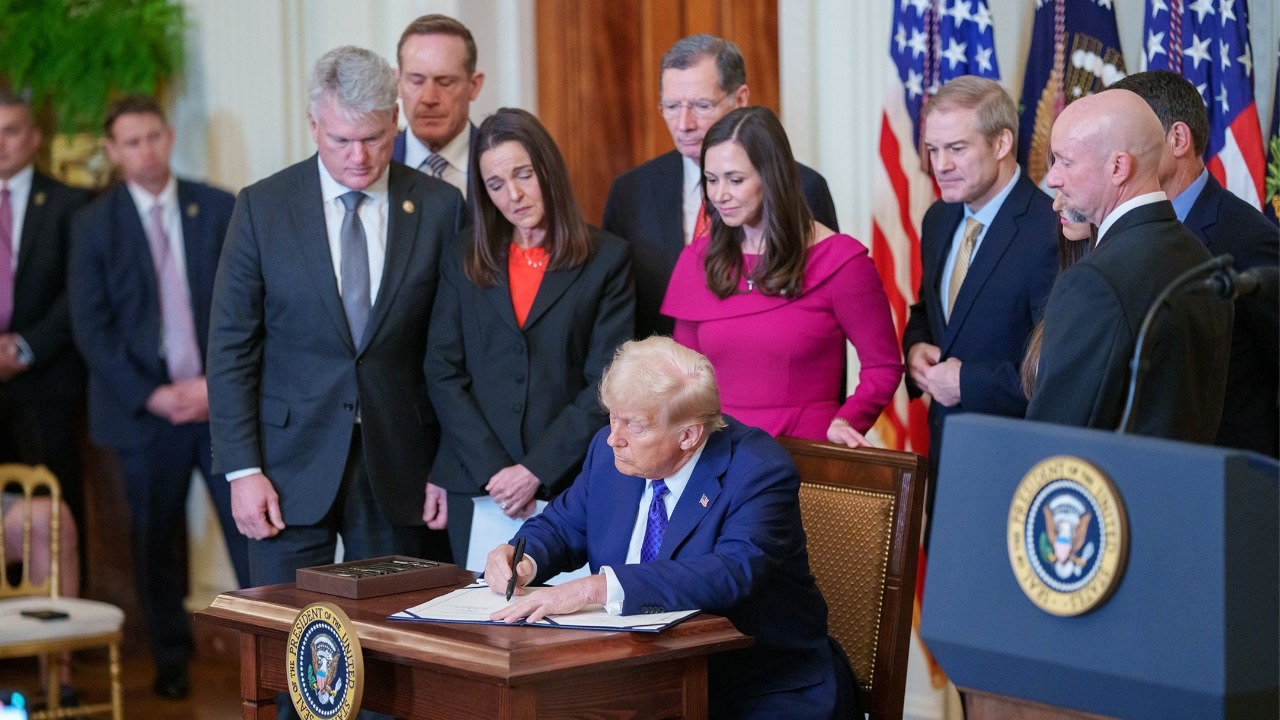

President Donald Trump is moving to recast the power grid as the backbone of the artificial intelligence race, demanding an emergency auction that would effectively force the biggest technology companies to bankroll new electricity supplies. The proposal aims to channel the AI boom’s soaring profits into concrete steel and concrete, turning data center demand into a funding stream for power plants that utilities have been slow to build. It is a high‑stakes attempt to keep the lights on, contain household bills and keep the United States ahead in AI, all at the same time.
The plan drops into a fraught moment for energy politics, with consumers already angry about rising utility prices and local regulators sparring with Silicon Valley over who should pay for the next wave of infrastructure. By tying AI directly to grid reliability, the White House is betting that voters will accept a more muscular federal role, and that tech giants will swallow new costs rather than risk being blamed for blackouts.
The emergency auction at the heart of Trump’s AI strategy
At the center of the push is an emergency auction that would let existing and new power plants lock in payments from technology companies in exchange for guaranteeing electricity supplies over 12‑month periods. The Trump administration wants the largest AI and cloud players to bid for capacity, not just energy, effectively reserving slices of the grid so their data centers can run at full tilt even when demand spikes. According to reporting by Jan and By Jennifer, the structure is designed so that companies would commit to pay for power whether they ultimately consume the electricity or not, turning their appetite for AI computing into a predictable revenue stream for generators that might otherwise hesitate to invest in new capacity, a concept detailed in coverage of the emergency auction.
In practice, this would overlay a new federal mechanism on top of regional power markets, with the White House arguing that AI’s extraordinary load growth justifies extraordinary tools. The administration’s allies frame it as a way to avoid a scramble for scarce megawatts that could push prices even higher for households if data centers simply outbid everyone else in real time. Critics, including some state regulators, worry that locking in long‑term deals for tech firms could crowd out other investments or tilt the grid too far toward the needs of a single industry, but the Trump team is signaling that the alternative is a chaotic build‑out that leaves both consumers and AI developers exposed.
How the White House wants to reshape PJM and other power markets
The most immediate test bed for the plan is PJM, the country’s largest regional grid operator, which coordinates electricity for a swath of states stretching from the Midwest to the Mid‑Atlantic. The White House is seeking explicit caps on how much existing power plants can charge in PJM’s capacity market, while at the same time pushing to clear a path for new generation to connect more quickly. According to Jan and The White House, officials are focused on a recent PJM capacity auction that signaled tightening supply and on a backlog of projects that have been offered generation interconnection agreements but have not yet broken ground, pressure points described in detail in reporting on PJM.
By layering an emergency auction on top of PJM’s existing system, the administration is effectively trying to carve out a dedicated lane for AI‑driven demand without letting generators simply name their price. I see this as a delicate balancing act: if caps are too tight, plant owners may balk at adding capacity; if they are too loose, tech companies could end up paying eye‑watering premiums that eventually filter into consumer bills. The White House appears to be betting that a combination of price ceilings, long‑term contracts and faster interconnection will coax enough new steel into the ground to keep both AI clusters and residential neighborhoods powered, but the details of how PJM implements those instructions will determine whether the theory holds.
Data centers in the crosshairs as AI strains the grid
Behind the policy jargon is a simple reality: AI data centers are devouring electricity at a pace that traditional planning never anticipated. President Donald Trump is preparing to order that data centers explicitly pay for the power investments needed to support them, a shift that would move costs off general ratepayers and onto the balance sheets of the companies building massive server farms. Reporting on President Trump Orders Data Centers to Pay for Power as AI Strains the Grid describes how the administration wants these facilities to shoulder the expense of new or expanded plants as electricity demand surges, tying their expansion plans directly to the financing of additional generation that can handle the way AI workloads strain the grid.
From my vantage point, this is a political as much as a technical calculation. Voters see the logos of AI and cloud companies on gleaming campuses, not on their monthly bills, and Trump’s team appears determined to make sure that any blame for higher costs sticks to the industry rather than the White House. For the data center operators, the message is blunt: if you want to keep building hyperscale facilities to train larger models and serve more users, you will have to underwrite the turbines, substations and transmission lines that make that possible. That could slow some projects at the margin, but it also offers a clearer path to approval for those willing to pay, since local officials can point to concrete investments in the grid as a condition of growth.
Rising utility prices and the politics of the AI boom
The emergency auction is also a response to a political squeeze that has been building for years as electricity prices climb. Trump and his advisers know that any perception that AI is driving up household bills could quickly sour public opinion on the technology, so they are trying to get ahead of the backlash by explicitly separating consumer rates from the costs of powering server farms. Ben Werschkul has reported that Trump is pushing an emergency electricity auction that underscores the difficult politics of rising utility prices and AI, with the administration emphasizing that tech companies will be required to pay for capacity whether they consume the electricity or not, a structure that is central to the electricity auction.
In political terms, I read this as an attempt to turn AI from a liability into a bargaining chip. By insisting that the industry pre‑pay for capacity, Trump can argue that he is protecting ordinary ratepayers while still championing cutting‑edge technology. The risk is that if the auction fails to attract enough bids, or if generators demand higher prices than expected, the administration could find itself caught between angry voters and frustrated tech executives. For now, though, the message is clear: AI will not be allowed to free‑ride on a grid built for a different era.
Forcing Big Tech to fund the next wave of power plants
Beyond the auction mechanics, the broader strategy is to make technology companies the primary financiers of the next generation of power plants. Across the country, regulators and utility officials are already debating with tech companies how much they should have to pay for the massive new infrastructure needed to support AI and cloud computing, and the Trump plan would tilt those negotiations decisively toward “more.” Reporting on how Trump will propose that tech companies fund new power plants notes that these talks are unfolding against a backdrop in which higher interest rates and inflation have also boosted costs, making it harder for utilities to build without a deep‑pocketed partner, a dynamic captured in coverage that begins with the phrase Across the.
More from Morning Overview