
Toyota has officially confirmed that its family workhorse is going fully electric, turning the Highlander into a three-row battery SUV aimed squarely at mainstream households rather than early adopters. The move signals a strategic shift from dabbling in electrification to putting a core nameplate at the center of its EV push. If Toyota can deliver competitive range and pricing in the neighborhood of the Kia EV9 and Hyundai Ioniq 9, the Highlander EV could do for three-row crossovers what the Prius once did for hybrids: not by being flashy, but by making the technology feel normal at scale, backed by Toyota’s 1,500-dealer U.S. network and a reliability reputation that has historically been its strongest selling point.
The stakes are bigger than one model launch. A credible, relatively affordable three-row EV from a brand with Toyota’s production scale has the potential to reset expectations for family vehicles in the United States, where large crossovers still dominate school runs and road trips. But Toyota is also years behind its Korean competitors, and the Highlander EV will need to answer questions about range, charging speed, and pricing that Toyota has so far avoided.
The first three-row test of Toyota’s EV ambitions
The clearest signal of intent is that the 2027 Highlander will not hedge with gasoline or plug-in variants at launch. It will be a full battery-electric model. Toyota released an 11-second teaser video showing the Highlander badge alongside BEV and AWD emblems on a redesigned liftgate, leaving no ambiguity about the powertrain.
The company’s official statement was brief and deliberate: The company’s official statement was brief and deliberate: “Meet the all-new 2027 Highlander. Featuring sleek, modern lines, an electric powertrain, and a spacious three-row cabin with comfort for the whole crew.” Instead of creating a separate sub-brand or extending the bZ line that launched with the underwhelming bZ4X in 2022, the company is electrifying one of its most recognizable nameplates, betting that familiarity will ease the leap for cautious buyers.
This is Toyota’s first three-row electric SUV, and the positioning is deliberate. It puts the Highlander EV in direct conversation with the Kia EV9 and Hyundai Ioniq 9, though Toyota is entering a race those rivals have been running for over a year. The EV9 sold 22,017 units in the U.S. in 2024, according to InsideEVs’ analysis of manufacturer sales data, before falling to 15,051 in 2025 as federal tax credits expired. The infrastructure to support Toyota’s ambition is already in place: the company announced a $1.3 billion investment at its Georgetown, Kentucky plant in February 2024 specifically to build a three-row battery-electric SUV, with battery packs assembled on-site using cells from Toyota’s new North Carolina facility.
What we know about the platform and battery tech
Toyota has not confirmed the Highlander EV’s underlying architecture, but all signs point to the e-TNGA platform that underpins the bZ4X and its Subaru Solterra twin. Developed jointly with Subaru, e-TNGA uses a modular approach with fixed elements like motor positions and battery width, while varying the wheelbase, number of battery modules, and overhangs to accommodate different vehicle sizes. The platform supports front-, rear-, and all-wheel-drive configurations with battery capacities ranging from 50 to 100 kWh, according to specifications Toyota has shared publicly. For a three-row SUV the size of the Highlander, the upper end of that range seems likely.
The batteries themselves will come from Toyota Battery Manufacturing North Carolina, a $13.9 billion, 1,850-acre facility in Liberty, North Carolina, that began shipping lithium-ion cells in June 2025. At full capacity, the plant will produce 30 GWh annually across 14 production lines, ten of which support BEV and PHEV packs. Toyota has confirmed that batteries from this facility will power “an all-electric 3-row BEV,” its first to be built in the U.S. Notably absent from any Toyota announcement so far is any mention of solid-state battery technology for this model. While Toyota has invested heavily in solid-state research and has promised commercial deployment later this decade, the Highlander EV will almost certainly ship with conventional lithium-ion cells, the same chemistry used by every competitor in the segment.
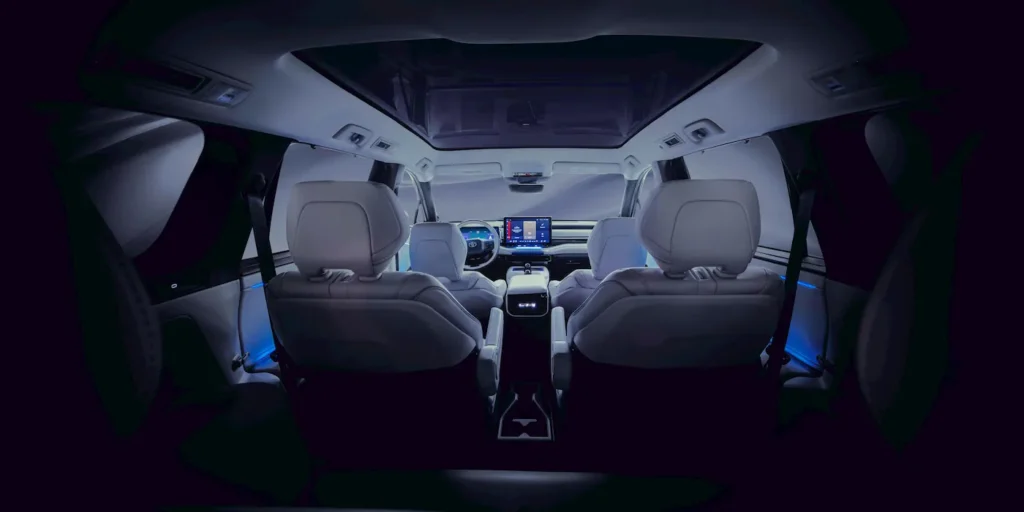
A previous teaser revealed the interior in detail, and MotorTrend’s analysis of that darkened image is worth noting for what it suggests, even with caveats. The outlet identified what appeared to be a dual-motor electric powertrain icon on the gauge cluster, along with a 199-mile figure on the central display at roughly 80 percent charge, which would imply approximately 240 miles of total range. That figure, if accurate, would trail the EV9’s EPA-rated 304 miles and the Ioniq 9’s 356 miles significantly, and would be a serious vulnerability for Toyota at launch. However, these are unverified readings from a darkened teaser image, and official specs could differ substantially when Toyota reveals them on February 10. The cabin itself showed seating for at least six, second-row captain’s chairs, a portrait-oriented infotainment screen, and physical controls including a volume knob.
Market timing, rivals, and the affordability question
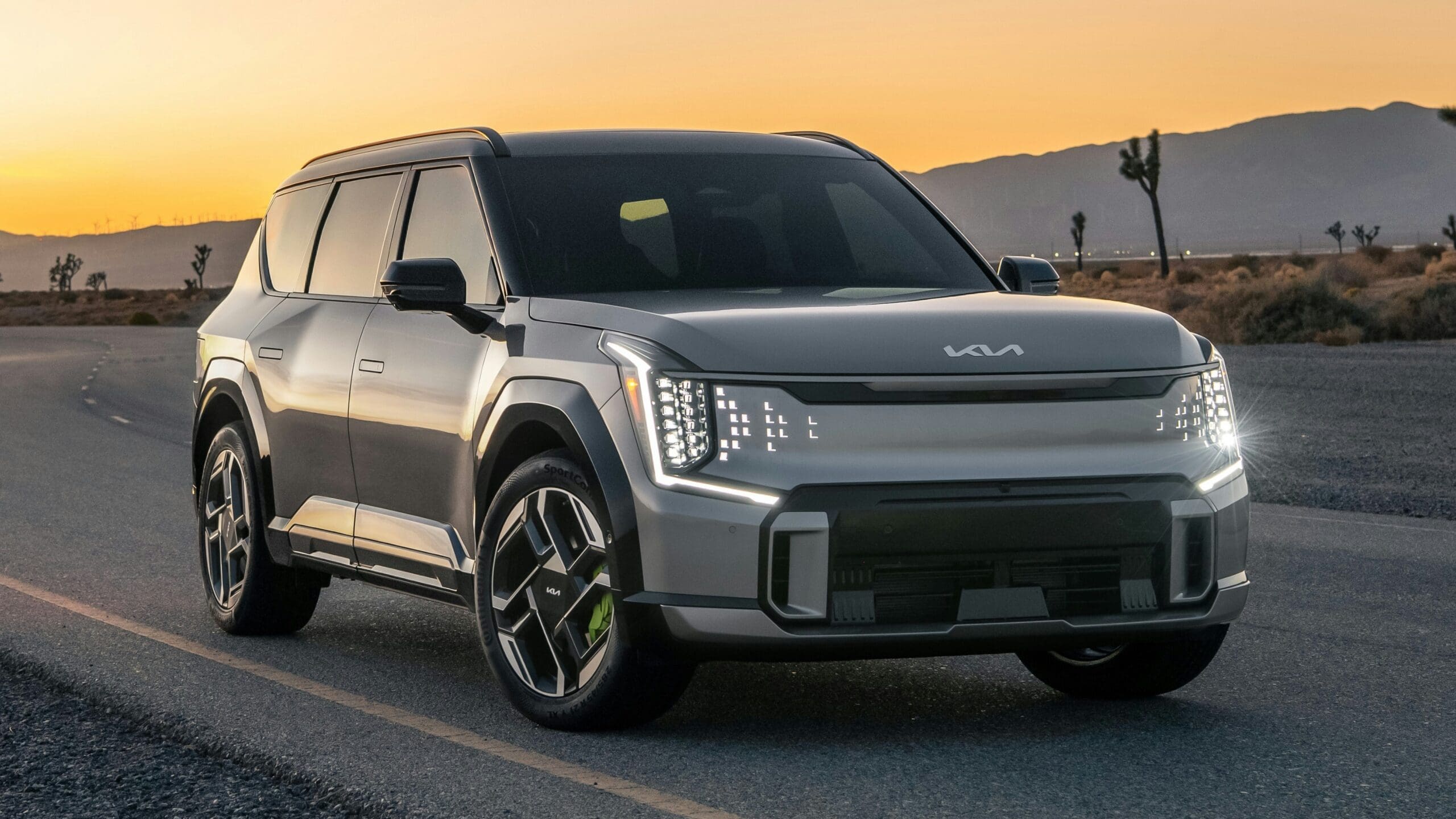
Toyota is arriving late to the three-row EV segment, but the timing solves a problem the company already had. WardsAuto’s year-end analysis of manufacturer-reported data shows the Grand Highlander surged 90.7 percent year-over-year in 2025 to 136,801 units, while the standard Highlander’s sales have declined sharply as buyers migrate to the larger model. The gas-powered Highlander was already losing relevance against its own sibling, and converting it to a dedicated EV preserves the nameplate while carving out a distinct role in the lineup.
But the competitive landscape has shifted since Toyota first teased this vehicle. The Kia EV9 and Hyundai Ioniq 9 arrived first and established the three-row EV category, only to see demand crater when the $7,500 federal clean vehicle tax credit expired at the end of September 2025. Kia’s EV9 sales fell 31 percent for the full year and collapsed further in the months that followed. If Toyota’s Highlander EV launches into a market without federal incentives, it will face the same headwind, and the company’s track record on EV pricing does not inspire confidence. The two-row bZ Woodland starts at $45,300, substantially more than comparable gas-powered Toyotas. The Grand Highlander, with three rows and a hybrid option, starts at just $41,660. If the Highlander EV lands in the mid-$50,000 range as widely expected, Toyota will need to make a compelling case for the premium, not just on environmental grounds, but on total ownership cost, charging convenience, and the practical advantages of an electric drivetrain for daily family use.
There is also a deeper strategic question. Toyota spent years publicly questioning the pace of EV adoption, investing instead in hybrids and hydrogen fuel cells while competitors built out their battery-electric lineups. The bZ4X, its first serious EV attempt, launched in 2022 to tepid reviews and an embarrassing recall over wheels that could detach. The company has since course-corrected with the better-received bZ Woodland and C-HR EV, but the Highlander represents a much higher-stakes bet. This is not a compliance car or a niche product. It is Toyota putting one of its safest, highest-volume nameplates directly into the electric era, a signal that the company’s internal debate over electrification has been settled. Whether the product matches the ambition is something we will know a lot more about after tomorrow’s reveal. Toyota has not yet disclosed battery size, range estimates, charging speeds, or pricing.
