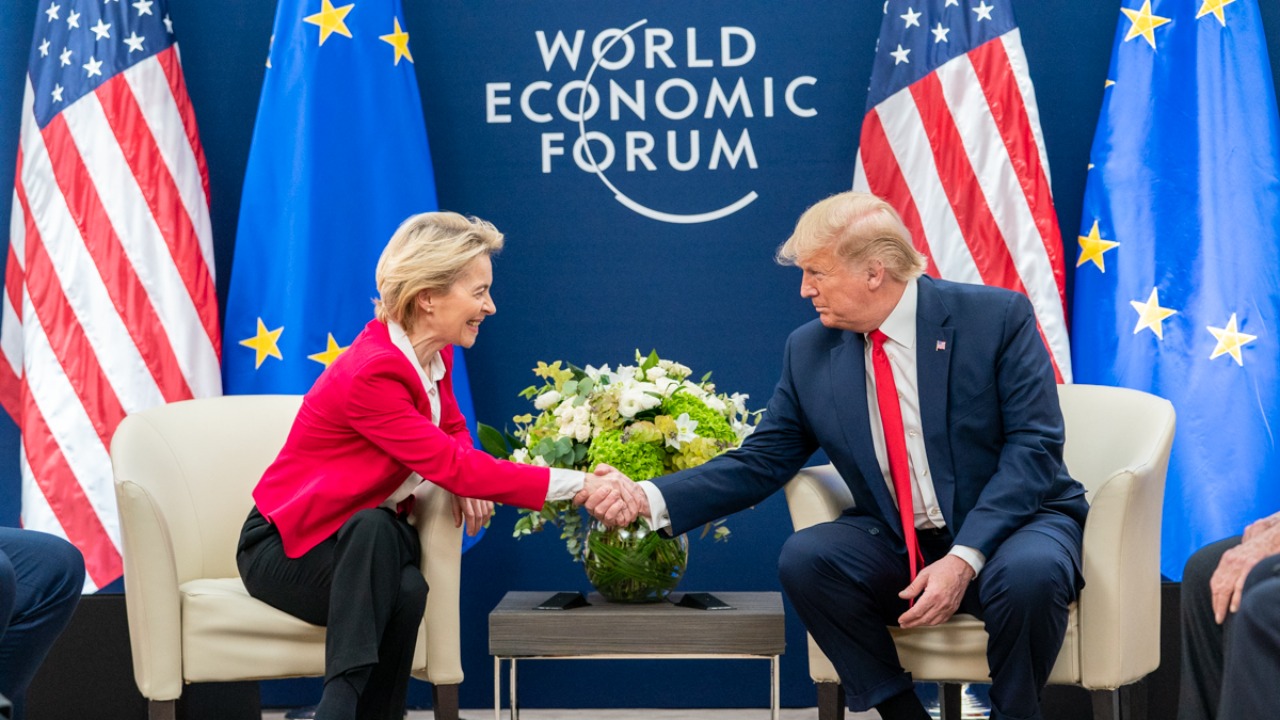

Top executives at the World Economic Forum have dropped the diplomatic language and are now using expletives to warn that the political backlash against green policies is putting both the climate and long term investment at risk. Their blunt message is that walking away from climate commitments to score short term points is not just irresponsible, it is bad business.
At Davos, these leaders framed the so called green backlash as an aberration driven by short term thinking, not a rational reassessment of climate science or economics. They argued that if governments and investors flinch now, the costs of climate damage and stranded assets will dwarf any short term relief from slowing the transition.
The Davos flashpoint: when CEOs stop mincing words
The turning point came when a group of top executives at the World Economic Forum abandoned the usual cautious phrasing and delivered what was described as an expletive laden warning about efforts to roll back climate policy. In a discussion captured by Top coverage from Davos, business leaders made clear that they see the current wave of climate scepticism as a direct threat to long term value creation. One senior figure from mining giant Fortescue was highlighted in a Top report as using profanity to underline that delaying decarbonization is, in his view, economically reckless.
The mood in Davos was shaped by a sense that the climate debate has shifted from technical arguments about carbon pricing to a raw political fight over identity and sovereignty. A detailed Story by Sam Meredith on the gathering described how these executives, meeting in The USA House near the main World Economic Forum venue, warned that the backlash is already influencing capital allocation. In their view, the more climate policy is framed as a culture war, the harder it becomes for boards to approve multi decade investments in clean energy, heavy industry decarbonization or resilient infrastructure.
Inside the “green backlash”: politics, populism and ESG fatigue
To understand why tempers are flaring, it helps to look at how the so called green backlash, or “greenlash”, has built up over the past few years. Analysis of this trend has pointed to a mix of political polarization and economic anxiety that has supercharged opposition to environmental, social and governance investing, often shortened to ESG. One assessment described “Net zero sceptic populist” movements that portray climate rules as an elite project that sacrifices jobs and national control, even as scientists warn that delaying cuts to emissions will deepen both economic and climate fallout over the next few years.
Corporate leaders are feeling this pressure directly. A global survey of executives found that Nearly a third, precisely 27 percent, of business leaders agree they are under pressure to take a stance on social and political issues that stakeholders care about, including climate policy, yet many admit they lack a clear plan for how to build trust with employees and the public on these topics. That tension, captured in the Nearly survey, helps explain why some companies are quietly retreating from high profile climate pledges even as others double down and speak more bluntly.
Trump’s counter narrative and the European fault line
Into this fraught landscape stepped President Donald Trump, who used his Davos platform to sharpen a competing story about energy and growth. In a widely discussed appearance, he argued that aggressive renewable energy targets in Europe were undermining competitiveness and described parts of Europe’s green agenda as a drag on prosperity. A separate video clip titled Trump Calls Europe Green Energy a Scam circulated online, in which Donald Trump claimed Europe had been “hoodwinked” by what he framed as overhyped clean power schemes. In his formal remarks, he leaned on emotive language about energy, warning that climate driven restrictions could, in his words, “cripple economic prosperity” according to a detailed Trump account of his Davos speech.
Trump’s message resonated with parts of the business community that are wary of rapid regulatory change, but it landed like a provocation for the executives who had just warned against backsliding. In their view, dismissing Europe’s climate policies as a scam ignores the mounting physical and financial risks from extreme weather and stranded fossil fuel assets. It also clashes with the argument, made repeatedly in Davos sessions, that the real economic opportunity lies in scaling clean technologies, from electric vehicles like the Volkswagen ID.4 and Tesla Model Y to grid scale batteries and green hydrogen. When Trump framed renewables as a threat, these leaders countered that the real threat is failing to invest in the transition at the speed required by climate science.
“Short term people” and the science business alliance
One of the most striking interventions in Davos came from Allianz CEO Oliver Bäte, who rejected the idea that climate action had become a luxury that could be postponed. In a televised conversation on CNBC Squawk Box Europe on Tuesday, Bäte described the backlash as “an aberration that short term people are saying that” and insisted that the focus should be on doing the transition intelligently, not abandoning it. His comments came amid concerns that businesses are increasingly shying away from public climate commitments even as planet heating greenhouse gas emissions continue to rise. For a global insurer that must price climate risk into policies for coastal real estate, agriculture and supply chains, the idea that decarbonization is optional is not just ideological, it is actuarial.
That message has been amplified by figures who straddle the worlds of science and industry. In a widely shared post, sustainability expert Klaus Kunz highlighted how Business leaders like Allianz CEO Oliver Bäte are echoing the urgency of climate scientists, arguing that short term thinking on climate action is unacceptable and that companies must align their strategies with a credible path to net zero. Kunz wrote that Business leaders are increasingly aware that while politicians debate tariffs and territorial ambitions, the atmosphere keeps accumulating carbon. In a follow up reflection, he stressed that His words cut through the noise with scientific clarity, arguing that the physics of climate change will not bend to political cycles, a point he underlined in a second His post.
What CEOs say they fear most: stranded assets, lost trust and policy whiplash
Behind the expletives and sharp quotes lies a more sober calculation about risk. Executives in Davos repeatedly warned that if governments slow or reverse climate rules now, companies that have invested heavily in cleaner technologies could be left with stranded assets and regulatory uncertainty. One detailed Follow up from the World Economic Forum described how leaders in sectors from energy to heavy industry argued that the question is no longer whether to decarbonize, but how to do it intelligently so that workers and communities are not left behind. They stressed that constant policy whiplash, for example shifting subsidies for electric vehicles or heat pumps every election cycle, makes it harder to plan investments that often run for 20 or 30 years.
There is also a reputational dimension that many CEOs are now willing to discuss in public. The same Davos reporting noted that Top business leaders this week said they “worry” about the planet’s future and about losing the trust of younger employees and customers if they are seen to cave in to anti climate pressure. One Top account from Davos quoted executives who framed climate action as part of their fiduciary duty, not a side project. Another segment of the same reporting captured how some leaders, speaking in The USA House near the main World Economic Forum venue, argued that the backlash is being driven by a vocal minority and that the silent majority of investors still expects credible climate strategies, a point reinforced in a And related segment.
More from Morning Overview