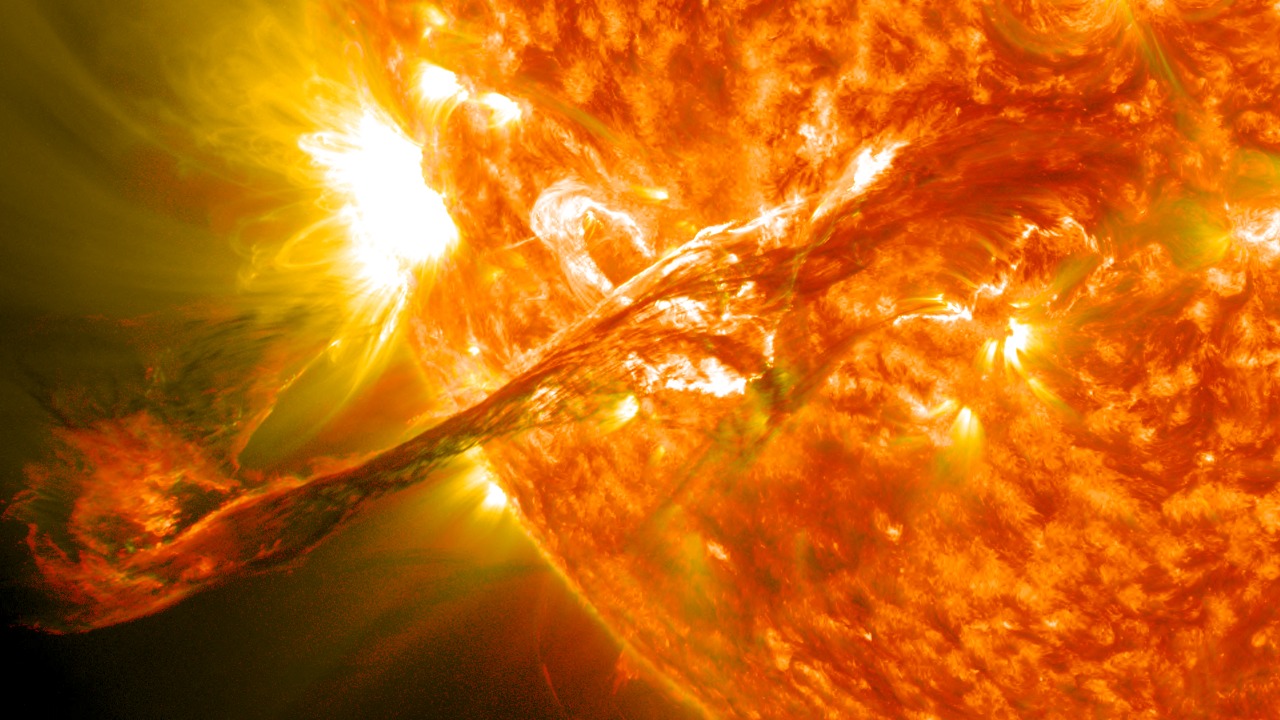

The most powerful solar flare of 2026 so far is racing toward Earth, riding on the heels of a historic radiation storm and threatening fresh radio blackouts just as power grids and satellites are still absorbing the last hit. Space weather forecasters now warn that conditions are ripe for R3-level disruptions, with a Northern Lights alert stretching across 22 U.S. states and aurora forecasts lighting up dashboards worldwide.
I see a pattern emerging rather than a one-off scare: a hyperactive Sun, a sequence of X-class eruptions, and a growing realization that our power, aviation, and communications systems are more exposed to space weather than most people ever think about.
From X1.9 flare to S4 storm: how the Sun lit the fuse
The current threat traces back to a powerful X1.9 flare that erupted from the Sun’s active region AR4341, an event that observers described with a literal “BAM” as the blast hurled a dense CME toward our planet. That eruption, recorded in detailed Sun updates, set the stage for a chain reaction in near‑Earth space, with the CME acting as the delivery system for charged particles that would later buffet the magnetosphere. As the plasma cloud closed in, forecasters tracked its trajectory using spacecraft such as SDO and SOHO (LASCO), watching for signs that the shock front would connect efficiently with Earth’s magnetic field.
Once the CME arrived, the impact was immediate and severe, triggering what specialists classify as an S4 (Severe) Solar Radiation Storm in Progress. According to detailed bulletins on the Solar Radiation Storm classification, S4 events are rare and associated with high‑energy particle showers that can disrupt radio communications in polar regions and pose radiation risks to satellites and high‑altitude flights. A companion notice on the same Severe event stressed that this Solar Radiation Storm was still in Progress, underscoring that the Sun had effectively opened a particle firehose toward Earth rather than delivering a single, isolated burst.
G4 geomagnetic shock and the strongest radiation in 22 years
As the radiation storm intensified, Earth’s magnetic field was pushed into what forecasters call G4 (Severe) Geomagnetic Storm Levels Reached, a threshold that signals significant stress on power systems and long‑distance infrastructure. Official alerts confirmed that Geomagnetic Storm Levels the Severe band, with G4 Levels remaining possible as the CME’s magnetic field continued to couple with our own. In practical terms, that meant grid operators had to watch for induced currents in long transmission lines, while satellite controllers monitored anomalies as the storm compressed the magnetosphere and heated the upper atmosphere.
At the same time, Earth endured its most intense solar radiation storm in more than two decades, a benchmark that space weather specialists do not use lightly. Detailed analysis noted that Earth endured its most intense Solar Radiation Storm in over 22 years, with measurements from the GOES‑19 satellite capturing the spike in high‑energy particles. Another synthesis of the event emphasized that Earth was effectively being sandblasted by energetic protons, a scenario that can degrade solar panels, interfere with onboard electronics, and force airlines to reroute polar flights to reduce crew and passenger exposure.
Why 22 U.S. states are on Northern Lights and blackout watch
For people on the ground, the most visible sign of this solar unrest is the Northern Lights Alert that now stretches unusually far south. A detailed breakdown of the alert explains that an X1.9‑class solar flare exploded on the Sun on Sunday, Jan. 18, 2026, prompting a Northern Lights Alert that specifically flagged Where And When To Look across 22 states. That footprint reflects how far geomagnetic disturbances can push the auroral oval toward mid‑latitudes when a storm reaches G4 intensity, turning normally dark rural skies into curtains of green and red light.
Behind the spectacle sits a more sober set of forecasts about radio and power reliability. The Aurora Dashboard’s Radio Blackout Forecast for Jan 22‑Jan 24 2026 lists R1‑R2 probabilities at “60% 60% 60%” with R3 or greater at 15% 15% 15%, a Rationale that reflects lingering instability in the solar regions facing Earth. A companion forecast notes that the greatest expected 3 hr Kp for Jan 22‑Jan 24 2026 is “4.67 (NOAA Scale G1), which would normally be modest, but in the context of an already stressed magnetosphere still recovering from G4 Levels, even a G1 can prolong grid and navigation headaches.
Global monitoring: from CET control rooms to SAST updates
What makes this event different from past solar cycles is the density of real‑time monitoring that now feeds into national and international decision making. The European Space Agency’s overview of the January activity, updated at 14:00 CET, notes that an X‑class solar flare was observed on 18 January 2026 and that this high energy particle shower has become a test case for CET‑based space weather monitoring capabilities. That European vantage point complements the core data streams from the U.S. NOAA Space Weather Prediction Center, which aggregates solar wind, magnetometer, and particle data into operational alerts.
In the Southern Hemisphere, agencies are issuing their own situational reports as the storm unfolds. A bulletin on Space Weather Conditions, timestamped for 20 Jan 2026 at 11:18 SAST, shows how South African Nation is tracking impacts on regional power and communications infrastructure. Another update framed the episode by noting that On January 19–20, 2026, the National Oceanic and Atmospheric Administration (NOAA) confirmed that On January those days, Earth was passing through a Sever solar storm, underlining that this is the largest such disturbance since 2003 and that the National Oceanic and Atmospheric Administration is now treating these episodes as global infrastructure events rather than niche scientific curiosities.
R3 risk, blackout watches and what comes next
Looking ahead, the key concern is whether the next incoming flare and CME will push conditions back into the R3 radio blackout range just as systems are stabilizing. The Aurora Dashboard’s Radio Blackout Forecast for Jan 22‑Jan 24 2026, which lists R1‑R2 at “60% 60% 60%” and R3 or greater at 15% 15% 15%, is paired with a Rationale that ongoing solar activity keeps the door open for more intense bursts. A separate notice with Updated Time 2026‑01‑21T06:00:00.000Z explains that the greatest expected 3 hr Kp for Jan 22‑Jan 24 2026 is 4.67 on the NOAA Scale, reinforcing that Kp for Jan remains elevated even after the initial shock. In parallel, a Space Weather Message Code WATA20 with Serial Number 1090 and Issue Time 2026 Jan 21 0731 UTC sets a WATCH for Geomagnetic Storm Category G1, noting that WATCH conditions include minor impact on satellite operations possible.
For the public, the most immediate advice is to enjoy the sky show while respecting the fragility of the systems that make modern life work. Analysts have pointed out that the aurorae, meantime, will linger, and that NOAA uses the K index to estimate how far from the poles the lights will reach so that people across a wide band of states can enjoy the show while staying informed. Guidance framed through ADD TIME ON GOOGLE and prompts to Show more content from TIME on Google Search, written by Editor at Large Jeffrey Kluger, underscores that people can use mainstream tools like Google Search to track evolving alerts. For those chasing the lights, practical tips on how Stunning aurora displays are predicted tonight as a severe geomagnetic storm hits Earth, along with advice on how Here to see them, sit alongside more technical briefings that describe how Solar Fury Unleashes G4 Storm, how an X‑Flare’s CME Hammers Earth Early, and how forecasts are eyeing prolonged activity that could stress power grids well beyond the initial flare.
More from Morning Overview