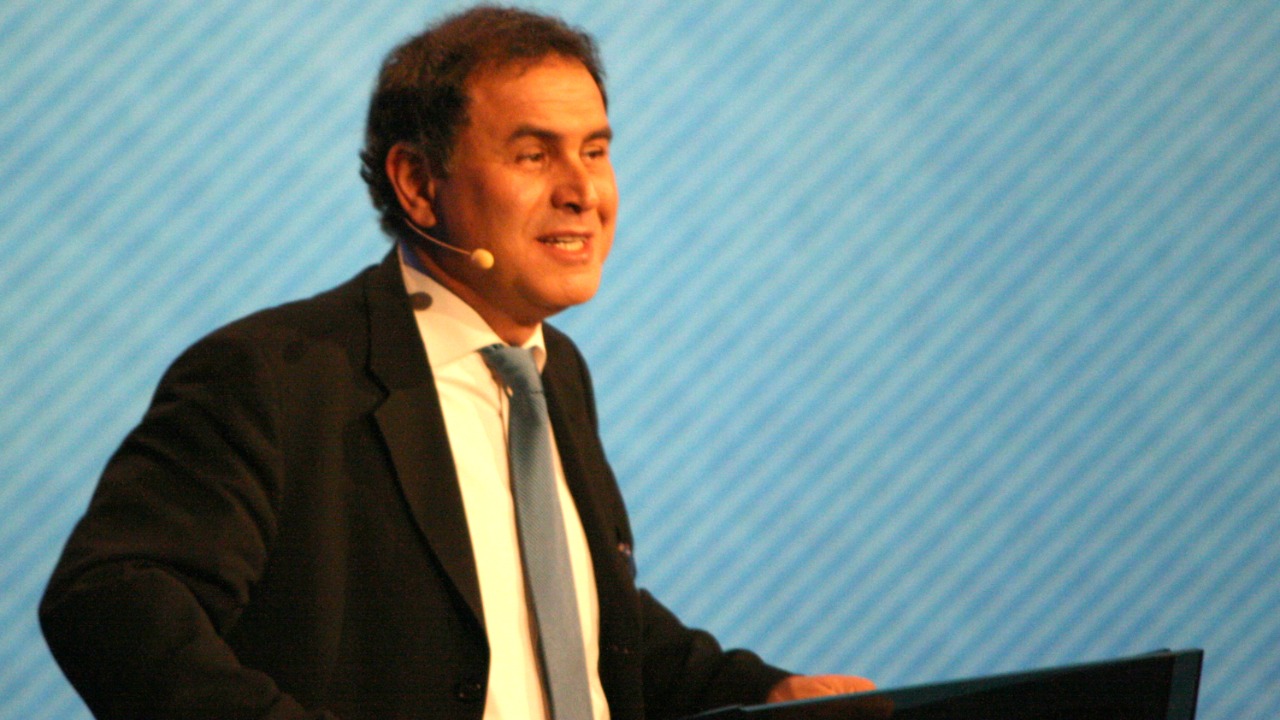

The economist who warned early about the 2008 crisis is now arguing that the artificial intelligence boom could act as a stabilising force in a world rattled by political shocks and geopolitical conflict. Nouriel Roubini sees a tech driven productivity surge that might offset some of the damage from policy uncertainty under President Donald Trump and from fracturing global trade relations, even as he warns that the path will be bumpy.
Rather than predicting an outright crash, he sketches a future in which slower growth, market volatility and social strain coexist with powerful gains in innovation and corporate profits. In that world, the AI wave does not cancel out political risk, but it could keep the United States on a modest expansion track while other economies struggle to adapt.
The pessimist who turned cautiously optimistic on AI
I start with the shift in tone from a figure long branded “Dr. Doom”. On his own platform, Nouriel Roubini has spent years cataloguing systemic risks, from debt overhangs to geopolitical fragmentation. Yet in his recent work he has begun to argue that artificial intelligence is driving what he calls a productivity revolution, one strong enough to reshape the outlook for growth and corporate earnings even in a fraught political environment. That change of emphasis matters because it comes from someone whose default setting has been to stress downside scenarios.
In public comments and written analysis, he has pushed back against the idea that the current tech rally is just another bubble waiting to burst. He acknowledges that equity prices can overshoot and that a correction is always possible, but he ties the current surge in valuations to structural forces, including AI driven gains in efficiency and profitability, rather than to pure speculation. For an economist who built his reputation on warning about excess, that is a notable recalibration of risk.
Three paths for the US economy, and where AI fits
When I look at his formal forecasts, the nuance becomes clearer. In one detailed assessment of the United States, he lays out a baseline in which the country suffers a “growth recession”, meaning below trend GDP growth for a few months, followed by a recovery as inflation continues to fall toward the target rate and financial conditions gradually ease. That scenario, described in his outlook for 2026, still anticipates a bumpy adjustment but stops short of a deep slump, with the drag from tighter policy and political uncertainty offset by resilient demand and productivity gains linked to new technologies such as AI. He also sketches darker alternatives, including a harder landing if inflation proves sticky or if financial stress flares up again, but he treats those as risks rather than his central case.
In a separate analysis titled Nouriel Roubini Predicts the United States, he again frames the future as a range of possibilities. Economist Nouriel Roubini describes a benign “soft landing” path, a middling outcome with sluggish growth, and a more severe downturn if shocks compound. Across those scenarios, he repeatedly highlights how innovation, and AI in particular, can tilt the balance toward better outcomes by lifting productivity and supporting corporate profits, even if headline GDP growth remains modest. The message is not that technology guarantees prosperity, but that it can cushion the blow from policy mistakes and external shocks.
Why Trump “can’t kill the boom”
The political backdrop to this argument is President Donald Trump’s second term, which has already revived fears of trade wars, tariff escalations and institutional erosion. Roubini has been explicit that Trump’s style of governance, with its preference for unilateral tariffs and confrontational rhetoric, injects volatility into markets and undermines long term planning for businesses. Yet he has also argued that the underlying drivers of the current expansion, especially the AI led investment cycle, are strong enough that Trump’s chaos is unlikely to fully derail them. In his view, markets, innovation and AI are overpowering Trump’s disruptions, keeping capital flowing into sectors that promise higher productivity and returns.
That logic is laid out most clearly in his essay “Trump Can Kill the Boom: Why the US Economy Will Roar Despite Him”, where he argues that the combination of strong balance sheets, pent up investment and rapid AI adoption gives the private sector enough momentum to power through policy noise. He points to “Markets” and innovation as the real protagonists of the story, with Trump cast more as a source of headline risk than as the architect of the cycle. The implication is that while tariffs, regulatory swings and diplomatic spats can dent confidence, they are unlikely to fully choke off an AI driven expansion that is already reshaping business models across industries.
A “productivity revolution” with real market stakes
Roubini’s optimism about AI is not abstract. In a recent interview, he described a tech led “productivity revolution” in the United States, arguing that the deployment of generative AI, robotics and advanced analytics is starting to show up in corporate performance and investment data. He notes that over the last few decades, US growth has averaged around 2 percent, while the average return on the S&P 500, including dividends, has been about 12 percent. That historical gap between modest GDP growth and strong equity returns, he suggests, can persist if AI continues to boost margins and earnings even in a low growth environment. The reference to the S&P 500 is meant to underline how markets can thrive even when headline macro numbers look subdued.
At the same time, he is careful to warn that valuations can still overshoot. In his detailed outlook for the US economy, he notes that business confidence could take a hit if concerns about an AI bubble lead to a large equity price correction and a tightening of financial conditions. That risk is echoed in his academic style assessment hosted by New York University, where he writes that the United States has been on a “bumpy” path, with inflation falling but growth slowing and financial markets sensitive to any sign that the AI story might be overhyped. In that document, titled “In the” Outlook for the U.S. Economy in 2026, he again stresses that GDP growth is likely to remain below its long run trend for a period, even as technology supports profits and investment.
No AI bubble, but serious social risks
One of the most striking elements of Roubini’s recent commentary is his insistence that, over the medium term, the United States is not in a massive AI bubble that is bound to crash. In a widely cited interview, he argues that the now common view that the US stock market is destined for a dramatic collapse is incorrect, at least on a multi year horizon. He ties that conviction to what he calls a new form of American exceptionalism, rooted in the country’s lead in AI research, deep capital markets and capacity to commercialise innovation. At the same time, he acknowledges that the political environment, including Trump’s confrontational trade stance and the risk of renewed tariff battles, could still trigger corrections or shifts from unilateral measures to more conventional trade negotiations. Those political swings, he suggests, will shape the path of the AI boom but are unlikely to erase its underlying drivers.
Yet Roubini is far from a techno utopian. In an earlier discussion of the AI threat to workers, he warned that the technology could exacerbate “excessive oligopolistic or dualistic concentration” in key sectors, concentrating power and profits in a handful of dominant firms. He also flagged the risk that AI systems could turbocharge misinformation and disinformation, undermining democratic processes and social cohesion. In that conversation, recorded in Jun, he stressed that without strong regulation and social safety nets, the same tools that boost productivity could deepen inequality and fuel political backlash. Those concerns sit uneasily alongside his optimism about growth, but they are central to his argument that policymakers need to shape the AI boom rather than simply cheer it on.
More from Morning Overview