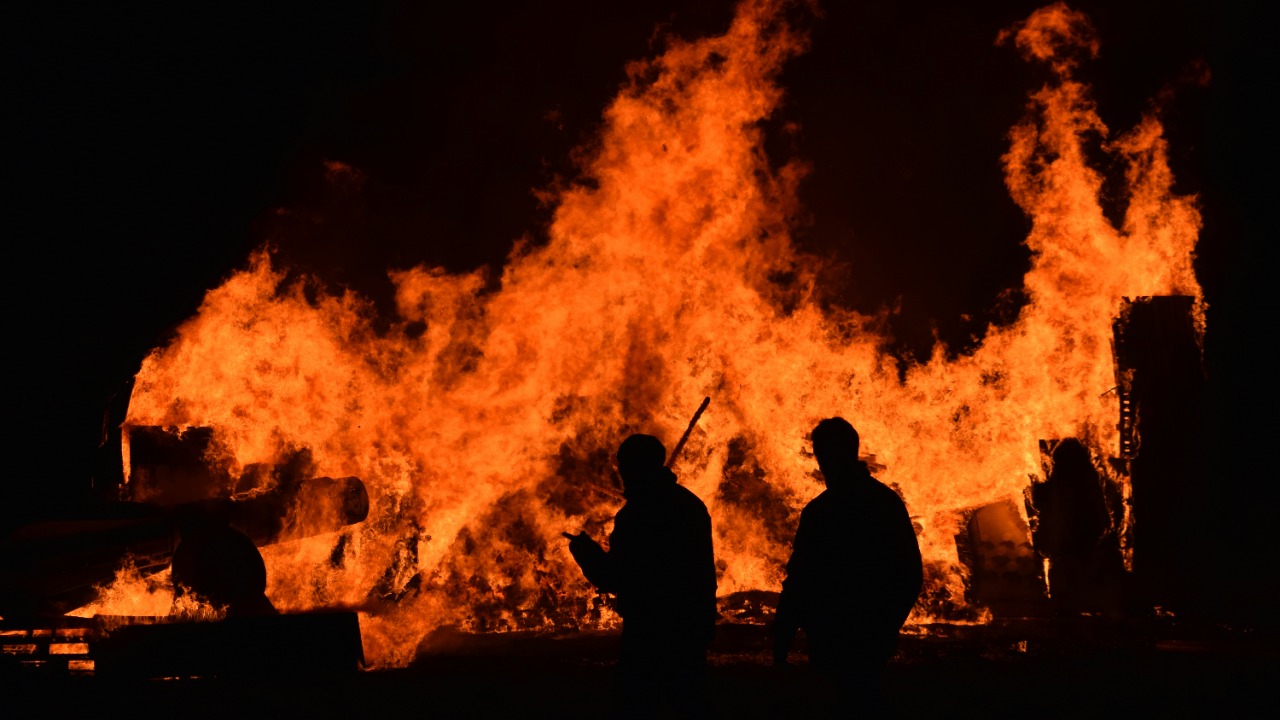

Wildfires ripping through central and southern Chile have turned entire neighborhoods into smoking ruins, killing at least 18 people and forcing tens of thousands to flee with little more than the clothes on their backs. Flames driven by fierce winds and extreme heat have raced into towns, trapping residents in cars and homes as they tried to escape. The disaster has pushed Chile’s government to deploy the military, impose curfews, and declare a national emergency as exhausted firefighters battle a crisis that is still unfolding.
The fires have exposed how quickly a familiar summer hazard can escalate into a lethal catastrophe when drought, heat, and expanding urban sprawl collide. From coastal communities to inland industrial hubs, the blazes have jumped highways and rivers, overwhelming local defenses and leaving families searching for missing relatives amid the ashes.
Lives lost and communities erased in minutes
The human toll is stark. Authorities say at least 18 people have died as wildfires sweep through central Chile, a figure President Gabriel Boric has cited while declaring a national emergency. In some cases, victims were found in burned-out vehicles on roads choked with traffic as residents tried to outrun advancing flames, a pattern confirmed in multiple official briefings and captured in harrowing images shared from the fire zones. One widely circulated transcript notes that “at least 18 people have died” as the fires swept through central regions, underscoring how quickly the situation deteriorated for those caught in the path of the firestorm earlier.
Entire neighborhoods have been reduced to rubble in a matter of minutes. In the municipality of Concepción in the Biobío region, local authorities reported that 253 homes were destroyed, a snapshot of the scale of destruction even as the total number of houses lost nationwide remains unclear. Residents described watching flames leap from hillside scrub into densely built streets, turning what “used to be people’s homes” into blackened shells in the space of a single afternoon. For many families, the first priority has shifted from salvaging belongings to simply locating loved ones, with emergency teams still combing debris for the missing.
From forest fires to urban infernos
What began as forest and grassland fires has rapidly become an urban disaster. In the southern regions where the crisis is most acute, flames have torn through communities on the edge of plantations and industrial zones, exploiting dry vegetation and strong winds to reach populated areas. In some towns, residents said the fire advanced “in seconds,” leaving almost no time to organize evacuations before homes, workshops, and small businesses were engulfed. One dispatch from PENCO in southern Chile described how Uncontrolled flames ripped through streets, a reminder that the line between rural and urban risk has effectively vanished.
Authorities have highlighted the particular danger posed by the Penco-Lirquén corridor, where industrial infrastructure and dense housing sit close to flammable hillsides. President Gabriel Boric has singled out the “Penco-Lirquen fire” as one of the most critical fronts, a reference to the twin coastal communities of Penco and Lirquén that have seen warehouses, port facilities, and homes threatened simultaneously. Officials have also warned about fires near inland towns such as Nacimiento and Laja, where industrial plants and residential neighborhoods sit side by side, multiplying the potential for both human and economic losses.
States of catastrophe, curfews, and a race to evacuate
Confronted with the speed and ferocity of the fires, Chilean President Gabriel Boric has moved to deploy extraordinary powers. He has declared a “state of catastrophe” in at least two southern regions, including Ñuble, enabling the military to support evacuations, secure roads, and enforce movement restrictions. In parallel, he has also announced a state of emergency in hard-hit areas, a step that allows the central government to redirect resources and coordinate firefighting assets across regional boundaries more directly. These overlapping measures reflect both the geographic spread of the fires and the political pressure to show that every available tool is being used.
On the ground, those decisions translate into curfews, roadblocks, and mass evacuations. Boric has ordered nighttime curfews in some zones to keep people off roads needed by emergency vehicles and to deter looting in evacuated neighborhoods, a move detailed in reports that note how Boric paired the curfew with warnings of “extreme temperatures.” Evacuation orders have affected more than 50,000 people, many of whom left in convoys of cars or on foot as smoke darkened the sky. For those who stayed behind, either by choice or because they lacked transport, the curfew has meant long nights listening to sirens and helicopters while watching the glow of fires on nearby hills.
Firefighters outpaced by wind, heat, and terrain
Chile’s firefighters and emergency crews are confronting a perfect storm of conditions that favor the flames. High temperatures, strong winds, and parched vegetation have combined to create what specialists describe as “explosive” fire behavior, with embers carried long distances to ignite new fronts. In some areas, local media have reported that the fire line advanced so quickly that crews were forced to abandon defensive positions and retreat to safer ground. One account from PENCO in southern Chile, relayed by BSS and AFP, emphasized how the flames moved in “seconds,” a pace that makes traditional containment lines almost meaningless.
Despite reinforcements from the armed forces and neighboring regions, the sheer number of active fires has stretched resources thin. Reports from the fire zones describe exhausted crews rotating through 24-hour shifts, with aircraft and ground teams prioritizing the most immediate threats to life over property protection. In one detailed account, uncontrolled wildfires were said to be tearing through communities in southern Chile, underscoring how even a well-practiced wildfire response system can be overwhelmed when multiple fronts ignite at once. For residents, that has meant watching some neighborhoods receive aerial water drops and bulldozer lines while others are effectively left to burn until conditions improve.
Political pressure, public anger, and what comes next
The political stakes are rising alongside the flames. President Gabriel Boric has used national addresses and social media to frame the fires as a national tragedy that demands unity, while also acknowledging that climate conditions are making such disasters more frequent and more severe. In one message shared widely, he warned that the country was facing days of “extreme temperatures” and urged people to follow evacuation orders, a sentiment echoed in coverage that noted how he posted updates around “Jan. 18, 2026, 10:57 AM PST / Updated Jan. 18, 2026, 2:14 PM PST / Source: The Associated Press. By Joe Kottke and The Associated” as the death toll climbed throughout the day. At the same time, opposition figures and local leaders are already questioning whether fuel reduction, land-use planning, and early warning systems were adequate in the hardest-hit areas.
Internationally, images of burning neighborhoods and residents fleeing through smoke-choked streets have drawn attention to how climate stress is reshaping risk in countries long accustomed to seasonal fires. One video report showed “neighborhoods burn as wildfires tear through southern Chile,” with the caption noting that Chilean President Gabriel Boric had declared a state of catastrophe and that the disaster had left “more than a dozen people dead” already. Another analysis highlighted how Chile’s declaration of a “state of catastrophe” in Ñuble and other regions reflects a broader pattern in which governments are forced to invoke emergency powers more frequently as wildfires menace cities and towns across the country. For families picking through the ruins of their homes, those debates feel distant. Their immediate reality is one of displacement, grief, and uncertainty about whether the places they fled will ever again feel safe.
Supporting sources: 24news.ge.
More from Morning Overview