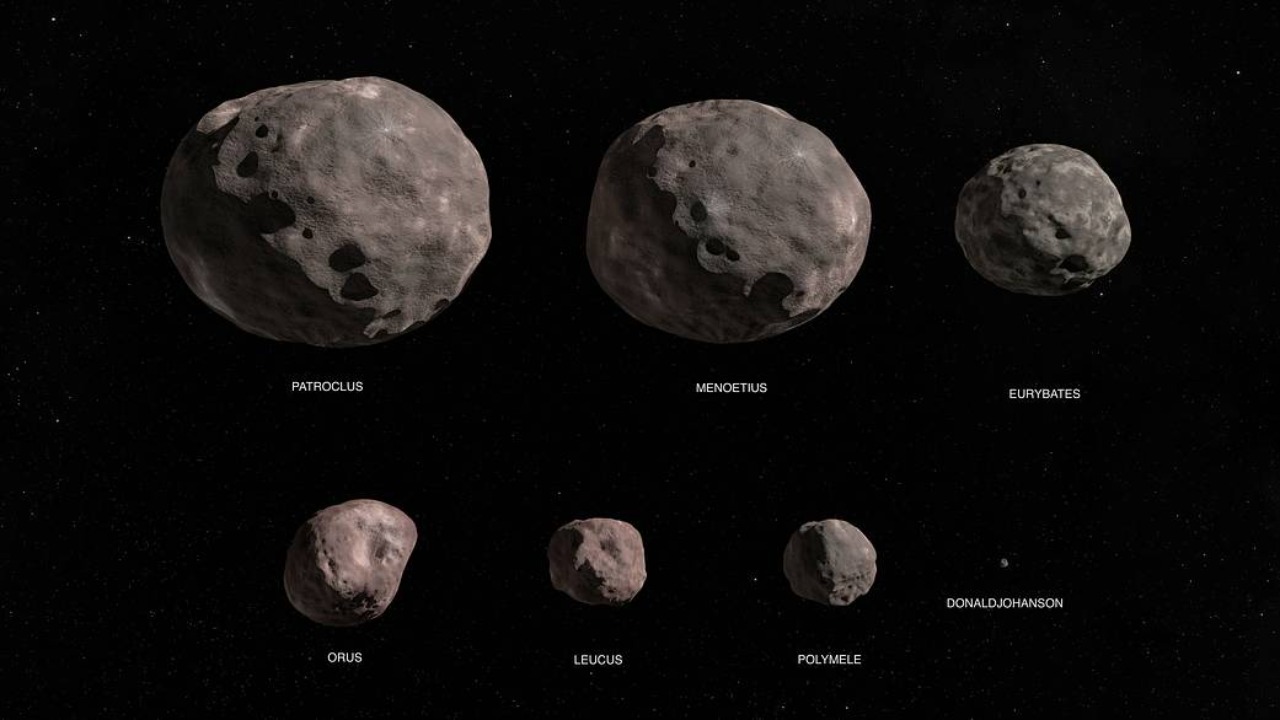

NASA sent the Lucy probe out to study ancient space rocks, not to rewrite the rulebook on how small worlds can assemble themselves. Yet as the spacecraft has raced through the inner solar system on its way to Jupiter’s orbit, it has repeatedly stumbled on structures so strange that mission scientists have had to rethink what they thought asteroids and their moons could look like. The latest images, revealing a body that seems pieced together like a puzzle from slow-moving fragments, have left the team confronting a landscape they never designed the mission to see.
Those surprises are not isolated curiosities. They are arriving in rapid succession, from an unexpected moon around a Trojan asteroid to contact binaries that look like nested ice cream cones, and they are turning Lucy into a case study in how exploration routinely outpaces expectations. I see a mission that was billed as a tour of primitive relics now forcing planetary scientists to grapple with active, evolving systems on scales they once reserved for full-size worlds.
Lucy’s ambitious hunt for Jupiter’s Trojans
Lucy was conceived as a long-haul explorer, a NASA probe dispatched on a twelve-year journey to visit eight different asteroids that trace the orbit of Jupiter. The spacecraft’s complex trajectory will carry it past objects in both of the giant planet’s Trojan swarms, the clusters of small bodies that share Jupiter’s path around the Sun and are thought to preserve material from the earliest days of the solar system. According to mission descriptions, NASA’s Lucy mission is explicitly designed to use these Trojans as time capsules that can reveal more about our origin story.
The spacecraft itself is a compact but sophisticated platform, with large solar arrays and a suite of cameras and spectrometers tuned to read the surfaces and interiors of small bodies. As summarized in technical overviews, the Lucy spacecraft is a NASA probe optimized for flybys, not orbiters, built to swoop past targets at high speed and extract as much information as possible in a few frantic minutes. That design choice assumed the targets would be relatively simple, single objects. The mission’s unfolding story shows how quickly that assumption has been overtaken by reality.
The first shock: a bizarre moon at Dinkinesh
The mission’s first close encounter, with the small asteroid Dinkinesh, was supposed to be a dress rehearsal for the main Trojan campaign. Instead, Lucy found that Dinkinesh was not alone. As the spacecraft closed in, its cameras revealed that the target was a binary system, with a small natural satellite in orbit around it, turning a routine flyby into a discovery of a tiny moon that no one had predicted. Detailed reports note that Lucy was able to show that this companion is part of a contact binary, a configuration where two lobes are stuck together yet still accompanied by an orbiting body.
The geometry of that system is what stunned mission scientists. Instead of a single, roughly spherical rock, Dinkinesh appears as a complex assembly of at least three distinct components, a configuration that one account described with the exclamation, “We never suspected anything so bizarre!” That reaction is echoed in broader coverage of the flyby, where a speeding NASA spacecraft is said to have found a “surprise within a surprise” as the images sharpened. For a mission team that had calibrated its instruments for solitary Trojans, the sudden need to track and interpret a nested system of rocks was a jolt that previewed how strange the small-body frontier could be.
Donaldjohanson and the age of weird asteroids
If Dinkinesh hinted that Lucy’s quarry would be more intricate than expected, the flyby of the asteroid Donaldjohanson confirmed that complexity is the new normal. Earlier this year, Lucy came as close as 600 miles, or 960 kilometers, to Donaldjohanson, snapping images every two seconds as it sped past the elongated object. Mission updates emphasize that Lucy came as to this target, a proximity that allowed the cameras to resolve a double-lobed shape that looks less like a simple rock and more like two worlds welded together.
Scientists now interpret Donaldjohanson as a fragment of a larger collision, a shard that stuck together instead of shattering completely. Simone Marchi, Lucy deputy principal investigator at SwRI, has described Donaldjohanson as a piece of a broken body that still counts as “a new world,” a sentiment captured in coverage that highlights how these objects stick together after violent impacts. Other observers have likened the shape to two nested ice cream cones, a comparison that appears in reports noting that, while it is not unusual for an object in space to be a contact binary, this one looks like two. For a mission that was never explicitly designed to model such intricate shapes, the encounter has pushed Lucy’s data systems and the scientists’ imagination into new territory.
Moons built like puzzles from mini-moons
The strangest twist in this story is not just that Lucy keeps finding moons, but that those moons may themselves be mosaics of smaller pieces. A recent study, drawing on data from small-body missions, argues that at least one asteroid moon formed like a puzzle from slow-moving mini-moons that gradually merged instead of colliding catastrophically. The analysis, highlighted in a press release, describes an “Asteroid’s Moon Formed Like” a “Puzzle” from “Slow” accretion, a process that suggests these tiny satellites can evolve through gentle assembly rather than single, dramatic impacts.
Lucy’s early discoveries slot neatly into that emerging picture. The contact binary at Dinkinesh, with its small companion, and the double-lobed Donaldjohanson both look like products of low-speed mergers in crowded debris fields. When I connect those shapes to the idea of moons built from mini-moons, I see a continuum of processes that blur the line between asteroid, moon, and rubble pile. That perspective is reinforced by broader mission context, where NASA’s Lucy Spacecraft reports emphasize how each close pass is feeding models of how small bodies form and evolve. The “puzzle” metaphor is no longer just a catchy phrase; it is becoming a literal description of how these worlds are built.
A golden age of small missions and Trojan surprises
Lucy is not operating in isolation. It is part of a broader wave of focused spacecraft that are transforming how scientists see small and distant worlds. Within NASA’s current portfolio, for example, the small satellite Pandora is designed to characterize exoplanet atmospheres and their host stars, a role described in agency materials that note that Pandora is a slated to observe at least a handful of systems in detail. That kind of specialized platform mirrors Lucy’s own philosophy: build a targeted instrument, send it to a carefully chosen set of objects, and let the data surprise you.
Within that context, Lucy’s Trojan campaign is already paying off before the spacecraft has even reached its primary targets. Earlier in the mission, the team used ground-based and space-based observations to detect a small moon orbiting a Trojan asteroid, a discovery that showed the mission was generating science even during its cruise phase. Reports on that work note that NASA’s Lucy mission team identified the Trojan moon from observations months before any close flyby. When I put that together with the Dinkinesh system, the Donaldjohanson flyby, and the puzzle-like moons described in recent studies, it is hard to avoid the conclusion that we are, as one scientist put it, in a golden age of asteroid exploration.
More from Morning Overview