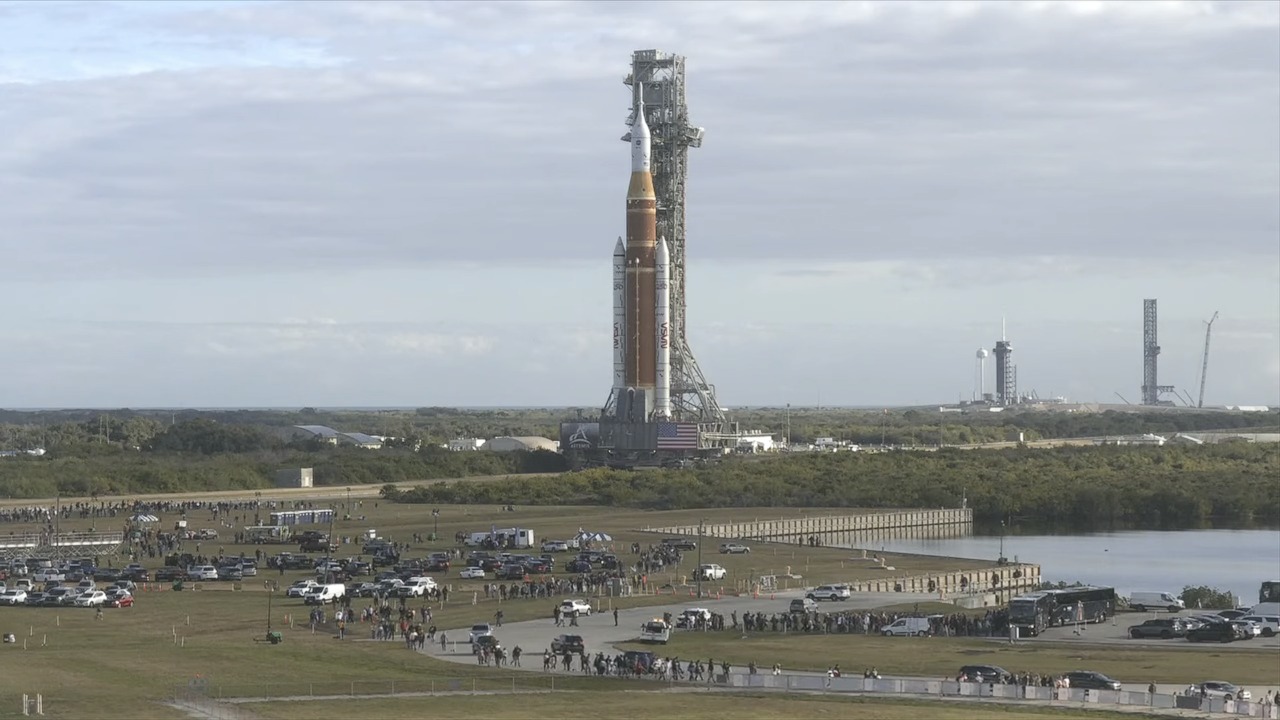

The towering Space Launch System that will send astronauts around the Moon for the first time in more than half a century is now standing at its Florida launch pad, poised for an ambitious February liftoff. With the Artemis II stack rolled out and vertical, NASA has shifted from construction to countdown, moving into the final stretch of checks before a mission that is meant to prove the agency can safely carry crews back to deep space.
The rollout marks a visible turning point in the Artemis program, transforming years of design work and testing into a flight-ready “mega moon rocket” that the agency expects to send on a roughly 10 day journey around the Moon and back. If the schedule holds, the February launch window will open a new era of human exploration that NASA officials have already described as a mission watched by the world.
The 11 million pound crawl to Launch Pad 39B
NASA’s Artemis II rocket and spacecraft made the slow, methodical trip from the Kennedy Space Center Vehicle Assembly Building to Launch Pad 39B on a crawler that moves at roughly 1 mph, a procession that turned the spaceport into a rolling photo op. The Artemis II stack, which includes the core stage, solid rocket boosters and the Orion spacecraft, was described as an 11 million pound, 322-foot-tall vehicle that engineers eased out to the pad for its final round of ground tests before flight, a move that capped years of assembly inside the cavernous building. In agency updates, officials emphasized that All work platforms had been retracted from around NASA’s Artemis II SLS (Space Launch System) rocket and Orion spacecraft before the move, clearing the way for the rollout.
The journey from the Vehicle Assembly Building to the Launch Pad was reported to take nearly 12 hours, underscoring how carefully the agency handled the fully stacked rocket on its crawler-transporter. NASA’s own social updates noted that NASA’s Artemis II rocket had made it to the launch pad after a nearly 12 hour journey from the Vehicle Assembly Building, a reminder that simply getting the vehicle to the pad is itself a major operation. Coverage of the rollout highlighted that the Artemis II rocket and spacecraft rolled out from the Kennedy Space Center’s Vehicle Assembly Building to Launch Pad 39B on Sat at a 1 mph pace, with The Artemis II stack framed against the Florida sky.
Inside the Artemis II mega moon rocket
At the heart of this rollout is the Artemis II SLS, a heavy lift booster that NASA has built specifically to send crews toward the Moon and beyond. The agency has described the Artemis II SLS as part of a broader Space Launch System architecture that pairs the rocket with the Orion spacecraft, a configuration that was fully integrated before the move to the pad. In pre rollout briefings, NASA officials stressed that the Artemis II Moon as the Artemis II Space Launch System, SLS, began its journey to the pad, signaling that the vehicle is now in its final launch configuration.
On top of the rocket sits Orion, the capsule that will carry the Artemis II crew around the Moon and back to Earth. Technical descriptions identify the Artemis II spacecraft as the Orion spacecraft Integrity and its European Service Module for the Artemis II mission, a combination that provides both life support and propulsion for the journey. Public mission overviews note that Artemis II will use Orion, Integrity and the European Service Module for the Artemis II flight, tying together hardware from NASA and European partners. Ahead of rollout, NASA confirmed that NASA had secured the Artemis II SLS Space Launch System and Orion to the mobile launcher, clearing the way for the move.
Countdown to a February launch window
With the rocket now at the pad, attention has shifted to the launch calendar and the sequence of tests that must unfold before liftoff. NASA has outlined a 10 day flight plan for Artemis II and has identified an earliest launch window in early February, specifying that the earliest launch window for Artemis II is Feb. 6, 2026, according to When the agency discussed the mission profile. Additional reporting on NASA launch dates for Artemis II has noted that NASA’s Artemis II mission to send astronauts round the Moon and back could launch as early as February, with follow on rehearsal opportunities listed for 8, 9, 11 March in planning documents cited by NASA.
Before any of those dates can be locked in, the rocket must clear a series of pad tests, including a full fueling rehearsal that will load the SLS with cryogenic propellants. Live coverage of the rollout has already pointed out that that fueling test is actually a key milestone ahead of historic moon launch, as NASA prepares Artemis for flight. Another detailed rundown of the mission timeline has reiterated that the earliest launch window for Artemis II is Feb, with additional opportunities stretching into April 30 if early attempts are scrubbed.
Final tests, dress rehearsal and crew readiness
Now that the rocket is in position, NASA teams are pivoting to a dense checklist of final tests, checks and a full dress rehearsal that must be completed before the agency gives the go ahead for the 10 day mission. One detailed briefing explained that Now it is in position, the final tests, checks and a dress rehearsal will take place before the go ahead is given for the 10 day flight, with additional launch opportunities flagged as in March and April for backup windows, a sequence summarized under the simple marker Now. Engineers will also use the pad stay to run emergency egress drills and refine procedures for getting the crew off the rocket quickly in case of a problem, exercises that were highlighted when The Space Launch System rocket and Orion spacecraft made their way to Launch Complex 39B, as noted by Space Launch System rollout coverage.
On the human side, the Artemis II crew has been vocal about its readiness to fly, describing the mission as the first time in decades that astronauts will travel around the Moon for the first time in decades, a milestone that has been framed as taking humans back to the Moon for the first time since Apollo last left footprints on it in December 1972. Live mission updates have captured that sentiment with the phrase Moon for the first time in decades as the mega rocket was taken to its launch pad, a moment chronicled in Moon for the updates. Broader public commentary has echoed that excitement, with one widely shared description calling Artemis II a mission watched by the world and noting that NASA has confirmed that humans are officially returning to the Moon with Artemis II, the first crewed flight of the program, a sentiment captured in a post about Artemis II.
Why this rollout matters for the Moon and beyond
The rollout of Artemis II is more than a logistical step, it is a public signal that NASA is on the cusp of sending people back to the Moon and eventually on to Mars. Agency communicators have repeatedly framed the program in those terms, noting that NASA has confirmed that humans are officially returning to the Moon with Artemis II and that the mission is part of a broader effort to build a sustainable presence in deep space, as highlighted in posts that describe NASA returning to the Moon. Another summary of the program has emphasized that NASA returns to the Moon in 2026 with Artemis II, the first crewed flight that will pave the way for later landings, reinforcing that the Moon is once again at the center of U.S. human spaceflight strategy.
More from Morning Overview