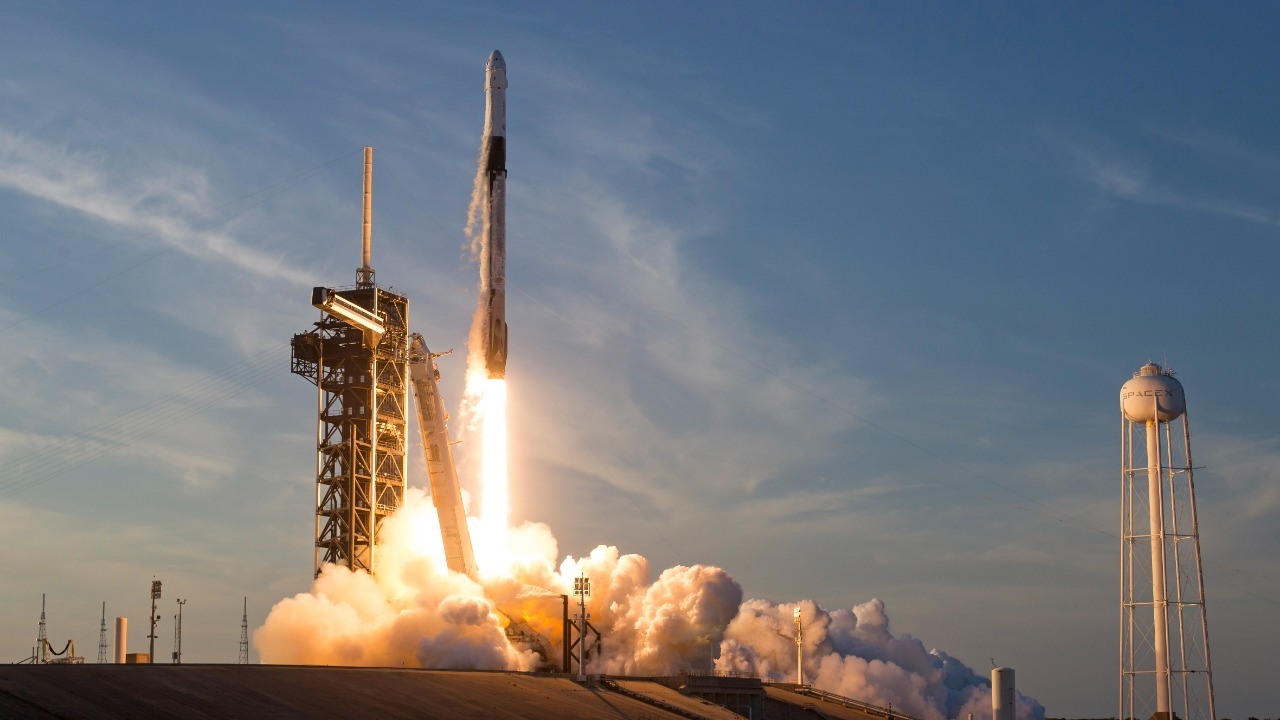

The United States is back in the business of launching people toward the Moon. With a 322 ft tall mega-rocket now standing on its seaside pad in Florida, NASA has locked in the hardware for the first crewed lunar voyage in 54 years and shifted the Artemis program from concept to countdown.
The rollout of the towering booster and its Orion capsule is more than a photo op. It signals that the agency is ready to run the same high-stakes playbook that preceded Apollo, using full-up fueling tests and dress rehearsals to prove the system before committing a crew to a loop around the Moon.
The 322-foot rocket that finally moved
The centerpiece of this return to deep space is the Space Launch System, a super heavy booster that now dominates the skyline at Cape Canaveral. Earlier this month, the U.S. space agency inched the roughly 11 million pound Space Launch System and its mobile launcher along a four mile route to a pad at Cape Canaveral, Florida, using an aging crawler transporter that traces its lineage to the Apollo era. The vehicle now standing at the pad is described as a super heavy rocket that is 322 feet tall, or 98.27 meters, a scale that puts The SLS in the same visual league as the Statue of Liberty.
Standing at 322-feet tall, the SLS, built by Boeing and Northrop Grumman, is one of the largest active launchers on Earth and is now positioned for a series of critical tests. Images from the rollout show the orange core stage and twin white boosters emerging from the Vehicle Assembly Building and creeping toward the coast, a scene that has been echoed in coverage describing how Standing SLS hardware will soon be loaded with cryogenic propellants for rehearsal. Parallel reports have highlighted the same 322-feet figure and the role of Boeing and Northrop, underscoring how much industrial weight is now tied to getting this single stack ready to fly.
From rollout to “wet dress” and launch window
Moving the rocket to the pad is only the first act in a tightly choreographed campaign. NASA has outlined a sequence in which the so called wet dress rehearsal will load the SLS with its full complement of super cold propellants, then drain them again, to validate plumbing, valves, and countdown procedures before any attempt to light the engines. That full up fueling test is described as the next major step for the wet dress campaign, and it will unfold with the vehicle exposed to the coastal environment it will face on launch day.
NASA has already sketched out when it wants that launch day to arrive. Earlier this month, the agency announced that the earliest launch window for Artemis II would open in a specific period, with later windows to be confirmed after the test campaign is complete, a schedule that has been summarized in The Brief on upcoming dates. The mission profile itself, including the use of Orion to loop around the Moon in a single flight, is laid out in public technical descriptions of Artemis II, which also note that the stack now at Launch Complex 39B is the same one that will carry the crew. As the rocket sits at the pad, a 24/7 live feed shows the vehicle undergoing tests and checkouts at the Launch Complex, turning the slow work of launch preparation into a public spectacle.
A crewed lunar flight after a 54-year gap
Hardware alone does not make history, and the stakes of this mission are defined by who will ride atop the SLS. NASA has been explicit that Artemis II will be the first crewed lunar flight in 54 years, a milestone that has been repeated in coverage of the Artemis II Moon rocket and Orion spacecraft now at the pad. Social media posts have amplified the same point, noting that after a 54-year hiatus, humanity is just weeks away from returning to the Moon, and framing the mission as a bridge to future Mars expeditions, a sentiment captured in an After post that has circulated widely.
The crew itself reflects a deliberate attempt to make this return to lunar space look different from Apollo. Public mission manifests describe how Artemis II will carry Wiseman (Reid Wiseman) along with Victor Glover and Christina Koch, also of NASA, and Jeremy Hansen of the Canadian Space Agency, with Hansen identified as Jeremy Hansen of the first non American to orbit the Moon if the mission succeeds. That lineup, detailed in coverage of Wiseman and his crewmates, is paired with NASA statements that Artemis II will send four humans flying by the Moon in a single flight, a description echoed in briefings on The Artemis II mission profile.
Who gets to ride: Glover, Koch and a new kind of firsts
The individual biographies behind those names underscore how much representation is built into this flight. NASA astronaut Victor Glover (Victor J. Glover) is a U.S. Navy pilot who is set to become the first person of color to orbit the Moon when the mission launches, a milestone that has been highlighted in profiles of Victor Glover. If successful, Christina Koch will become the first woman to travel toward the Moon, and Victor Glover the first Black astronaut to do so, while Jeremy Hansen is positioned to become the first non U.S. national to orbit the Moon, a trio of firsts laid out in analysis of Christina Koch and her crewmates.
Christina Hammock Koch brings her own record setting experience to the mission. NASA’s official biography notes that Astronaut Christina Koch was selected as a NASA astronaut in 2013 and has already spent extended periods on the International Space Station as part of Expedition 59, 60, and 61, experience that is detailed in the agency’s profile of Astronaut Christina Koch. Together with Reid Wiseman and Jeremy Hansen, the crew has been featured in live coverage that shows NASA’s Artemis rocket at the pad while teams prepare for the first crewed flight around the Moon in decades, a scene that plays out continuously on a stream focused on Artemis hardware and its future passengers.
Why this rollout matters beyond the launch
For NASA, getting the Artemis II stack to the pad is as much about program credibility as it is about a single mission. The agency has framed the move as part of “Moving the System that Will Launch the Artemis II Mission,” emphasizing that getting the rocket to the launch pad was not easy and required careful planning, a point underscored in technical descriptions of Moving the System and Getting the stack into position. Other reports have stressed that NASA moves Artemis II rocket to launch pad as final preparations begin for a historic crewed mission around the Moon, describing how the agency’s mega Moon rocket and Orion spacecraft are now in place for astronauts to travel around the Moon.
The broader Artemis architecture is designed to turn this single flight into a stepping stone. Public facing explainers have framed the current moment as one in which NASA has the hardware on the pad and a crew assigned, and is now working through the same kind of incremental testing that defined Apollo, but with a more diverse astronaut corps and a long term goal of supporting future Mars missions, themes that echo in the viral Moon posts celebrating the 54-year gap. With Artemis II at Launch Complex 39B in January 2026 and the mission’s Names and crew list now public, the program has moved from PowerPoint to pad, a shift captured in technical summaries of Names and the Artemis Explor objectives that follow.
More from Morning Overview