In the lush jungles of Costa Rica’s Diquís Delta region, a remarkable archaeological discovery was made in the 1930s by workers clearing land for banana plantations. They unearthed more than 300 massive granite stone spheres, with the largest measuring 8 feet in diameter and weighing up to 16 tons. These pre-Columbian artifacts, crafted by the Diquís culture between 300 B.C. and A.D. 1500, were meticulously arranged in straight lines or triangles along the jungle floor and riverbanks near sites like Palmar Sur and Batambal. While their exact purpose remains a subject of debate, recent studies suggest they held symbolic or astronomical significance rather than serving as functional objects.
Historical Discovery of the Spheres
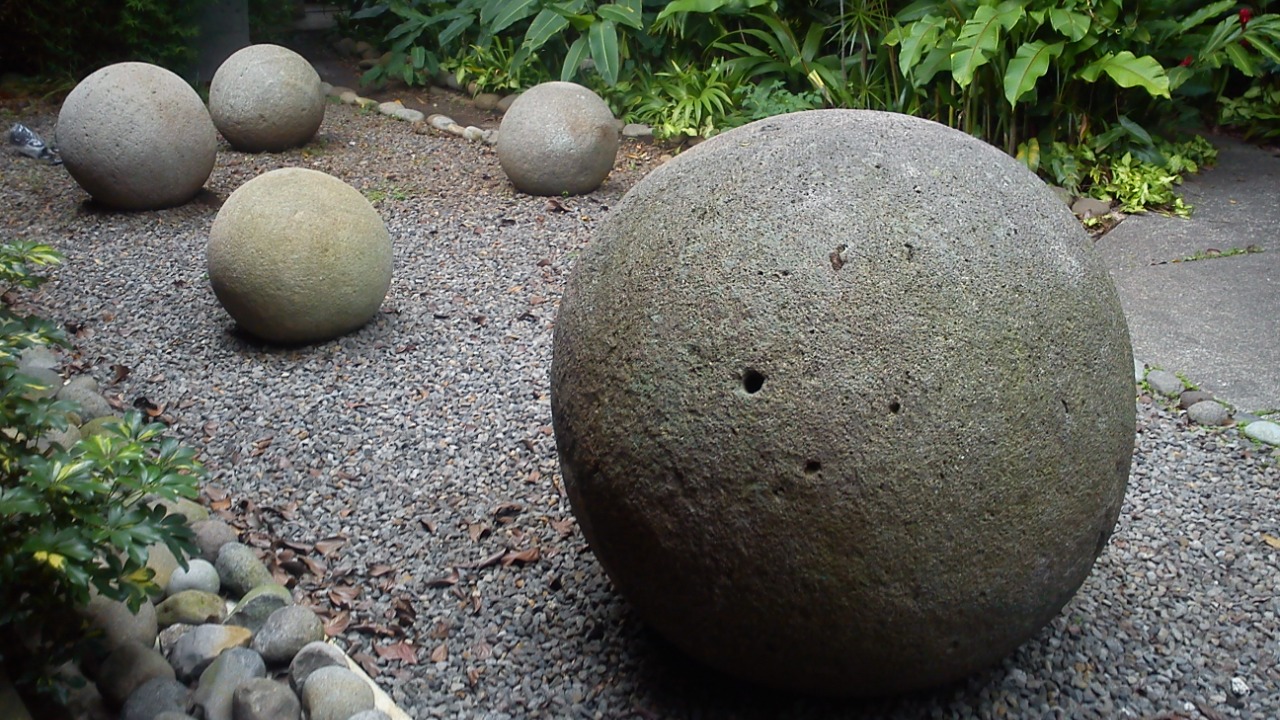
The initial discovery of these enigmatic stone spheres occurred during the 1930s when workers for the United Fruit Company began clearing the Diquís Delta for banana plantations. As they unearthed these spheres in clusters near ancient settlements, the artifacts quickly attracted attention, leading to early looting before formal archaeological involvement. It wasn’t until 1940 that the National Museum of Costa Rica began systematic studies to understand their origins and significance [source].
In the 1960s, efforts were made to preserve these cultural treasures, including the relocation of a 12-ton sphere from Palmar Sur to San José. Despite these efforts, only about 130 spheres remain intact today, as many were destroyed by dynamiting and erosion over the years [source]. The spheres’ significance was further recognized in the 2010s when UNESCO designated sites like Guayabo, La Mula, and El Silencio as World Heritage sites. This designation protected 12 key locations and spurred renewed archaeological surveys, revealing alignments with celestial events [source].
Craftsmanship and Materials

The creation of these stone spheres showcases the remarkable craftsmanship of the Diquís people. Artisans quarried local granite and limestone deposits in the region, using stone tools to shape the spheres to near-perfect roundness. The diameters of these spheres range from 2 feet to 8 feet, with unfinished examples found near Farm 4 providing insights into their construction process [source].
Transporting these massive stones was no small feat. It likely involved wooden rollers and ramps, moving the spheres over distances of up to 10 miles. Tool marks and experimental archaeology recreations suggest that hundreds of laborers were required to move each large sphere [source]. Variations in composition, including soapstone and sandstone examples, have been identified through petrological analysis, confirming their sourcing from specific riverbed boulders in the Térraba-Sierpe wetlands [source].
Cultural Context of the Diquís People

The Diquís culture, which thrived from 300 B.C. to A.D. 1500, was a chiefdom-level society with villages along Costa Rica’s Pacific coast. The stone spheres may have served as markers of elite status or territorial boundaries, as suggested by their association with pottery and jade artifacts [source]. Connections to neighboring Chorotega and Boruca groups indicate a complex network of trade extending to Nicaragua, with spheres placed near burial mounds suggesting a role in ancestor veneration [source].
The decline of the Diquís culture around A.D. 1500, due to environmental changes and Spanish conquest, left these spheres abandoned and overgrown until their modern rediscovery. This historical context highlights the spheres’ significance as remnants of a once-thriving society and underscores the importance of preserving these artifacts for future generations [source].
Ongoing Mysteries and Theories

The purpose of the stone spheres has long been a topic of debate among archaeologists. Early theories suggested they were Olmec imports or sports equipment, but these ideas have been largely dismissed in favor of astronomical alignments. Archaeologist Doris Stone proposed in the 1940s that some spheres were oriented toward solstices, a theory that has gained traction with recent studies [source]. Pseudoscientific claims of extraterrestrial origins have been debunked by radiocarbon dating, which ties the spheres to local volcanic activity around A.D. 600-800 [source].
Conservation challenges persist, with threats from looting and climate change posing risks to these cultural treasures. There are calls for expanded excavations at sites like Caño Island to uncover more contextual artifacts and further our understanding of the spheres’ significance [source]. As research continues, these stone spheres remain a testament to the ingenuity and cultural richness of the Diquís people, offering valuable insights into their world and the mysteries that still surround them.
