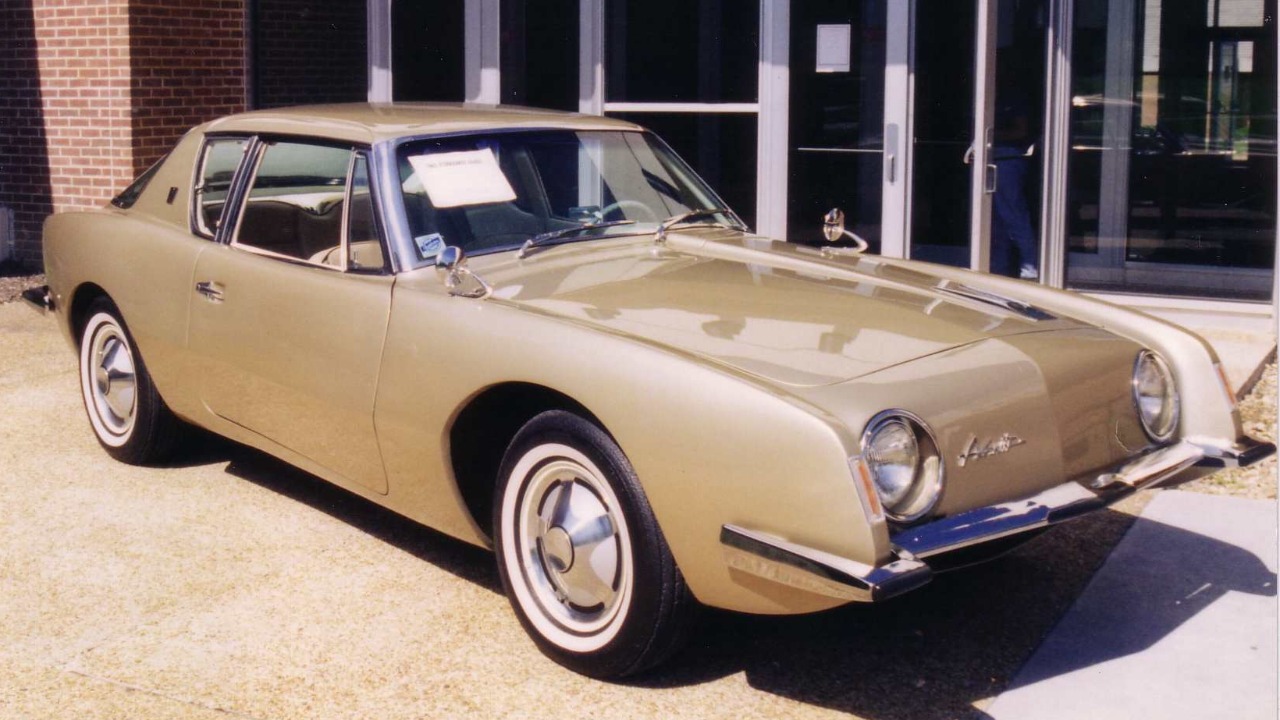

The Studebaker Avanti arrived looking like it had slipped through a wormhole, a fiberglass bullet with no grille and a cockpit full of safety ideas Detroit had barely begun to consider. It was too radical to rescue its parent company, yet that same audacity is what now fuels a small but fervent cult around the car. Today the Avanti sits in a strange sweet spot, part design landmark, part affordable classic, and part ongoing experiment in how long a “dead” model can keep evolving.
What makes the Avanti feel so contemporary is not just its shape, but the way it anticipated modern priorities: safety, aerodynamics, and brand storytelling. That is why values are quietly climbing, why designers keep sketching new versions, and why a car that once seemed too futuristic to live has become a legend that refuses to fade.
The moonshot coupe that arrived before its time
When Studebaker greenlit the Avanti, it was not chasing another chrome-laden boulevard cruiser, it was trying to leapfrog the entire American industry. In 1962, while American automakers were still locked in a race for bigger dimensions and conservative lines, a strange new coupe appeared with a smooth fiberglass body, minimal ornamentation, and a cabin that treated safety as a design brief rather than an afterthought, as detailed in period accounts of the Aug launch context. The car’s very name, Avanti, signaled a push “forward” at a company that knew it was running out of time.
The urgency behind the project produced one of the most compressed design sprints in automotive history. The 1963 Studebaker Avanti was reportedly Designed in just 40 days, a pace that would be punishing even for a modern studio armed with CAD and virtual reality. Contemporary retrospectives describe how, while Detroit slept, Studebaker created what some call America’s first fiberglass performance coupe, credited with chasing 170 m per hour and multiple speed records at a time when the company itself was struggling to stay afloat.
Design that still looks like tomorrow
The Avanti’s styling remains startling because it sidestepped the visual language of its era. The nose had no conventional grille, the sides were clean, and the glassy cabin sat over a tapered tail that looked more like a jet than a sedan. Enthusiasts still single out the 1963 Studebaker Avanti as a groundbreaking American sports coupe, introduced as a bold response to the era’s excess, with its low beltline, sculpted fenders, and integrated bumpers all cited as reasons it holds a special place in American automotive history. The car’s fiberglass construction allowed sharper creases and more daring curves than stamped steel would have tolerated at the time.
That visual daring was not accidental. The Studebaker Avanti was Designed by Raymond Loewy, the industrial designer behind everything from streamlined locomotives to corporate logos, and later enthusiasts describe the 1964 Studebaker Avanti R2 as a futuristic sports coupe ahead of its time, a sleek, aerodynamic shape that showcased Raymond Loewy and American ingenuity. Recent digital reimaginings of the Studebaker Avanti keep the signature coke-bottle profile and glassy greenhouse intact, proof that the original lines are strong enough to carry a modern aesthetic while preserving the car’s most iconic cues in contemporary renderings.
Safety, speed and the “most advanced” claim
For all its visual drama, the Avanti’s real radicalism was in how it treated safety and performance as selling points. The Avanti introduced Advanced Safety Features that were rare in American coupes of the period, including a padded dash and anti-burst door latches that enthusiasts still highlight when debating whether a modern revival could match the original’s reputation as a particularly safe vehicle, as seen in discussions of The Avanti. Inside, aircraft-style switches and a roll bar integrated into the roof structure reinforced the sense that this was more cockpit than cabin.
That blend of innovation underpinned Studebaker’s own marketing, which leaned into claims that the Avanti was America’s most advanced automobile. The Studebaker National Museum still frames the Avanti as a technological flagship, noting how the Avanti and Studebaker Avanti evolved through an 18‑month production run that saw running changes and rare variants, a story preserved in talks that follow the Avanti from launch to its short-lived factory end. Later video histories of the 1962 Studebaker Avanti describe how, in that year, American car makers were still chasing size and chrome while this strange new car quietly appeared with speed records and safety gear that would only become mainstream decades later, as recounted in Aug retrospectives.
From failed savior to long-lived cult
Despite its ambition, the Avanti could not save its maker. Production problems, dealer skepticism and Studebaker’s broader financial crisis meant the car’s run as a factory model was brief, even if the first 1963 Studebaker Avanti off the line is still celebrated in enthusiast circles as a landmark, with video tours lingering on the very first Avanti to leave the production line before output ended in Dec. Commentators now describe the Avante as Studebaker’s last hurrah, a moonshot that arrived too late to reverse the company’s decline but too compelling to disappear, a narrative that underpins modern video essays on how the Avante became the car that would not die.
What happened next is part of what makes the Avanti such an unusual cult object. Following Studebaker’s demise, five different owner arrangements continued producing the Avanti and Studebaker Avanti model for many years, stretching the nameplate’s life to around 45 years according to detailed histories that track how Following Studebaker the design migrated from South Bend to other facilities. That continuity, with small-batch production and evolving mechanicals, turned the Avanti into a rolling case study in how a niche sports coupe can outlive the corporation that created it.
Values, buyer behavior and the modern market
For a car with such a dramatic backstory, the Avanti remains relatively attainable, which is part of its cult appeal. Price guides for the 1963 Studebaker Avanti Base show Past sales that include a Studebaker Avanti Base in North America with 64500 MILES selling for $44,820 on a Hagerty Marketplace listing in Dec, a figure that puts well-kept early cars in the same conversation as more common European coupes. Separate valuation tools for the 1964 Studebaker Avanti note that condition, options and history can swing prices widely, with Common Questions sections emphasizing how originality and documentation shape what a given Studebaker Avanti is worth.
Auctions confirm that pattern. A price guide tracking THE SALES of the supercharged Studebaker Avanti R2 records a Bring a Trailer result of £35,059 for a Modified 1964 example sold in Oct, alongside other R2 transactions that show steady demand for higher performance cars in the THE dataset. A broader Avanti guide lists THE SALES at venues like Mecum, including a 1963 Studebaker Avanti Custom Land Speed Racer crossing the block in Jan and a 1963 Studebaker Avanti 4‑Speed in Sep, illustrating how both modified and stock cars find buyers in the Mecum era. For later iterations, Hagerty’s valuation for a 1983 Avanti Avanti notes that Typically, you can expect to pay around $13,200 for a good example, with the highest selling price in the last three years reaching $34,230, a spread that reflects how condition and specification drive the Avanti Avanti market.
More from Morning Overview