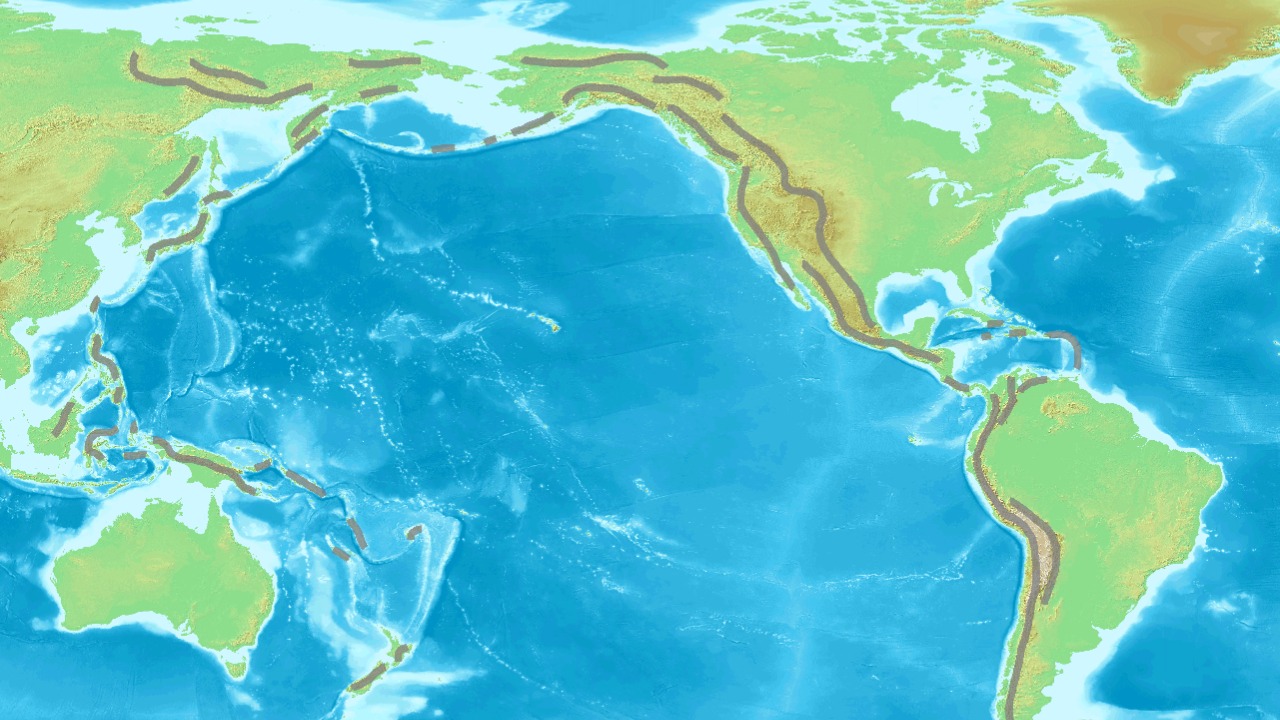

The Pacific Ring of Fire is living up to its name, with scientists tracking a chain of restless faults and volcanoes that circle the Pacific Ocean. From Alaska to Kamchatka and down to the Oregon Coast, new data points to zones where pressure is building and magma is on the move. I look at ten seismic hotspots that show how the ring is waking up and why that matters for the hundreds of millions of people living along its rim.
Pacific Ring of Fire, 40,000 km of rising risk
The Pacific Ring of Fire is a horseshoe-shaped belt, Stretching roughly 40,000 km around the Pacific Ocean, where tectonic plates collide, dive and grind past each other. One detailed warning framed it starkly as “The Pacific Ring Of Fire Awakens” and linked its activity to “500 M Million Lives In Danger,” underscoring how many people live within reach of its earthquakes and eruptions. That language reflects a growing sense that the ring is not quiet but in a new phase of agitation.
Separate commentary on Pacific Ring of describes it as WAKING, with Volcanic and seismic activity “rapidly increasing across the Pacific” and no longer isolated to single events. Analysts there point to creeping tension along fault lines and clusters of eruptions as signs that stress is redistributing through the system. For coastal cities, ports and energy hubs, that means more frequent disruptions, higher infrastructure costs and a sharper focus on early warning networks.
Global tally, 45 volcanoes erupting now
One viral breakdown of current activity states bluntly that “45 volcanoes are currently erupting worldwide,” adding that most of them are locked along the Pacific Ring of. That same update brands the situation as RING, FIRE, ACTIVE, NOW, a compressed way of saying that this is not a dormant arc but a live system. The figure of 45 is not unprecedented, but it is a reminder that eruptions are often simultaneous, not isolated spectacles.
Another social report framed the moment as “Alaska’s Ring of Fire is active,” noting that The Alaska Volcano Observatory had three volcanoes on alert at the same time and was tracking them with seismic instruments and webcams in real time. When multiple centers along the ring light up together, it complicates aviation routing, disaster logistics and insurance risk models. For residents, the message is that preparedness cannot be localized to a single mountain or island chain when the entire belt is restless.
Alaska Ring of Fire, volcano alerts and quakes
In the north, Jan updates under the banner “ALASKA RING OF FIRE: VOLCANO ALERTS AND EARTHQUAKES TOGETHER” describe how, in the last 48 hours, the Alaska Volcano Observatory has kept Great Sitkin, Shishaldin and Cleveland under close watch. The same feed notes that Great Sitkin is being monitored through satellite data and webcams in real time, reflecting how remote Aleutian peaks are now wired into global surveillance networks. These volcanoes sit directly on the subduction boundary that defines Alaska’s segment of the Ring of Fire.
A separate Jan clip, tagged “Alaska’s Ring of Fire is active,” highlights that The Alaska Volcano Observatory had three volcanoes on alert simultaneously, a configuration that raises aviation concerns over ash and forces contingency planning for coastal communities. When volcano alerts and earthquake clusters overlap in this region, it signals that the plate interface beneath Alaska is shifting. For fisheries, shipping lanes and military infrastructure spread along the Aleutians, that convergence of hazards can translate into sudden closures and costly rerouting.
Northern California’s hidden earthquake zone
Scientists are now mapping a surprisingly complex earthquake zone beneath Northern California by tracking swarms of tiny tremors. According to one Jan briefing, Scientists are using dense seismic arrays to reveal structures that standard catalogs miss, showing how stress is distributed across one of the most active seismic regions in North America. These microquakes act like dye in water, tracing out faults that could host larger events.
Public alerts have amplified that concern. One Jan update labeled “NEW EARTHQUAKE ALERT – NORTHERN CALIFORNIA” reported a magnitude 4.3 earthquake near the coast and stressed that the area forms part of the Ring of Fire. For planners, the combination of hidden structures and frequent moderate quakes means building codes, lifeline routes and emergency drills must assume a more intricate fault network than the simple San Andreas narrative suggests.
San Andreas and California’s 264 quakes in 24 hours
Along the broader California margin, Jan posts have warned that “California is showing active stress movement again,” citing Breaking updates tied to USGS readings. One alert described a magnitude three point event as evidence that the San Andreas and related faults are loading. The language emphasized that Today’s tremors are part of a longer pattern, not isolated blips, and urged viewers to follow USGS dashboards for live changes.
A separate Jan breakdown, tagged “CALIFORNIA 264 EARTHQUAKES IN 24 HRS,” noted that a USGS map window showed 264 quakes in a single day across the region. While most were small, that density signals an actively adjusting crust along the Ring of Fire’s eastern edge. For utilities, rail lines and data centers that thread through California’s valleys, such swarms underscore the need for automatic shutoff systems and rapid inspection protocols after even modest shaking.
Kamchatka, Russia’s 6.2 wake-up call
On the opposite side of the Pacific, a magnitude 6.2 earthquake struck near Kamchatka, Russia, at 12:42 UTC, rattling one of the world’s most densely volcanic peninsulas. The Report’s Key Points stressed that the quake occurred close to major stratovolcanoes that line the subduction front. Although no significant tsunami threat was identified, the event was a reminder that Kamchatka’s segment of the Ring of Fire can generate both powerful quakes and explosive eruptions.
Kamchatka’s volcanoes, including Klyuchevskoy and Shiveluch, have long histories of ash plumes that disrupt trans-Pacific flights. When a 6.2 shock hits this environment, it can alter hydrothermal systems and trigger landslides on steep volcanic flanks. For Russia’s Far East communities and for airlines routing between North America and Asia, the combination of seismic shaking and ash risk demands close coordination with regional observatories and global aviation warning centers.
Axial Seamount off the Oregon Coast
Far offshore, the Axial Seamount on the Juan de Fuca Ridge has emerged as one of the best-studied submarine volcanoes on the Ring of Fire. A detailed briefing explained that the Axial Seamount Set to Erupt in 2026 is the focus of “Scientists Make Alarming New Discovery,” with Scientists predicting that the Axial Seamount will erupt based on seafloor inflation and seismicity. The Axial Seamount is described as an active underwater volcano whose monitoring is helping to refine eruption forecasts.
Complementary coverage from the Oregon Coast notes that the Axial Seamount volcano off the Oregon Coast is now predicted to erupt in 2026, emphasizing that it sits on a spreading ridge that is part of the Ring of Fire’s complex plate boundary. While a deep-sea eruption would not look like a towering ash column, it could disrupt seafloor cables, alter hydrothermal ecosystems and generate small tsunamis. For West Coast emergency planners, Axial’s behavior is a test case for integrating submarine hazards into coastal risk maps.
Etna and the Mediterranean’s restless margin
Etna, on Sicily’s east coast, lies outside the classic Pacific loop but mirrors its dynamics as part of a convergent plate boundary. A recent Report for Etna noted that The Sezione di Catania, Osservatorio Etneo, INGV documented ongoing eruptive activity at Etna’s summit craters, with lava fountains and ash emissions. That pattern shows how subduction-driven volcanoes can cycle between quiet degassing and sudden paroxysms.
Although Etna is not on the Pacific Ring of Fire, its behavior offers a crucial analogue for cities built near stratovolcanoes along the ring. INGV’s detailed tracking of gas output, tremor and deformation illustrates the kind of multi-parameter monitoring that Pacific observatories are racing to match. For aviation, agriculture and tourism around Catania, each new phase of activity is a live test of communication systems that Pacific communities may need when their own giants stir.
Mayon and Lewotobi in the western Pacific arc
On the western side of the Pacific, Jan footage highlighted erupting volcanoes in the belt during 2025, including new or ongoing activity at Lewotobi in Indonesia and Mayon in the Philippines. The clip stressed that Lewotobi in Indonesia and Mayon in the Philippines had already shown they can hurl ash high into the atmosphere. Both sit squarely on the subduction zones that define the western Pacific Ring of Fire.
Earlier analysis of the region’s volatility pointed to a surge in volcanic activity on the Pacific Ring of Fire that raised global concerns about aviation routes and densely populated slopes. Mayon, with its near-perfect cone, looms over communities that have repeatedly faced evacuations, while Lewotobi threatens rural settlements and agriculture. For governments in Indonesia and the Philippines, these eruptions test evacuation logistics, school closure policies and the resilience of health systems under ashfall.
USGS and the race to read the signals
Behind many of these alerts is a dense web of instruments and analysts, with agencies like the USGS providing baseline seismic and volcanic monitoring across the United States. USGS maps underpinned the Jan claims that CALIFORNIA had 264 EARTHQUAKES in 24 HRS and that Northern CALIFORNIA’s 4.3 event was part of a broader Ring of Fire pattern. The agency’s open data feeds allow independent researchers and communicators to spot clusters and translate them into public warnings.
Globally, similar observatories feed into composite views of the ring. Place-based tools, such as the mapping of Kamchatka, Northern California, the Oregon Coast and Alaska, help visualize how these zones connect into a single seismic system. For coastal planners, insurers and ordinary residents, the race is on to turn that data into practical steps, from retrofitting bridges to rehearsing evacuation routes before the next segment of the Ring of Fire snaps.
More from Morning Overview