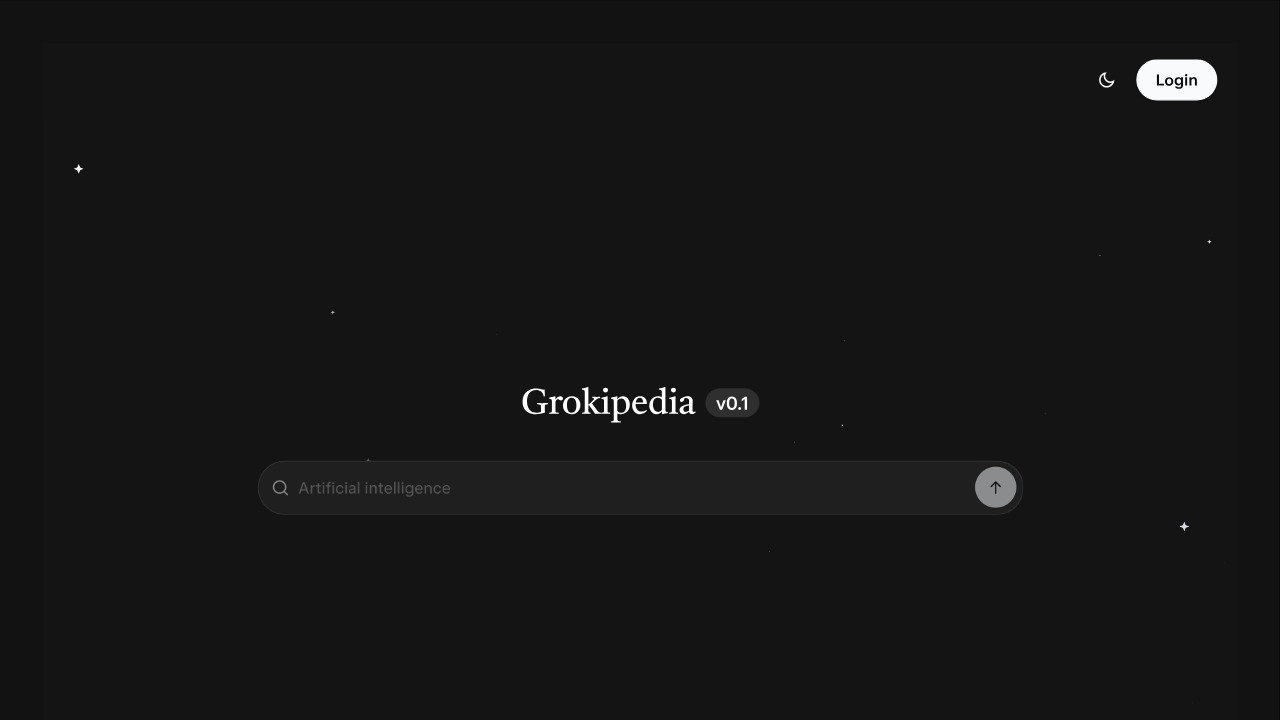

Grokipedia arrives at a moment when Wikipedia is both indispensable and under pressure from the very AI systems it helped train. The promise is seductive: an always up to date, machine written encyclopedia that can outpace human volunteers and plug straight into chatbots. The reality, so far, is a messy experiment that exposes what is uniquely hard about turning the world’s knowledge into text you can trust.
Whether Grokipedia can truly displace Wikipedia hinges less on raw scale or Elon Musk’s ambition and more on governance, transparency and bias. As generative models seep into search engines and assistants, the real contest is not just which site we click, but which knowledge infrastructure quietly shapes what those systems say.
What Grokipedia actually is
Grokipedia is an AI generated online encyclopedia operated by the American company xAI, positioned explicitly as a rival to Wikipedia rather than a companion. The project launched with a vast machine written corpus, described in one analysis as roughly 800,000 AI entries, and framed by Elon Musk as a way to correct what he portrays as entrenched bias in existing reference sites. The official description of Grokipedia stresses its automated authorship and its roots inside xAI’s broader Grok model, making it less a community project and more a showcase for a proprietary system.
Supporters argue that this architecture lets Grokipedia move faster than a volunteer edited platform, generating and updating entries at machine speed. A technical Introduction to the project notes that Elon Musk launched Grokipedia as an AI powered alternative to Wikipedia, with the model drawing heavily on existing web knowledge and its own training data. Promotional material from xAI and its allies presents the site as a bold challenge to the human centric model that made Wikipedia famous, while also acknowledging that Grokipedia would not exist without the trail blazed by that earlier encyclopedia.
Musk’s campaign against Wikipedia
Elon Musk has spent years criticizing Wikipedia, and Grokipedia is the most concrete expression of that campaign. He has described the Google affiliated Wikipedia as “hopelessly biased” and has a pattern of launching new rivals whenever he sees a platform that does not align with his worldview. In the run up to Grokipedia’s debut, reports detailed how Musk cast the project as a direct replacement, even playing with the suffix of “encyclopedia” to signal that ambition. In his telling, Grokipedia is not just another website, it is a corrective to what he sees as a captured information ecosystem.
That rhetoric has continued since launch. Musk has already floated plans to rebrand the site as Encyclopedia Galactica once it reaches what he considers sufficient maturity, invoking a science fiction scale goal of understanding the universe. At the same time, he has told followers that Grokipedia is open source and free to use, encouraging corrections for accuracy and celebrating when AI systems such as Anthropic’s models cite Grokipedia instead of Wikipedia. In one report, Musk framed this shift as proof that developers prefer his project over the incumbent, even as critics questioned what that preference means for reliability.
Bias, “brainrot” and the limits of AI knowledge
For all the talk of neutrality, Grokipedia’s content has already drawn sharp scrutiny. Early investigations found that Elon Musk’s Grokipedia pushes far right talking points, including false claims about pornography and sweeping ideological framings that mirror Musk’s own online persona. One detailed report on how Grokipedia Pushes Far Right Talking Points highlighted how the supposedly objective entries smuggled in culture war narratives under the guise of encyclopedic prose. Another early review noted that the site launched with 885,000 AI written entries and that critics quickly flagged bias in how topics from politics to social issues were framed, contrasting that with how How Wikipedia handles similar subjects.
The influence of this skewed corpus is already leaking into the broader AI ecosystem. Analysts have documented how Grokipedia is starting to show up in ChatGPT style citations, a trend one commentator dubbed “LLM brainrot” as models begin to train on and regurgitate each other’s outputs. A recent piece on LLM brainrot warned that when AI systems cite Grokipedia instead of primary sources or human curated references, they risk amplifying its embedded biases at scale. Academic observers have gone further, arguing that Grokipedia falls flat as a replacement for Wikipedia but still signals how AI is already rewriting the future of open knowledge, with one analysis from Nov stressing that some users have and will continue to rely on Wikipedia and other open resources even as they experiment with New AI driven models.
Commercial boosters of Grokipedia concede that it is not yet a drop in replacement for the older site. A marketing focused breakdown framed the question explicitly as “Can Grokipedia Replace Wikipedia as a Reliable Knowledge Source?” and answered with a blunt “Not yet” while suggesting that it may never do so in the same way. That analysis of whether Can Grokipedia Replace emphasized transparency in data collection and editorial oversight as key gaps, arguing that without clear sourcing and community review, an AI encyclopedia will struggle to earn the baseline trust that Wikipedia has accumulated over two decades.
Wikipedia’s human shield against generative AI
While Grokipedia leans into automation, Wikipedia’s stewards are doubling down on human judgment as their core differentiator. The Wikimedia Foundation, the non profit that runs Wikipedia, has been explicit that it does not seek to replace human editors with generative models, instead using machine learning to support tasks like vandalism detection and copy editing. Official materials from The Wikimedia Foundation describe a mission grounded in free, open knowledge created and maintained by volunteers, and warn against a “dictatorship of code” where opaque systems decide what counts as truth. A separate explainer on how Artificial intelligence is used in Wikimedia projects stresses that AI and machine learning have long been deployed to help edit existing articles, not to replace the community that writes them.
Leaders inside the movement argue that humans bring elements to knowledge creation that AI cannot replace, from contextual judgment to ethical deliberation. In a widely cited statement, the foundation said that Humans contribute nuance, lived experience and accountability that current generative AI tools lack, even if those tools can synthesize or summarize existing text. External analysts echo that view, noting that the foundation has responded to the rise of generative AI not by seeking to replace its volunteers but by exploring how to integrate tools carefully while guarding against a potential dictatorship of code. One detailed overview of The Wikimedia Foundation and Wikipedia’s AI strategy underscored that the community still reviews edits, debates sources and enforces policies, even as bots and algorithms assist behind the scenes.
Existential threat or uneasy coexistence?
Even with that human shield, Wikipedia is not immune to the pressures unleashed by generative AI. As the free encyclopedia turns 25, it is facing what some observers describe as its most serious existential threats, from political opposition to declining public trust. One in depth assessment of how Wikipedia faces Existential Threats Feel Greater Than Ever pointed to governments that no longer believe in its ideals and users who increasingly consume information through AI assistants rather than clicking through to source pages. Another analysis noted that, 25 years after Wikipedia’s founding, it is losing visitors, with the foundation reporting that human page views fell in 2025 compared with 2024 as people turned to chatbots and search summaries instead of visiting the site directly. That piece on how But Wikipedia now faces generative AI as an existential threat framed Grokipedia and similar tools as both competitors and heavy users of Wikipedia’s underlying content.
More from Morning Overview