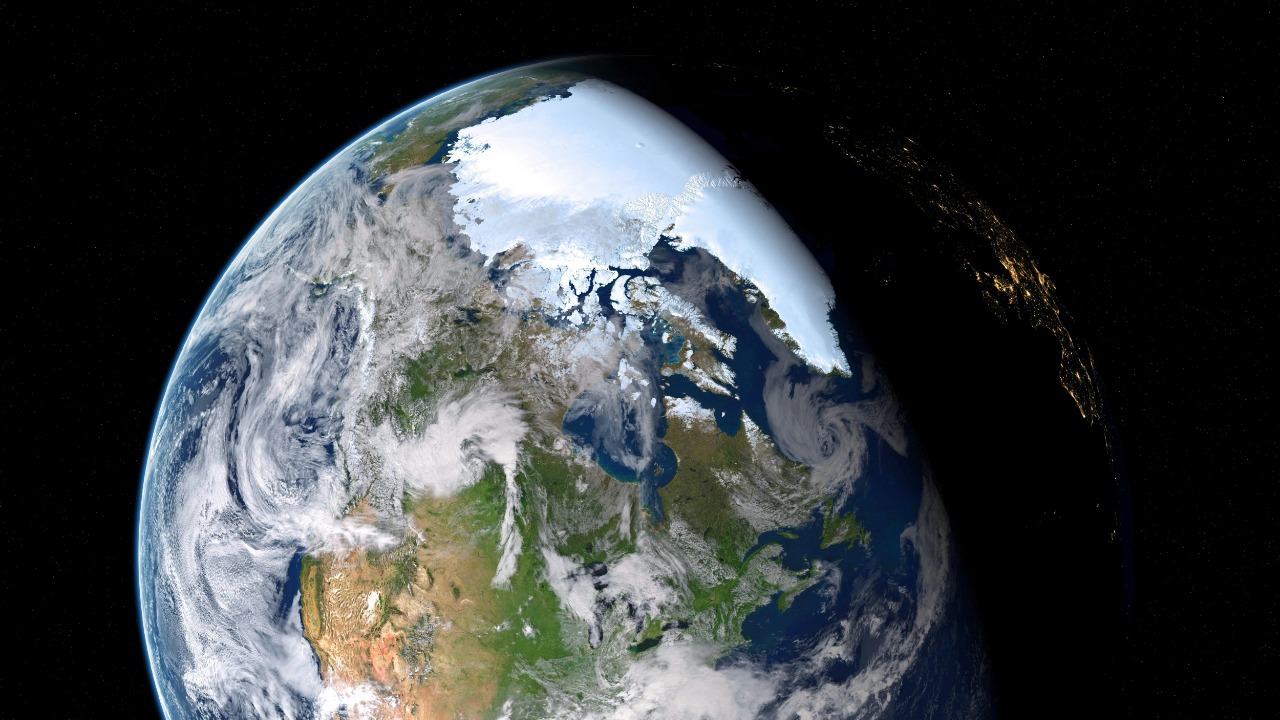

Earth’s spin is not as steady as it looks. As ice melts and groundwater is pumped from deep aquifers to the surface, the planet’s mass is shifting, and with it the position of the rotational axis that defines the North and South Poles. I want to unpack how that redistribution of water is nudging the axis by tens of inches, why scientists say it is not “normal,” and what it really means for seasons, sea level and the climate story we are writing into the planet’s physics.
Earth’s axis is not fixed, and water is a powerful lever
The first thing to understand is that Earth’s axis has never been nailed in place. The planet spins around an imaginary line that passes through the poles, but that line wobbles and drifts as mass moves around inside the mantle, across the oceans and through the atmosphere. What is new is the scale and speed of the shift that researchers are now tying directly to human activity, especially the way we move water from one part of the globe to another, which alters how weight is distributed and subtly changes the spin.
Scientists describe this as a problem of angular momentum and inertia, the same physics that makes a spinning figure skater turn faster by pulling in their arms. When ice locked on land melts into the ocean or groundwater is pumped from deep underground and eventually flows to the sea, the effective “shape” of Earth’s mass changes, and the axis adjusts in response. Recent analyses of satellite data and polar motion records show that the cumulative effect of these water shifts has tilted the axis by roughly 31.5 inches relative to where it would otherwise be, a figure that has been highlighted in detailed explainers on why the planet’s tilt is changing.
The 31.5‑inch tilt: what scientists actually found
When people hear that Earth’s axis has moved by 31.5 inches, it can sound like a social media exaggeration, but that number comes from careful reconstruction of how the pole has wandered over recent decades. Researchers combined long records of polar motion with models of how ice sheets, glaciers and groundwater have changed, then asked how much of the observed drift could be explained by each factor. The result is that the axis has shifted by more than 31 inches toward the east, a change that stands out from the background wobble that geophysicists expect from natural processes inside the planet.
That distance is small compared with Earth’s radius, but it is large in geophysical terms, and scientists emphasize that the pattern of motion is not what they would predict without the influence of modern climate change and water use. Detailed breakdowns of the calculations note that the shift is not a one-time jump but a steady migration that tracks with accelerating ice loss and groundwater extraction, a point that is spelled out in reporting on how the 31.5‑inch tilt emerged from the data.
Groundwater pumping: how farms and cities tug on the pole
Among the human activities that move water around, large scale groundwater pumping stands out as a direct way we are reshaping the planet’s mass. When farmers and cities draw trillions of tons of water from deep aquifers in places like the western United States, northern India or the Middle East, that water does not stay put. It is used for irrigation, drinking and industry, then flows through rivers and drainage systems into the oceans, effectively shifting weight from land to sea and changing the balance that defines Earth’s spin.
Researchers who modeled this process found that intensive groundwater extraction since the mid‑1990s has pushed the rotational pole eastward by several dozen centimeters, a contribution that rivals the effect of melting ice in some analyses. One study estimated that pumping roughly 2,150 gigatons of groundwater over a few decades was enough to alter the direction and speed of polar drift, a conclusion that has been widely cited in coverage of how pumping aquifers is shifting the axis. Follow up work has reinforced that this is not a marginal effect: groundwater use is now a measurable driver of Earth’s changing orientation in space.
Melting ice and glaciers: climate change in the planet’s spin
Ice locked on land is another major lever on the axis, and here the fingerprints of global warming are unmistakable. As temperatures rise, the Greenland and Antarctic ice sheets, along with mountain glaciers from the Himalayas to the Andes, are losing mass and sending freshwater into the oceans. Because this meltwater comes from high latitudes and high elevations, its movement toward lower latitudes and sea level has an outsized effect on how Earth’s mass is distributed, nudging the axis in the direction of the regions that are losing the most ice.
Geophysicists have used satellite gravimetry and climate models to show that the rapid loss of ice since the late twentieth century has changed both the speed and direction of polar drift, effectively bending the path of the pole toward regions of intense glacier melt. One analysis concluded that the shift in the axis around the year 2000 could be traced in large part to accelerating ice loss in Greenland and West Antarctica, a finding that has been detailed in work on how melting glaciers have redirected Earth’s axis. In that sense, the pole’s motion has become another line of evidence that the climate system is changing in ways that reach all the way into the planet’s rotation.
Soil moisture, drought and the subtler water shifts
Not all of the water that matters for Earth’s spin is locked in ice or deep aquifers. The amount of moisture stored in soils, wetlands and shallow groundwater also changes with seasons, droughts and floods, and those shifts can add up across continents. When a region experiences prolonged drought, for example, soils dry out and reservoirs shrink, reducing the mass in that area and slightly altering the balance of the planet’s rotation. Conversely, years of heavy rainfall can load more water onto land, temporarily tugging the axis in the opposite direction.
Recent studies that combine satellite observations with hydrological models have shown that these changes in soil moisture and surface water can measurably affect the length of the day and the fine details of Earth’s rotation, even if they do not dominate the long term drift of the pole. Researchers have pointed out that extreme events, such as multi year droughts in the Amazon or the American West, leave a detectable signature in the rotation record, reinforcing the idea that the water cycle and the planet’s spin are tightly linked. That connection has been explored in reporting on how soil moisture variations influence Earth’s rotation, which notes that even relatively small changes in stored water can be seen when scientists look closely enough.
How we know: satellites, gravity maps and polar motion records
To trace these subtle shifts, scientists rely on a suite of tools that did not exist a few decades ago. One of the most important is the Gravity Recovery and Climate Experiment, or GRACE, a pair of satellites that measured tiny changes in Earth’s gravitational field as mass moved around the planet. By tracking how the distance between the satellites changed as they flew over regions gaining or losing mass, researchers could map where water and ice were being added or removed, then link those patterns to changes in the axis and the length of the day.
Analyses of GRACE data helped solve long standing puzzles about why the pole was drifting in particular directions and at certain speeds, showing that the combined effects of glacial rebound, ice loss and groundwater pumping could account for much of the observed motion. One NASA led study used GRACE to reconcile discrepancies between models and observations of polar wander, demonstrating that including realistic water storage changes brought the two into alignment, a result that has been highlighted in explanations of how satellite gravity data clarified Earth’s wobble. Those findings, combined with decades of precise measurements from ground based observatories that track the exact position of the pole, give scientists confidence that the 31.5‑inch figure is rooted in hard data rather than speculation.
Separating science from viral claims and public anxiety
As news of the axis shift has filtered into public conversation, it has often been distorted into claims that Earth is “tipping over” or that seasons are about to collapse. The reality is more nuanced. The 31.5‑inch movement is significant for geophysicists, but it is tiny compared with the overall tilt of about 23.5 degrees that gives us seasons, and it does not mean that the planet is suddenly unstable. What it does show is that human activity has become powerful enough to leave a measurable mark on the planet’s rotation, a fact that is striking even if the immediate practical effects are modest.
Some of the most widely shared posts about the axis shift have mixed accurate numbers with misleading interpretations, suggesting, for example, that the tilt change is responsible for every unusual weather pattern or that it signals an imminent catastrophe. Scientists who work on polar motion have pushed back on those narratives, stressing that while the shift is real and linked to climate change and water use, it is not a doomsday sign. That tension between solid research and online exaggeration is evident in viral discussions that cite the 31.5‑inch figure without context, such as social media threads that claim scientists have found the axis has shifted by over 31 inches but do not explain what that means in practice.
What the axis shift does and does not change for daily life
For most people, the immediate consequences of the axis drift are imperceptible. The change in the length of the day is measured in milliseconds, and the shift in the geographic position of the poles is far too small to notice without specialized instruments. Navigation systems, satellite operations and astronomical observations do need to account for these changes, and agencies that maintain global reference frames regularly update their models to reflect the latest measurements of polar motion and Earth’s rotation.
Where the axis shift matters more is as a diagnostic of how deeply we are altering the planet. The same processes that move the pole, such as melting ice sheets and draining aquifers, also drive sea level rise, change regional water availability and reshape ecosystems. In that sense, the wobble of Earth’s spin is another indicator on the dashboard of planetary change, one that complements temperature records, sea level gauges and glacier surveys. Analysts who have walked through the implications emphasize that the tilt shift is a symptom of broader climate and water stress, a point underscored in detailed discussions of how rampant groundwater pumping has altered the axis and in long form explainers that frame the 31.5‑inch figure as a warning sign rather than an isolated curiosity.
Why scientists say this pattern is not “normal”
Earth’s axis has always wandered, but the current pattern stands out when scientists compare it with what they would expect from natural processes alone. Internal flows in the mantle, the slow rebound of land once buried under ice, and long term changes in the core all contribute to polar motion on timescales of centuries to millennia. What researchers are seeing now is a relatively rapid shift over a few decades that lines up closely with the timing and geography of human driven ice loss and groundwater depletion, which is why they describe it as outside the bounds of the preindustrial norm.
Several recent syntheses argue that the axis drift should be viewed alongside other markers of the Anthropocene, the proposed epoch in which human activity is the dominant force shaping Earth’s systems. They point out that the same industrialization and fossil fuel use that warmed the climate also enabled the massive irrigation projects and urban growth that draw down aquifers, linking the axis shift to a broader story of planetary engineering. Commentators who have tried to translate this for a general audience have leaned on the 31.5‑inch figure as a vivid way to convey the scale of our impact, as in essays that explain why scientists do not see the current tilt change as normal and in accessible breakdowns that walk readers through the physics behind the numbers.
How the story of Earth’s tilt fits into the larger climate picture
When I step back from the technical details, what strikes me is how the axis shift connects everyday choices to planetary scale outcomes. Decisions about how much groundwater to pump for crops, how quickly to cut greenhouse gas emissions, or how aggressively to protect glaciers and snowpack are not just local policy debates. They are part of a chain of cause and effect that reaches into the rotation of the planet itself, altering the path of the pole in ways that scientists can now measure with satellites and precise clocks.
That does not mean the axis drift should be a new source of fear, but it does make it harder to argue that human influence stops at the atmosphere or the oceans. The same physics that governs a spinning top is now recording our imprint on Earth, from the 31.5‑inch tilt tied to water redistribution to the more subtle changes in day length linked to soil moisture and seasonal snow. For readers who want to dig deeper into the mechanics and the evidence, there are clear, accessible explainers that walk through the science of how humans have shifted the axis and others that lay out the broader context of why the 31.5‑inch figure matters, but the core message is already clear. By moving water, we are moving the world.
More from MorningOverview