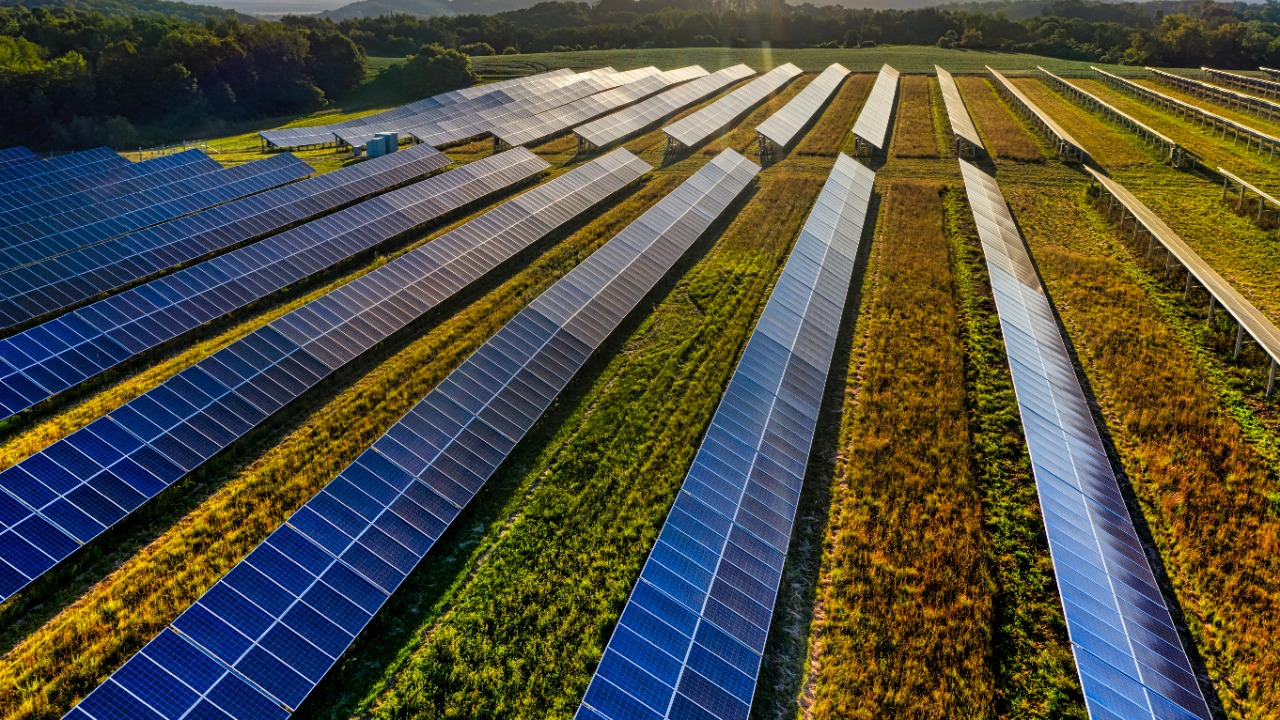

Far off the coast of Shandong, a new kind of power plant is quietly feeding China’s coastal cities. A vast field of solar panels, fixed to steel trusses in shallow water, has become the world’s first gigawatt scale open sea photovoltaic farm and a test bed for how to run a modern grid on weather dependent power. Instead of just adding more renewables at the margins, China is using this project to rewire how electricity is generated, moved and balanced across its system.
The offshore complex is designed to supply millions of people, relieve pressure on crowded land near the coast and anchor a broader push to harden the grid for an era of electric vehicles and data centers. I see it as less a one off engineering feat than a preview of how a densely populated, industrial economy might lean on the ocean to hit long term climate goals.
The 1 GW power plant at sea
The centerpiece of this shift is the Guohua Investment Shandong HG14 installation, a 1 gigawatt array of photovoltaic modules planted in open coastal waters off Dongying in the Kenli District. Multiple reports describe it as China’s first gigawatt level offshore photovoltaic project and currently the largest open sea solar installation in the world, with China’s first gigawatt-level offshore plant now covering a significant share of Kenli District’s total electricity demand. The project, developed by Guohua Investment under China Energy Investmen, is often referred to simply as HG14 and is part of a broader portfolio of coastal energy assets that China is building to serve its eastern load centers.
Engineering details underscore how different this is from rooftop or desert solar. The offshore installation occupies around 1,223 hectares of shallow coastal waters, with panels mounted on offshore steel truss structures that are designed to withstand waves, gales and winter ice conditions described in Vietnamese coverage By Thu Thao. The capital cost has been put at 8.1 billion yuan, or about $1.2 billion, according to Guohua Investment, which highlights how quickly offshore solar is scaling from pilot projects to utility scale assets.
From floating experiment to grid workhorse
What makes HG14 more than a showpiece is the way it has been integrated into China’s onshore network. The Guohua Investment Shandong HG14 Offshore Photovoltaic Project is now online and operating commercially, with Guohua Investment Shandong project reported as capable of covering Kenli District’s total electricity demand at times. Social media posts from China emphasize that the plant is fully connected to the national grid, not just running as an islanded system.
Earlier commentary from Ann Arbor framed the project as a milestone in how coastal provinces manage peak demand, noting that The China Daily reported the 1 gigawatt offshore photovoltaic project in Kenli as a resource that can be paired with storage to cover evening peaks and even some night time load. That analysis, published by Ann Arbor under the Informed Comment banner, highlighted how the plant’s output profile dovetails with local consumption patterns. A separate link to the same discussion of the 1 gigawatt offshore photovoltaic project in Kenli underlines how The China Daily framed the project as a grid asset rather than a standalone generator.
Powering 2.6 m people and a coastal economy
The scale of the offshore complex is easiest to grasp in human terms. Multiple technical write ups say the world’s largest offshore solar farm could meet the power needs of 2.6 m people, a figure echoed in lifestyle focused coverage that describes how China has built the world’s largest offshore solar farm to provide power for 2.6 m residents. For a single project, that is comparable to the population of a mid sized European country, and it illustrates why coastal authorities see offshore solar as a serious contributor to regional energy security.
Video explainers have amplified that message for a global audience. One widely shared clip opens with the line that China just built an enormous solar farm on the ocean and stresses that when the narrator says enormous, they mean astronomical, arguing that it can actually power millions of homes, a claim that aligns with the YouTube description. A separate upload of the same video, accessible through a different link, repeats that China just built an enormous solar farm on the ocean and uses the same language about the project being astronomical, reinforcing how the Jan video has become part of the project’s public narrative.
Grid upgrades and China’s $574 billion bet
None of this would matter if the electricity could not be moved and balanced across provinces. That is where China’s grid investment plans come in. BEIJING based reporting says China’s State Grid will spend 4 trillion yuan, or $574 billion, to upgrade the country’s power grid between 2026 and 2030, a record surge in spending that explicitly cites the need to accommodate renewable energy, electric vehicles and data centers. A climate policy digest summarizing that plan notes that China’s grid investment is expected to “surge” as part of a broader response to global elite concerns about energy security, with The Associated Press also highlighting how international media have flocked to Greenland as Trump turns the Arctic island into a geopolitical flashpoint, underscoring how energy and geopolitics are increasingly intertwined.
China’s own planners have been explicit about the geographic challenge. One official analysis notes that While China’s main electricity demand centers are concentrated in the eastern coastal regions, transporting energy from the west to the east has long been a strategic priority to ensure regional energy security, as While China explains in the context of hydropower. Academic work on China’s 2060 carbon neutrality target adds that China’s east, near the coast, will run out of land that can be used for renewable energy plants, which means any solution will have to lean heavily on offshore resources and distributed generation on residential and commercial buildings, as China focused researchers have argued.
Why offshore solar fits China’s energy strategy
Against that backdrop, the HG14 project looks less like an outlier and more like a template. Commentators have pointed out that China has started work on gigawatt scale open sea solar farms as part of a broader pattern in which China’s dominance in the solar supply chain is now being leveraged offshore, with one analysis noting that the project is backed by China Energy Investment Corporation Co., Ltd., a detail highlighted in coverage of China’s dominance. A separate report describes how China has commissioned the world’s largest open sea offshore solar photovoltaic project, a 1 gigawatt installation that is already being compared with typical onshore installations in terms of cost and performance, according to January 25 coverage.
The same corporate ecosystem is also pushing floating solar in more sheltered waters. CHN Energy has started full commercial operations at the 1 GW HG14 floating PV project off the coast of Dongying, described as the largest FPV installation in the world, according to a project update that credits CHN Energy with bringing the plant online. A second reference to the same announcement notes that CHN Energy has started full commercial operations at the 1 GW HG14 floating PV project off the coast of Dongying, again stressing that it is the largest FPV project of its kind, which shows how quickly lessons from one site can be replicated along the coast.
More from Morning Overview