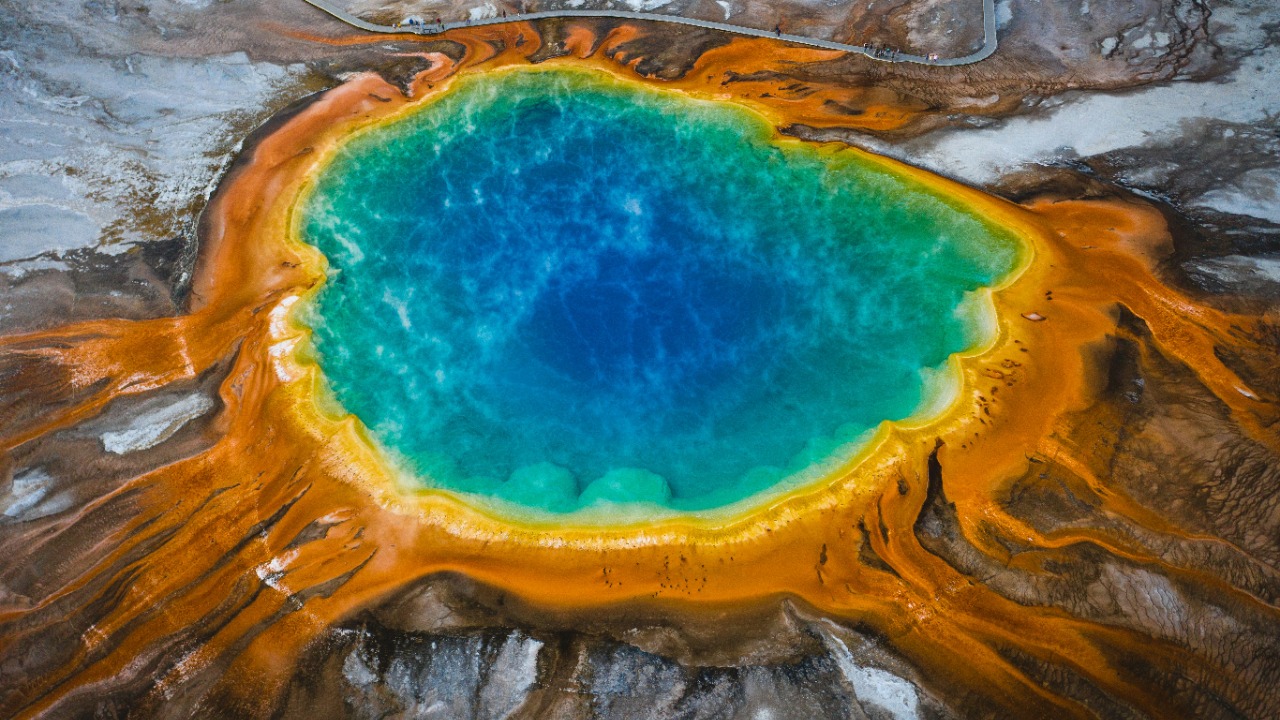

Far beneath Yellowstone’s famous geysers, the ground is quietly on the move. Parts of the volcanic system are rising by millimeters to centimeters, forming a broad, city-scale bulge that only shows up in precise measurements. I see a story not of imminent catastrophe, but of how a dense web of instruments now tracks every subtle shift in one of the world’s most closely watched volcanoes.
That quiet uplift has returned along the volcano’s north rim, where a feature known as the Norris Uplift Anomaly is again pushing the surface upward. The change is too small for visitors to notice, yet sensitive sensors and satellites are mapping it in fine detail, turning Yellowstone into a real-time laboratory for how restless calderas breathe.
Yellowstone’s restless floor and a Chicago-sized bulge
Yellowstone has always been a dynamic landscape, but the current pattern of uplift is unusually focused along the north rim of the Yellowstone Caldera. Scientists describe a Chicago-sized bulge that has risen about an inch since July, a reminder that the volcanic system is still very much alive beneath Yellowstone National Park. I find it striking that such a large feature can grow in a matter of months while remaining invisible to anyone standing on the ground.
Researchers say this swelling is centered near the caldera’s edge and is being tracked as a city-scale deformation zone that continues to evolve. Reports note that Scientists are monitoring a Chicago-sized bulge along the volcano’s north rim that has risen an inch since July, and that the feature lies along the Yellowstone Caldera in Yellowstone National Park. A separate account underscores that There is a city-sized uplift along the caldera’s north rim, reinforcing the scale of the deformation that is now under close watch.
The return of the Norris Uplift Anomaly
The Chicago-scale bulge is part of a broader pattern centered on a feature volcanologists call the Norris Uplift Anomaly, or NUA. This anomaly, located near the Norris Geyser Basin, has a history of rising and falling by roughly an inch over multi-year cycles, behavior that points to shifting fluids and heat beneath the surface rather than a single, linear build-up toward eruption. When I look at the current reports, what stands out is that the NUA has “come back” after a period of relative quiet, resuming a familiar pattern of uplift.
Scientists confirmed that the NUA had reawakened using a combination of ground instruments and satellite data, noting that the latest uplift episode is similar in magnitude to one that occurred from 1996 to 2004. The final confirmation of the uplift was from interferometric synthetic aperture radar, or InSAR, a satellite radar technique that can detect ground movement of just a few millimeters over large areas. In their description of the renewed activity, researchers emphasize that the current deformation is comparable to the earlier episode, and that the Norris Uplift Anomaly is once again rising. A more detailed technical note explains that the final confirmation of the uplift was from InSAR, and that the pattern is similar to that of 1996–2004, a point highlighted in a focused discussion of the technique used to verify the anomaly.
How millimeter-scale motion is measured
Capturing these subtle changes requires a dense and sophisticated monitoring network. On the ground, permanent GPS stations anchored into bedrock record how their positions shift over time, logging movements as small as a few millimeters per year. I see these instruments as the volcano’s fitbits, quietly tracking how the caldera floor breathes in response to changes in magma, hot water, and gas at depth.
Above, satellites equipped with radar instruments repeatedly scan Yellowstone, and by comparing successive images, scientists can map uplift and subsidence across the entire region. This is where InSAR comes in, turning phase differences in radar signals into detailed maps of ground motion. A technical overview of the deformation program explains how researchers use GPS, tiltmeters, and satellite radar to monitor the park, describing how monitoring deformation has become central to understanding the caldera’s behavior. A broader explainer on how scientists know what is happening beneath the surface notes that Yellowstone is a monitored volcanic system with instruments tracking earthquakes, ground movement, and gas, and that this integrated network is how experts know what is going on beneath the ground at Yellowstone.
Recent coverage of the NUA highlights just how far this technology has come. One account describes how advanced tools, including InSAR, have been used to map the anomaly’s rise and fall by about an inch, turning what would once have been a mysterious ground shift into a well-characterized deformation cycle. In that discussion of advanced tech, the NUA is shown in satellite imagery, labeled as NUA with an Image Courtesy of the USGS, YVO, Public Domain, and the piece explains that the anomaly has a history of rising and falling by an inch. A more technical section titled How Is the walks through how InSAR data of NUA in 2025, combined with ground sensors, reveals that the anomaly has been rising and falling by an inch, again credited as Image Courtesy of the USGS, YVO, Public Domain.
Inside the Yellowstone Volcano Observatory’s watch
Behind this network is the Yellowstone Volcano Observatory, a partnership that coordinates monitoring and interpretation of the caldera’s activity. The observatory runs the seismic stations, GPS receivers, and gas sensors that feed into monthly updates on what the volcano is doing. When I look at their public information, what comes through is a calm, methodical approach that treats uplift as one of several routine indicators, not as a singular alarm bell.
The observatory’s overview describes how it tracks earthquakes, ground deformation, and hydrothermal changes across the region, and how these data streams are used to assess volcanic hazards. It notes that the Yellowstone Volcano Observatory coordinates this work and provides regular updates on the state of the Yellowstone Caldera. In a recent video update, the team introduces a “friend” that helps visualize the caldera’s motion, explaining that while the north rim is experiencing uplift, the caldera itself is undergoing subsidence, a gentle sinking that offsets some of the overall movement. That update from the Yellowstone Volcano Observatory emphasizes that uplift at the rim and subsidence of the caldera itself can occur at the same time, a reminder that the system’s behavior is complex and three-dimensional.
Official status reports back up that measured tone. The Newest Volcano Notice Including Yellowstone states that Yellowstone Caldera activity remains at background levels, with 79 located earthquakes and no signs of escalating unrest. In that notice, the Newest Volcano Notice explicitly notes that Yellowstone Caldera activity remains at background levels, with 79 located events, underscoring that, despite the uplift, the overall hazard status has not changed.
What the bulge means, and what it does not
Whenever Yellowstone’s ground rises, public anxiety tends to rise with it. The phrase “It’s Gonna Blow” often surfaces in conversations about the caldera, but the current science paints a more nuanced picture. The Chicago-sized bulge and the renewed NUA are best understood as part of the volcano’s normal breathing, driven by the movement of magma, hot water, and gas in the crust, rather than as a countdown to a catastrophic eruption.
Reports on the north rim uplift stress that while the ground is rising, it is not a sign of an imminent eruption, and that the most likely source of the ongoing episode is the movement of fluids beneath the surface. One account notes that Gonna Blow is the question people ask, but clarifies that while the uplifting ground is not a sign of an imminent eruption, the most likely source of the ongoing episode is the movement of magma or gas underground. Another detailed report explains that the bulge was Dubbed the Norris when it first appeared near the Norris Geyser Basin, and that it is often caused by the movement of magma or gas underground, forming a gigantic bulge that is too subtle to see from above ground.
More from Morning Overview