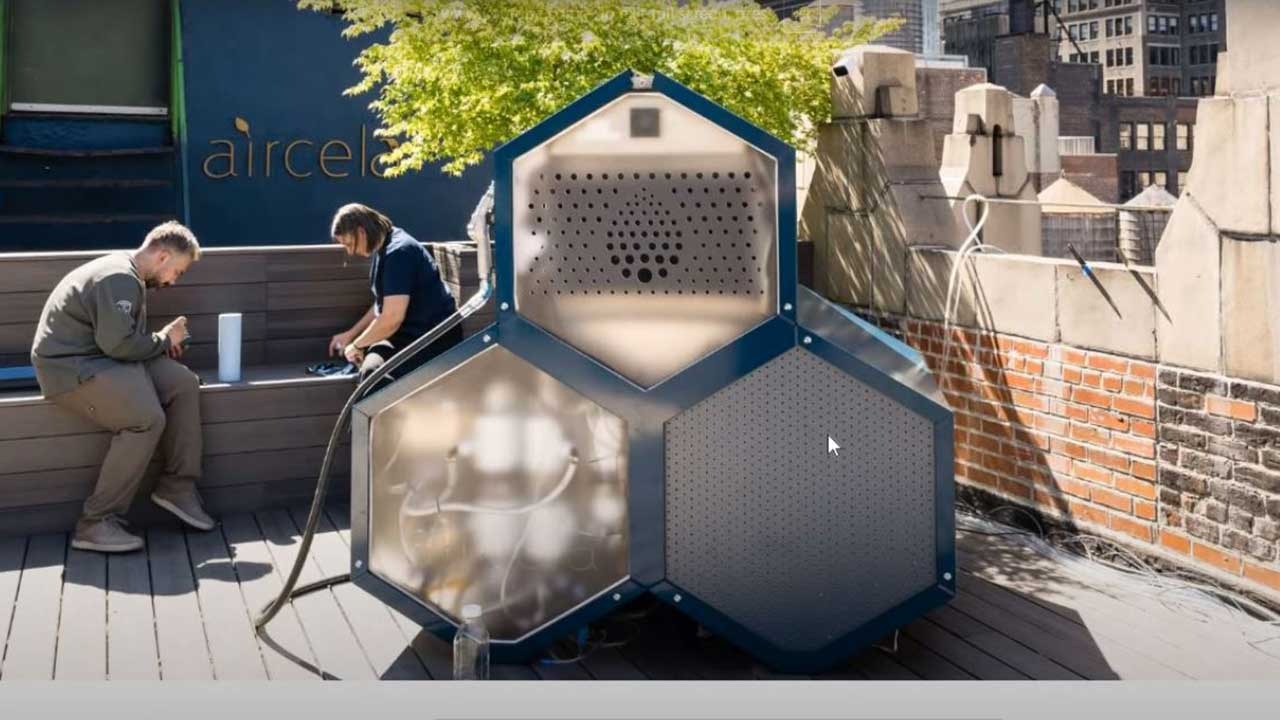

A refrigerator-sized box on a Manhattan rooftop is quietly challenging one of the most entrenched assumptions in energy: that gasoline has to come out of the ground. Instead, this machine pulls carbon from the air, mixes it with hydrogen made from water, and synthesizes a liquid fuel that can go straight into the tank of a conventional car. The promise is simple but radical, a way to keep existing vehicles running while cutting the climate cost of every mile.
The company behind the device, Aircela, is betting that drivers will not abandon gasoline cars overnight, no matter how fast electric vehicles grow. By turning ambient air into a drop-in fuel, it is trying to turn a climate liability into a resource, and to do it with hardware compact enough to sit beside an elevator shaft rather than in a sprawling refinery complex.
The rooftop machine that makes its own gasoline
The core of the story is a compact unit that looks less like a refinery and more like an appliance. Aircela describes its system as a fridge-sized machine that turns air and water into real gasoline using renewable electricity, a kind of modular fuel plant that can be deployed where the demand is, rather than where oil happens to be. On its own site, Aircela presents the device as a complete system that starts with the air outside and ends with a hydrocarbon blend that behaves like pump gas.
The first public demonstration took place in the Garment District in Manhattan, where Aircela set up its machine on a rooftop and ran it in front of an audience. Reporting from that event describes a New York based fuels company operating what it calls the first working system in the United States that can turn air into gasoline on site, rather than shipping fuel in from a distant plant. A separate account of the same debut notes that the unit is roughly the size of a Refrigerator, underscoring how far the hardware has shrunk from the industrial plants that usually dominate carbon capture and fuel production.
How Aircela turns thin air into liquid fuel
Under the hood, the system combines two processes that are usually treated as separate industries: direct air capture and synthetic fuel production. Aircela’s own technical description, under the heading How It Works, breaks the process into stages that start with Capturing Carbon from the air, then producing hydrogen from water, and finally synthesizing gasoline molecules using renewable electricity. The company emphasizes that the output is chemically similar enough to conventional gasoline that it can run in today’s engines without modification.
Independent reporting fills in more of the plumbing. One detailed account explains that the Aircela machine works through a three-step process, beginning with a fan that pulls ambient air into the unit so it can capture carbon dioxide directly from the air, then generating hydrogen and combining the two streams into fuel, a sequence summarized as “The Aircela machine works through a three-step process” in one technical write-up of The Aircela. Another description of How turning air into gasoline actually works notes that Aircela’s system combines these steps in a single integrated machine, rather than splitting them between separate facilities, and stresses that the resulting fuel can be used in today’s engines without modifications, a point highlighted in coverage of How turning air into gasoline.
From Manhattan rooftop to global shipping and beyond
What makes this more than a clever rooftop science project is who is paying attention. Strategic investor Maersk Growth, described as the venture arm of shipping company A.P. Moller – Maersk, has backed Aircela’s technology as a potentially meaningful tool for decarbonizing liquid fuels, according to a detailed account of the first U.S. machine to turn air into gasoline that highlights Maersk Growth and A.P. Moller – Maersk by name. That same report notes that the rooftop demonstration in the Manhattan Garment District was framed as a proof of concept for a broader rollout, not a one-off stunt.
Other coverage stresses that the machine offers a climate-aligned alternative to fossil fuels without requiring new infrastructure or new vehicles, a point made explicitly in a profile that describes Initial deployment plans and lists Maersk Growth among the early backers of Initial projects. A separate social media report from New York describes Aircela as a startup from New York that has built a fridge sized machine that turns air into clean gasoline for drivers seeking fossil free fuel alternatives, underscoring how the company is pitching itself both to heavy industry and to everyday motorists in New York.
Why direct air capture gasoline matters in the climate race
To understand why a rooftop gasoline machine matters, it helps to look at the broader trajectory of carbon removal. In the fall of 2021, the largest operational direct air capture facility went into operation in Iceland, removing up to 4,000 tonnes of CO2 per year, a figure that appears verbatim in an analysis of how In the global direct air capture sector. That plant stores CO2 underground, while Aircela’s approach recycles it into fuel, but both rely on the same basic ability to pull carbon out of the sky at meaningful scale.
At the same time, other clean fuel pathways are racing ahead. A technical overview from Stanford notes that Green Hydrogen Hydrogen is expected to play a major role in a decarbonized future and that Currently most hydrogen is produced via processes that still emit significant CO2, a reminder that even promising alternatives have their own transition challenges, as laid out in the summary of Green Hydrogen Hydrogen. Policy forecasts for the near term add another layer, with one energy outlook warning that Although the fossil fuel industry will aggressively oppose new efficiency and electrification requirements, customers will ultimately benefit from cleaner technologies as costs continue to decline, a dynamic captured in a set of Although the predictions for 2026. In that context, a machine that can decarbonize the fuel for existing cars looks less like a curiosity and more like another tool in a crowded but necessary toolbox.
Part of a wider push to make fuel from air and sunlight
Aircela is not the only group trying to turn the sky into a fuel source. In Switzerland, researchers have already shown that it is possible to produce carbon neutral jet fuel using only sunlight and air, with one account describing how Fueling Jets with Just Sunlight and Air became a reality when Swiss scientists at ETH Zurich built a solar powered mini refinery, a project summarized under the phrase Fueling Jets with Just Sunlight and Air and highlighting that Switzerland Made It Happen In collaboration with Swiss researchers at ETH Zurich. A more technical report on the same research notes that an ETH Zurich Team Developed 3D-printed ceramics to boost solar fuel efficiency, improving the efficiency of its core process, a detail captured in the description of the Zurich Team Developed ceramics.
Back in New York, social media posts have highlighted how Aircela, a startup from New York, has unveiled a fridge sized machine that turns air into clean gasoline for drivers seeking fossil free fuel alternatives, a framing that appears in a widely shared description of Aircela in New York. A more technical explainer aimed at car owners breaks down How it works by noting that Aircela’s air to gasoline conversion process is divided into three subsystems, starting with a fan that pulls air into the machine, a description that appears in a step by step overview of How Aircela turns air into car gas. Another report on the same rooftop demonstration in Manhattan’s Garment District emphasizes that the compact machine turns air into ready to use gasoline and frames Aircela’s gasoline from air machine as a potential pathway to cleaner energy for everyone, language that appears in a detailed description of how Aircela’s gasoline from air machine operates.
More from Morning Overview