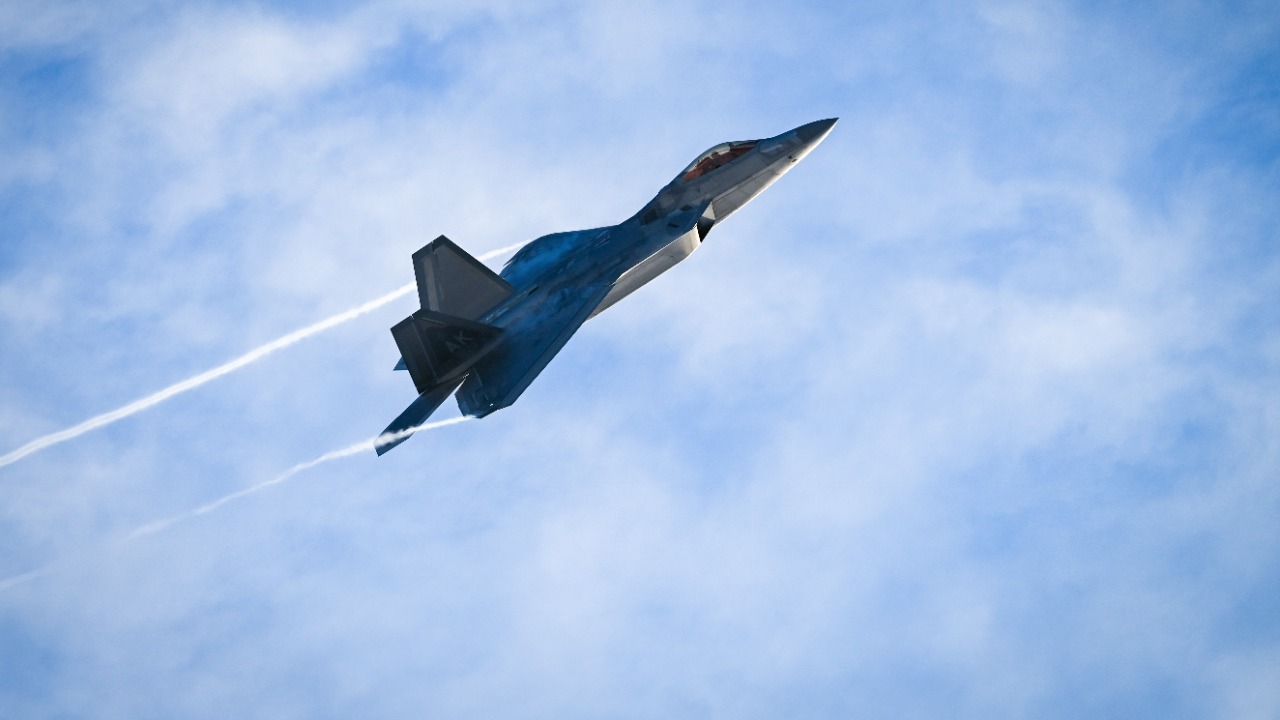

The F-22 Raptor arrived as the first operational fifth generation fighter and quickly became the benchmark for air superiority, yet the United States is already charting its exit. The decision to wind down the fleet is less about weakness in the jet and more about cost, scale, and the race to field a new generation of aircraft that can survive against rapidly improving defenses. I see the story of the Raptor’s retirement as a case study in how even the most dominant platform can become a strategic dead end.
The world’s top fighter, built in tiny numbers
By almost any tactical measure, the F-22 Raptor still sits at the top of the food chain. Multiple analyses describe the Raptor as the world’s most dominant air superiority fighter, a jet that was designed to sweep the skies clear long before an enemy ever saw it on radar, and even now it is framed as the centerpiece of American air power in discussions of future conflicts. Video explainers underline that the F-22 Raptor is still the world’s most dominant air superiority fighter, even as they acknowledge that these same Raptors are heading to retirement, a tension that defines the current debate about the fleet.
The problem is that the United States never bought enough of them. Only 195 Raptors were ever built, far short of the original plans for a much larger force, and that tiny inventory has become incredibly expensive to maintain as the aircraft ages. Commentators who track the program point out that high performance comes at a high cost and that the small fleet size magnifies every maintenance bill and upgrade package. Even social media posts that celebrate the jet’s prowess note that the F22 is America’s air superiority fighter and that its exclusivity, America does not export it, has left the United States with a boutique capability that is hard to sustain at scale, a point echoed in one post that bluntly states “Its the” best in the world but hints at the limits of such a rare asset.
Cost, complexity and a software architecture stuck in time
Behind the glamour of stealth and supercruise, the Raptor is a maintenance and integration challenge. Analysts who have dug into the program argue that Because the software is not very modular or open, adding a new sensor requires a lot of extra work, and that For the F-22 to outperform jets that are coming online now, it would need repeated cycles of hardware and software modernization that are structurally harder to bolt onto its original architecture. That means every new radar mode, electronic warfare suite, or data link is more expensive and slower to field than it would be on a newer, more open system.
Operationally, the jet has also struggled with availability and sustainment. Contributors on forums such as Quora have highlighted that What are the issues with the F-22 Raptor and Why was it retired early are questions that often come back to maintenance intensity and the difficulty of keeping stealth coatings and complex systems at acceptable readiness rates. A separate Facebook discussion framed Why do advanced fighter jets like the F-22 become outdated so quickly in terms of how fast adversary systems evolve and how hard it is for a closed design to keep up, even as The US Air Force is not retiring the F-22 Raptor outright but instead is focusing on modernizing and managing its role. Put simply, the jet still dominates tactically, but its underlying design makes each incremental improvement disproportionately painful.
Budgets, bridges and the coming F-47 NGAD
Money and strategy are now pulling in the same direction. The Department of Defense has asked Congress for permission to retire 32 of its F-22 Raptors, focusing on older training and test jets, and officials have been explicit that the savings are intended to help pay for next generation platforms. As the Air Force tries to balance long term strategy with short term budgets, it plans to slice some F-22s from the already slender fleet to help pay for next generation platforms, a tradeoff critics captured in an opinion piece that opened with the phrase As the Air Force to underscore the service’s dilemma.
At the same time, the service is pouring money into upgrades for the Raptors that remain. Program documents show that F-22 Retirement in 2030 is described as Unlikely as USAF Looks to Spend $7.8 Billion on it before then, a figure that underscores how much capability the service still expects to squeeze out of the jet. Senior Air Force leaders have described the F-22 program now through 2030 as a bridge to the NGAD Fighter, and Several have said that investments like long range tanks and new sensors are meant to keep it relevant until that successor arrives, a view laid out in detail in one analysis of how the Senior Air Force sees the NGAD Fighter portfolio.
The bridge now has a name and a manufacturer. On March, President Donald Trump announced that the Air Force would move forward with development of the F-47, a sixth generation aircraft that will become the centerpiece of the Next Generation Air Dominance family, and that decision locked in the logic of treating the F-22 as a finite bridge. More recently, Boeing has said that the U.S. Air Force’s new F-47 Fighter has already entered production, a speedy turnaround that reinforces why planners are willing to start peeling away older Raptors now. In that context, the Raptor’s retirement is less a retreat than a reallocation toward a system designed from the ground up for contested skies filled with advanced surface to air missiles and rival stealth fighters like the J-20 and J-35.
Congress, NDAAs and a tug of war over timing
Even as the Air Force sketches out this transition, lawmakers have repeatedly slammed on the brakes. The FY23 NDAA stopped the Air Force from retiring those Block 20 F-22s through FY27, and a congressional staffer told Defense News that lawmakers wanted more data on how the service would modernize the entire fleet by 2029. A separate watchdog report noted that USAF failed to provide Congress with F-22 retirement data, with the GAO highlighting that Congress prohibits F-22 retirement until The US Air Force answers detailed questions about Block 20 aircraft squadron maintenance issues. That lack of transparency has hardened skepticism on Capitol Hill.
The pattern extends beyond the Raptor. Unpacking NDAA 2026 shows that Congress has moved to block USAF aircraft retirements and protect A-10, F-15E, KC-135 and RQ-4 fleets, a provision that reflects persistent scepticism about the service’s divest to invest strategy and its 2029 A-10 transition plan. Another defense policy bill has been described as a move in which Congress rescues F-22 Raptors, with language that in addition to preserving the F-22s (Lockheed Martin/Boeing F-22 Raptor) also imposes limits on other Air Force cuts and calls for a fighter inventory of at least 1,112 aircraft, a figure cited in defense coverage of the bill.
Public commentary has amplified that resistance. One widely shared argument urged that Congress should stop the Air Force from retiring F-22s, opening with the line Air Force tries to balance long term strategy with short term budgets, it risks hollowing out current combat power to pay for future systems. Another analysis summarized the situation under the heading Summary and Key Points and warned that the F-22 Raptor will be retired by the 2030s, describing how Described plans for the NGAD family have triggered concern that the F-22’s inevitable retirement could open a capability gap if the new jets slip. In that light, the fight over timing is not about nostalgia for a famous aircraft but about how much risk the United States is willing to accept in the near term.
More from Morning Overview