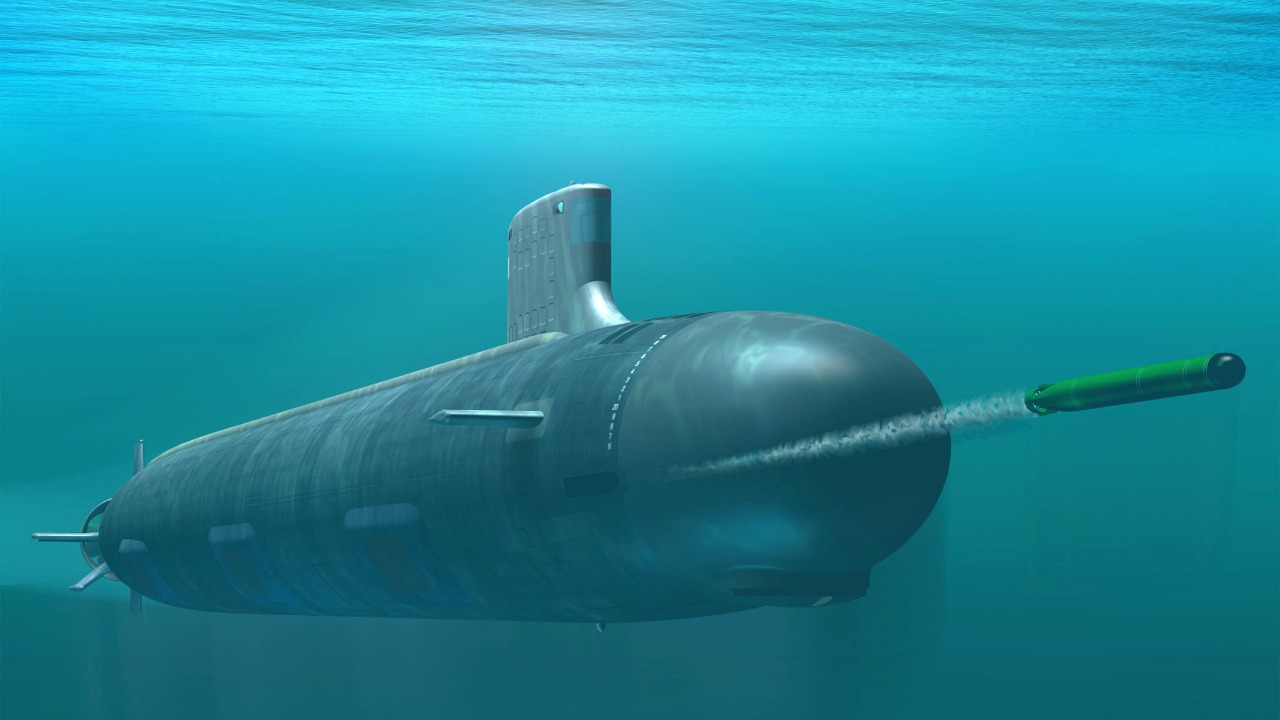

The U.S. Navy is trying to pull off a difficult trick: replace the retiring Ohio-class guided-missile submarines without losing the ability to unleash massive salvos of cruise missiles from the deep. The answer is the Virginia-class Block V, a fast-attack hull stretched and reworked to carry a payload that rivals the old missile “trucks” while remaining far harder to find. Instead of building a one-for-one clone of the Ohio SSGNs, the Navy is concentrating that firepower inside a stealthier, more flexible design that can hunt, spy, and strike in the same patrol.
That shift is not just about new hardware, it is about preserving deterrence in an era of great-power competition. By cramming Ohio-class levels of firepower into a Virginia hull, the Navy is betting that a smaller number of highly capable boats can hold targets at risk across the Pacific and beyond, even as adversaries invest heavily in anti-submarine warfare.
From cruise-missile “trucks” to stealthy predators
The starting point for understanding Block V is the looming retirement of the four converted Ohio-class guided-missile submarines, the USS Ohio, USS Georgia, USS Michigan and USS Florida. These SSGNs, originally built to carry ballistic missiles, were turned into platforms that can disgorge large salvos of Tomahawk cruise missiles, and they are slated to leave service between 2026 and 2028, taking with them nearly half of the Navy’s vertical launch payload capacity according to planners who track the SSGN force. Another assessment underscores that the SSGNs are the USS Ohio, USS Georgia, USS Michigan and USS Florida, heavily armed boats whose retirement will leave a gap that traditional attack submarines were never designed to fill, especially in terms of sheer missile volume carried in their vertical launch cells. I see the Block V effort as a direct response to that looming shortfall, not a luxury upgrade.
To mitigate the loss of these submarines, the Navy has initiated procurement of Block V Virginia-class submarines, a move that one detailed analysis describes as essential to avoid having undersea strike capacity “degraded for the foreseeable future” as the Ohio SSGNs age out of the fleet and new construction struggles to keep pace with demand for replacement hulls. A Congressional Research Service discussion captured in another report notes that The CRS highlighted how Building Virginia boats with the VPM is intended to compensate for a sharp loss in submarine force weapons capacity as the SSGNs retire, framing the Virginia Payload Module as a deliberate hedge against the retirement-driven dip in overall firepower. In my view, that makes Block V less an optional enhancement and more a strategic stopgap that has to work on the first try.
How the Virginia Payload Module rewrites the hull
The centerpiece of Block V is the Virginia Payload Module, a new 83-foot hull section inserted amidships that triples the submarine’s Tomahawk cruise missile capacity and creates room for future payloads such as large unmanned undersea vehicles, according to a technical breakdown that describes the 83-foot plug. Another source explains that The VPM consists of four large-diameter payload tubes, and taken together, these tubes allow Block V submarines to carry up to forty additional Tomahawk cruise missiles or other payloads that can be launched from beneath the ocean’s surface, turning the midsection of the boat into a kind of modular weapons bay that can be reconfigured as new systems are fielded through The VPM. I read that as a deliberate attempt to future proof the design, so the hull can evolve without another major structural change.
Earlier program descriptions note that The VPM submarines will have an additional (approximately 84 feet) section with four additional Virginia Payload Tubes, each of which can carry multiple missiles and is sized to handle new payloads as they emerge, a configuration that dramatically increases the number of weapons that can be fired in a single salvo from the 84 foot section. The Navy’s own fact file adds that the new bow also replaces the 12 individual Vertical Launch System (VLS) tubes with two large diameter 87-inch Virginia Payload Tu, a shift that simplifies the forward launch arrangement and aligns it with the larger-diameter tubes in the VPM for 87-inch compatibility. Taken together, these changes mean Block V is not just a stretched Virginia, it is a re-architected weapons carrier that uses every inch of added volume for combat power.
Matching Ohio-class firepower in a smaller package
Block V Virginia-class Submarines are described as the most heavily armed of the series to date, thanks to the extensive missile capacity added by the Virginia Payload Module and other modifications that distinguish these boats from earlier Block V Virginia. One video explainer notes that in the past, a Virginia-class sub could carry about 12 Tomahawk cruise missiles, a respectable amount of firepower for a fast-attack boat, but with the new payload section that number climbs dramatically, turning each hull into a hybrid between a hunter-killer and a Tomahawk magazine. Another segment highlights that some Block V Virginia-class boats will be able to carry 40 Tomahawks on one submarine, a figure that illustrates how much additional strike capacity is being squeezed into the 40 missile loadout. In my judgment, that is the core of the “Ohio firepower in a smaller hull” argument.
Program advocates go further, projecting that across the class, Navy New Block Virginia Class Submarines Will Unleash 400 Tomahawks when fully fielded, a fleet-wide figure that underscores how the cumulative effect of each hull’s expanded capacity can offset the retirement of the four heavily armed SSGN guided missile submarines that once carried a disproportionate share of the 400 Tomahawks. A separate analysis of the Ohio-class transition notes that the concern for military planners is that the four SSGNs currently make up nearly half of the vertical launch payload capacity of the submarine force, and that new construction, including the Virginia Block V, is also running behind schedule, which raises the stakes for getting these replacement shooters into the water. I see that tension between ambitious firepower goals and industrial reality as one of the defining challenges of the program.
Stealth, mission focus and the China problem
Firepower alone does not explain why Block V matters so much in the current strategic environment. One detailed assessment describes how the U.S. Navy’s Block V Virginia Class Submarine Is a Real Apex Predator China Fears, emphasizing that the combination of advanced sensors, quieting, and the VPM’s missile load gives these boats the ability to threaten high-value targets and surface groups in contested waters for decades to come, especially in the Western Pacific where Chinese anti-access systems are densest and undersea access is at a premium. Another focused look at the mission set notes that Summary and Key Points highlight how The Block Virginia submarines are optimized to counter advanced adversary submarines such as Type 039C Yuan-class submarines, while also providing land-attack options that give commanders flexibility in a crisis involving Chinese undersea forces. In my reading, that dual focus on anti-submarine warfare and strike is what makes Block V central to any Indo-Pacific war plan.
At the same time, the Virginia-class program remains the central element of U.S. attack submarine construction, and recent negotiations for 10 new Block VI Virginia-class and 5 Columbia-class submarines underscore that The Virginia line, including future Block VI, is expected to deliver improved acoustic performance and other enhancements while keeping costs under control compared to earlier variants by about 10 percent, according to planning documents that describe the Block VI trajectory. Another overview of the class stresses that America’s Virginia submarines are the backbone of U.S. undersea power, and that the Dec Block Virginia boats with expanded missile capacity will be central to maintaining that edge as rivals invest in their own quiet America attack subs. I see Block V as the bridge between today’s fleet and that future Block VI force, carrying Ohio-class firepower into a new era of stealthy, multi-mission undersea warfare.
More from Morning Overview