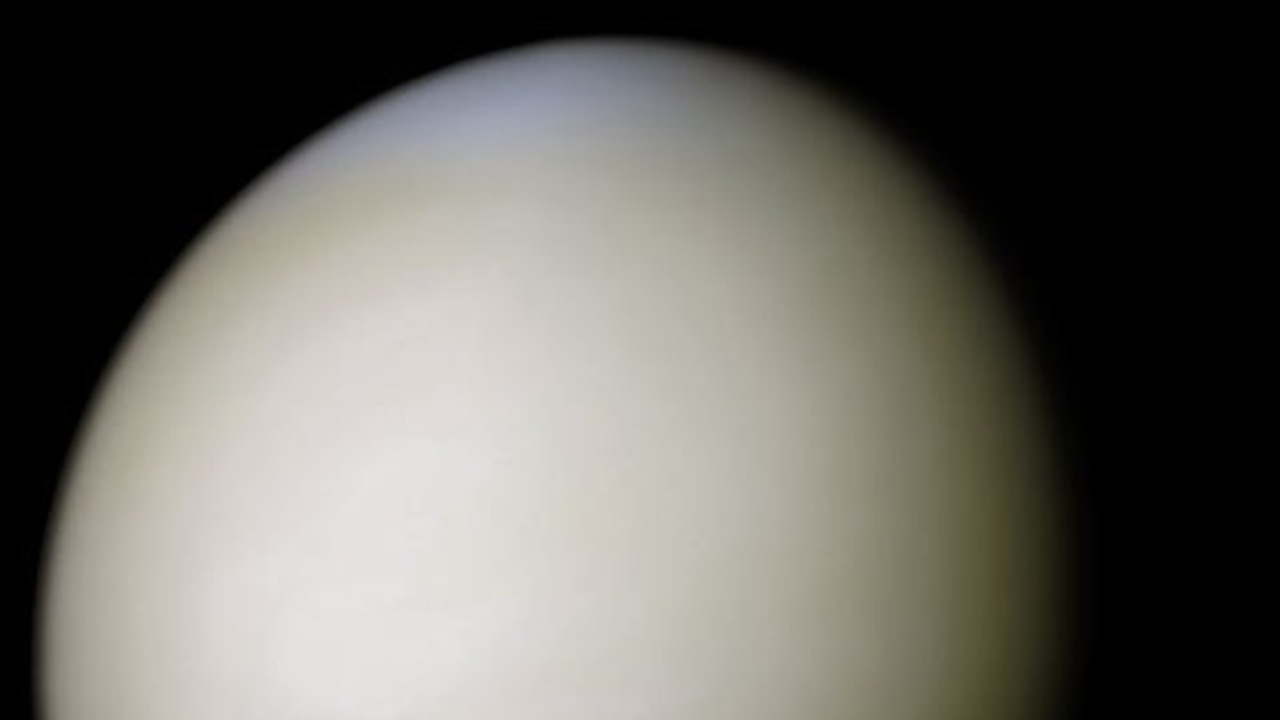

Venus looks like Earth’s twin at first glance, yet its rotation behaves like a cosmic prank. The planet spins backward, crawls through a day that outlasts its year, and even changes its spin rate in ways that leave models struggling to keep up. Astronomers can describe what Venus is doing in exquisite detail, but the deeper question of why it ended up with such a bizarre spin remains wide open.
That mystery reaches back to the birth of the Solar System roughly 4.5 billion years ago, when collisions, tides, and atmospheric forces were sculpting every planet’s motion. Venus seems to have taken an especially chaotic path, and its strange rotation is now a key test for ideas about how worlds form, evolve, and maybe even host life.
What makes Venus’s spin so strange
Most planets in our Solar System rotate counterclockwise when viewed from above the north pole, but Venus goes the other way. It spins clockwise, a so called retrograde rotation that makes the sun appear to rise in the west and set in the east on the Venusian sky, the opposite of what we see on Earth, as described in analyses of Earth and its neighbor. Detailed comparisons show that on Venus the sun rises in the west because the planet rotates in the opposite direction from most others, including Earth, a fact that has become shorthand for just how odd this world is.
The weirdness does not stop with direction. One full spin of Venus takes about 243 Earth days, while its trip around the Sun lasts about 224 Earth days, so a single day is longer than a year, a point that space enthusiasts underline with a simple “Yes” when explaining the numbers. Guides to the inner planets note that Venus spins clockwise on its axis while Almost all other major bodies in the Solar System spin anti clockwise and orbit the Sun in the same general sense, which makes Venus and Uranus the only planets that buck the usual pattern in this way, according to reference material on Solar System dynamics.
How astronomers figured out the backward rotation
Because Venus is wrapped in thick clouds, its surface does not reveal its spin the way Mars or the Moon do. Astronomers had to infer the rotation using radar and radio techniques, bouncing signals off the planet from Earth and tracking how the echoes shifted, a strategy summarized in discussions of Astronomers using both Venus and Earth based observatories. That work showed that the planet’s surface features drift in the opposite direction from what a prograde spin would produce, confirming the Reverse sense of rotation.
More recently, teams have used powerful radio dishes to treat Venus like a giant reflector, sending waves that bounce off its landscape like light off a disco ball and timing the returning flashes to pin down the spin rate. In one campaign, the waves bounced back off Venus in a pattern that allowed researchers to track tiny changes in rotation and even map subtle topographic features, an approach likened to turning the planet into a disco ball for science. That same technique revealed that Venus is spinning even slower than earlier estimates suggested, a result that came from a European space probe and follow up radar work and left researchers describing the planet as a Planet that refuses to match predictions.
Competing theories for a flipped world
Explaining how Venus ended up spinning backward has become a kind of stress test for planetary formation theories. One school of thought argues that a giant impact early in Solar System history could have knocked the planet over or reversed its spin, in the same violent era when worlds were ricocheting around the Sun like ball bearings on a pinball table, an image used in work that notes Venus has long puzzled astronomers and suggests that Again a giant collision could be the answer, as outlined in studies of Venus and its neighbors. A newer twist on that idea proposes that an ancient moon once orbited Venus and eventually spiraled inward, with its final collision powerful enough to flip the planet’s rotation, a scenario that has been popularized in explanations that say Venus spins differently than other planets and that They think an old moon with a bizarre orbit may be to blame for the odd spin, as described in coverage of a Venus focused model.
Researchers who developed the renegade moon hypothesis argue that such a satellite could have formed from debris and then destabilized, eventually crashing into the planet and reversing its spin, a possibility that has been discussed by Louis, who notes that They do offer an explanation for Venus but that other scenarios, such as a direct hit from a large object early in the Solar System’s history, remain viable, according to reporting on They. Another line of work asks whether the rotation axis itself might have switched over time, with models exploring what it would take For the axis of Venus to flip under the combined influence of gravitational tides and internal dynamics, a question raised in theoretical studies of Correia and colleagues. None of these ideas has yet delivered a definitive answer, which is why I see Venus as a kind of forensic puzzle from the era when the Solar System was only about 4.5 billion years younger than it is today, a time that popular explainers sometimes evoke with a wry “I remember it like it was 4.5 billion years ago.”
Atmospheric tides, super rotation and a slowing day
Even if a collision or axis flip set Venus on its retrograde path, the planet’s present day spin is being sculpted by its atmosphere. The world is wrapped in a dense blanket of gas that drives powerful thermal tides, and detailed models of Venus like planets show that When a planet has an atmosphere, thermal tides can excite the spin inclination to high values and even push the rotation toward slow or retrograde states, a mechanism explored in simulations of When gravitational and thermal tides interact. Observations show that Venus rotates around the Sun in an orbit that is among the most circular of any major planet, yet its atmosphere may be exerting enough torque to alter the spin rate over time, an idea that has been raised in discussions of how the Venusian atmosphere could even make the planet turn in the other direction, as summarized in technical notes on Venus and its orbit around the Sun compared to Earth.
At the same time, the atmosphere itself behaves in a way that seems to ignore the sluggish surface. High above the clouds, winds whip around the planet in just a few Earth days, a phenomenon known as atmospheric super rotation that is seen not just on Venus but also on Saturn’s largest moon Titan, as described in research that calls this a mysterious phenomenon of Venus and Titan. A new study of spacecraft data concludes that a daily thermal tide created by the Sun is a key driver of these super fast winds, with Scientists pointing to heating patterns between about 48 and 70 kilometers altitude as the engine that keeps the atmosphere racing, a result highlighted in an analysis of how the Sun powers Venus’s super rotation. That same coupling between sunlight, air and spin may be feeding back on the solid planet, helping to explain why radar campaigns and a European orbiter found that Venus is spinning slower than expected, a discrepancy that left mission teams frankly stumped.
More from Morning Overview