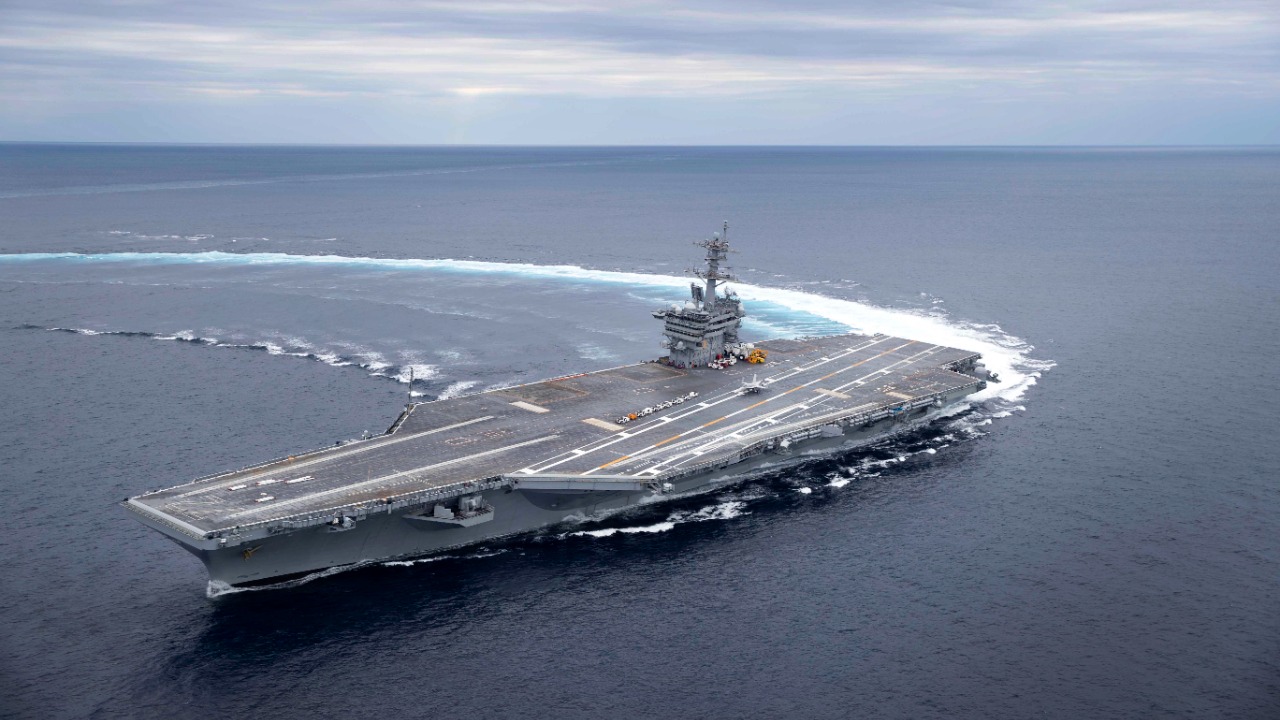

The United States has quietly assembled one of its most formidable naval and air packages in years around Iran, giving the White House a credible option to launch large-scale strikes on short notice. The deployment centers on a carrier strike group, long-range bombers, and regional bases that together can hit Iranian targets across the Gulf and deep inland.
What has changed in recent days is not just the size of the force, but the way President Donald Trump is openly pairing it with explicit threats over Tehran’s nuclear program. The posture now looks less like routine deterrence and more like a fully loaded spring, ready to be released if diplomacy fails.
The carrier at the heart of the build‑up
The clearest signal of U.S. intent is the arrival of a full carrier strike group in the Gulf region, led by the USS Abraham Lincoln. The Aircraft Carrier Arrives in the Middle East with its air wing of strike fighters and support aircraft, a visible reminder that Washington can project power from the sea without relying on any single host nation. The U.S. Navy has highlighted imagery of a Boeing aircraft operating from the deck, underscoring that the Navy and its aviation arm, the Navy and Boe partnership, are now fully in theater. Analysts note that this is part of a broader pattern of deployments that, taken together, amount to the largest U.S. military buildup in the region since the June 2025 strikes on Iran.
Reporting on the carrier’s movement indicates that the USS Abraham Lincoln has crossed into the area of responsibility of U.S. Central Command, bringing with it cruisers, destroyers, and embarked MH‑60R/S helicopters as part of a complete USS Abraham Lincoln strike group. Separate accounts describe how the group entered the broader Middle East region after transiting key chokepoints, a move that regional observers see as a direct response to Iranian actions and rhetoric. One detailed analysis of the standoff notes that, on January 26, 2026, the Navy’s USS Abraham Lincoln carrier strike group entered the Middle East, marking a new and more dangerous phase in the U.S.–Iran confrontation and raising the risk that any miscalculation could be interpreted as an On January act of full‑scale war.
From deterrence to a strike‑ready posture
What makes this deployment different from previous cycles is the way it is nested inside a wider regional surge. A detailed Strategic Context review describes how the United States has been steadily moving air and naval assets into position across the Gulf, building on the precedent of Operation Midnight Hammer and the June 2025 strikes. That report’s Executive Summary stresses that The United States is now conducting its largest military buildup in the Middle East since those earlier attacks, with additional fighter squadrons, air defense units, and logistics hubs reinforcing the carrier group’s punch. In practical terms, that means Washington can sustain high‑tempo operations against Iranian targets for days or weeks, not just a single night of cruise‑missile salvos.
Officials and experts quoted in regional assessments argue that the current force mix is designed to be flexible enough for anything from limited strikes on nuclear facilities to broader attacks on command, control, and missile infrastructure. One section of the same analysis notes that the regime’s response has been to disperse assets and test air defenses, but also concedes that there has not been such a gap in conventional capabilities between the sides since October 2023, a point underscored in the The regime’s response section. Another set of regional specialists, cited in a separate policy review, go further and say the overall force posture suggests strikes are likely, arguing that the combination of airpower, naval presence, and reinforced missile defense in the region introduces a sharp element of time pressure, a view captured in the Other commentary.
Trump’s ‘massive Armada’ and the nuclear ultimatum
President Trump has chosen to describe this buildup in unusually blunt terms, publicly calling it a “massive Armada” heading toward Iran and warning that time is running out for a new nuclear deal. In a social media post highlighted by one account, Trump said the Armada was moving toward Iran and that Tehran had limited time to reach an agreement, a message that was amplified in coverage of his Trump warning. A longer narrative of the standoff notes that, last June, after indirect nuclear negotiations collapsed, the United States joined Israel in a 12‑day war with Iran, bombing three nuclear sites and a range of military targets, a sequence that now hangs over the current crisis as a very recent precedent, as detailed in the Last June account.
Trump has framed the choice for Tehran in stark terms, telling Iran it can either negotiate “a fair and equitable deal” or face an attack that would be “far worse” than previous strikes. One report on his latest remarks quotes him warning that fears of US attack are justified and that Tehran should take seriously the prospect of an armada‑backed assault, a sentiment captured in coverage of how Fears of US attack rise. Another detailed feature on the nuclear standoff explains that Trump has repeatedly tied the naval deployment to his demand that Iran accept tighter limits on enrichment and inspections, presenting the “massive Armada” as both a negotiating tool and a ready instrument of force, a linkage explored in the broader Trump narrative.
Exercises, airpower and the regional chessboard
Beyond the carrier itself, the Pentagon has announced multi‑day aerial drills across the region, exercises that Trump has also described as part of his armada. The maneuvers are to be led by the USS Abraham Lincoln and involve U.S. and partner aircraft flying complex strike and air‑defense profiles over key waterways and desert ranges, according to officials who outlined the multi‑day plan. A more detailed description of the same drills notes that the Exercises have been framed by President Trump as a clear message to Tehran, with Central Command stressing that the USS Abraham Lincoln will serve as the centerpiece of the aerial campaign, a point reinforced in reporting by Exercises correspondent Andrew Roth.
At the same time, U.S. officials have quietly moved additional assets into the broader Middle East theater, including long‑range bombers and support aircraft that can operate from regional bases or from the carrier deck. A comprehensive Executive Summary of the buildup notes that The United States has been flowing forces into position across the Gulf, reinforcing airfields and logistics hubs to support sustained operations, a trend captured in the Executive Summary section. Another regional analysis points out that the USS Abraham Lincoln carrier strike group’s entry into the Middle East has already altered the strategic balance, with one assessment warning that the standoff has entered a dangerous phase in which any misstep around the carrier could be seen as a trigger for escalation, a concern echoed in the Abraham Lincoln analysis.
Iran’s response and the risk of miscalculation
Tehran has not taken these moves quietly. Iranian officials have publicly rejected Trump’s threats and insisted that the country is ready to respond to any U.S. attack, with state media amplifying images of anti‑American posters and Iranian flags in TEHRAN, IRAN as crowds rally against the possibility of intervention, scenes described in coverage datelined TEHRAN, IRAN in JANUARY. Another report quotes Iranian officials saying they are prepared for a confrontation and that any strike on their nuclear program would be met with retaliation across the region, a warning that frames Trump’s threats of a major new strike on Iran’s nuclear facilities as a high‑stakes gamble, as outlined in the broader threats analysis.
More from Morning Overview