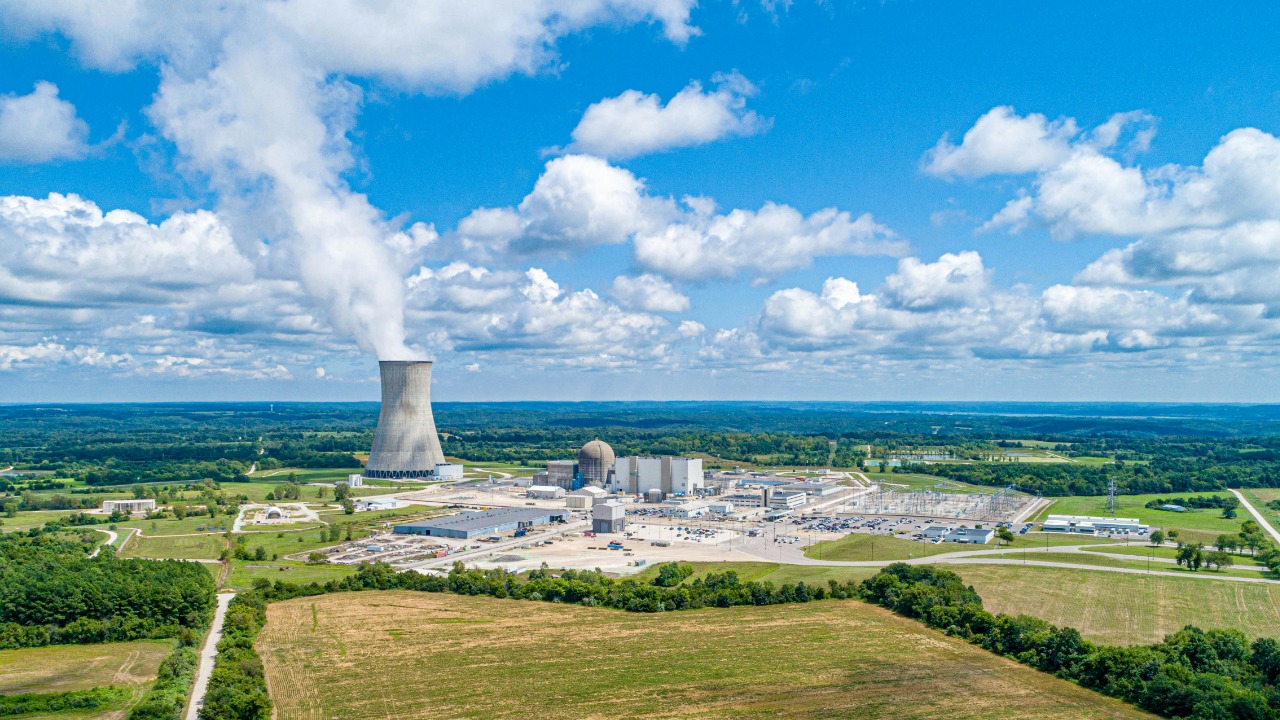

The United States is about to ship some of the world’s most closely watched nuclear fuel to a private company, a move that could shape the next generation of reactors. With federal backing, Kairos Power will receive highly concentrated uranium for its Hermes demonstration reactor in Tennessee, a project designed to prove that advanced nuclear can be safer, more flexible, and easier to build than the large plants of the past.
The allocation of this ultra concentrated fuel, known as HALEU, gives the Hermes project a clear path from construction site to first criticality. It also signals that the Federal government is prepared to use its own uranium stockpiles to jump start a commercial market for advanced reactor fuel that does not yet exist at scale.
What HALEU means for the Hermes reactor
The core of the story is the decision by the Department of Energy to Provide HALEU for the Hermes Demonstration Reactor, giving Kairos Power access to fuel that is richer in the fissile isotope uranium 235 than standard commercial reactor fuel. HALEU, or high assay low enriched uranium, is typically enriched to between 5 and 20 percent, below weapons grade but far above the fuel used in today’s large light water reactors. That higher concentration allows advanced designs like Hermes to run compact cores at high temperatures while maintaining strong safety margins.
Federal officials have framed the allocation as a strategic use of government-controlled material to support a first-of-a-kind system rather than a one-off favor. In a formal FOR IMMEDIATE RELEASE, the DEPARTMENT of ENERGY described the HALEU support as a way to de risk early deployment of advanced reactors that cannot operate on the lower assay fuel used in older plants. For Hermes, that means the demonstration will not be stranded by the absence of a commercial HALEU supply chain, a risk that has loomed over many Generation IV projects.
A US firm steps into the HALEU spotlight
For Kairos Power, the fuel deal is more than a technical milestone, it is a validation of its business model as a mission driven nuclear technology, engineering, and manufacturing company focused on commercializing advanced reactors. The company has emphasized that the Federal partnership on enriched uranium gives it a reliable path to operate Hermes and then iterate toward follow on units. A separate statement highlighted Kairos Power’s role as a mission-driven firm that intends to move quickly from demonstration to commercial deployment.
Reporting on the fuel allocation has underscored that the Federal government will send Kairos Power enriched uranium that is lower than weapons grade but significantly more concentrated than conventional reactor fuel. Local coverage described how the Federal government is drawing on material that was not originally produced for advanced reactors, repurposing it to support Hermes and related projects rather than older classes of commercial reactors.
Inside the Hermes design and its Tennessee footprint
Hermes itself is a relatively small unit, described as a 35-MWt nonpower Hermes demonstration reactor that will not generate electricity for the grid. Instead, it is intended to validate the core technology and operating methods of the Kairos Power design. According to technical descriptions, the 35-MWt system will sit in Oak Ridge, Tenn., where it can be closely coordinated with regulators and national lab expertise, and it is scheduled to be operational in 2026 if construction and fuel delivery stay on track, as outlined in material on Hermes technology.
Kairos Power has already begun building out the site, describing how Hermes Low, Power Demonstration Reactor Construction Is Underway in Oak Ridge after the company selected the East Tennessee Te region as its hub. The Tennessee project page explains that Hermes Low Power Demonstration Reactor Construction Is Underway in Oak Ridge and that local partnerships will enable the Hermes project, tying the fuel story directly to a physical build in the United States rather than a paper design.
Regulatory green lights and construction progress
The fuel allocation comes after a series of regulatory and construction milestones that have moved Hermes from concept to concrete. The NRC approved the first construction permit application for a Generation IV reactor, clearing Hermes to proceed under the oversight of the Office of Nuclear Energy and setting a precedent for future advanced designs. That decision, detailed in an NRC summary, signaled that regulators are willing to engage with nontraditional reactor types that use different coolants, fuels, and safety philosophies.
Following that approval, Kairos Power started construction on one of the first advanced reactors in the United States, with an Architect rendering of the Hermes Low-Power Demonstration Reactor facility illustrating the compact footprint and modular layout. Federal energy officials have highlighted that Kairos Power has started construction on one of the first advanced reactors in the United States and that the facility in Oak Ridge, Tennessee is expected to support broader deployment in 2027 and beyond.
Fuel fabrication, TRISO pebbles, and the HALEU supply chain
Hermes will not simply load conventional fuel rods into its core. Kairos Power plans to use HALEU in the form of TRISO based pebbles, a fuel type in which tiny uranium kernels are encased in multiple layers of ceramic and carbon to create robust particles that can withstand high temperatures. The company has described how its Los Alamos Low, Enriched Fuel Fabrication Facility Our next step will be manufacturing HALEU annular TRISO pebbles in a fuel fabrication line, with the Los Alamos Low Enriched Fuel Fabrication Facility Our next step will be manufacturing HALEU annular TRISO pebbles in a dedicated facility.
That fuel development program is central to the company’s iterative approach, which envisions a sequence of test reactors and manufacturing upgrades rather than a single leap to a full commercial plant. Earlier technical material explained that Hermes will use TRISO fuel in a 35-MWt configuration and that Kairos Power has been working with the Nuclear Regulatory Commission on the licensing of this fuel form, as noted in the description of TRISO fuel for the demo reactor.
More from Morning Overview