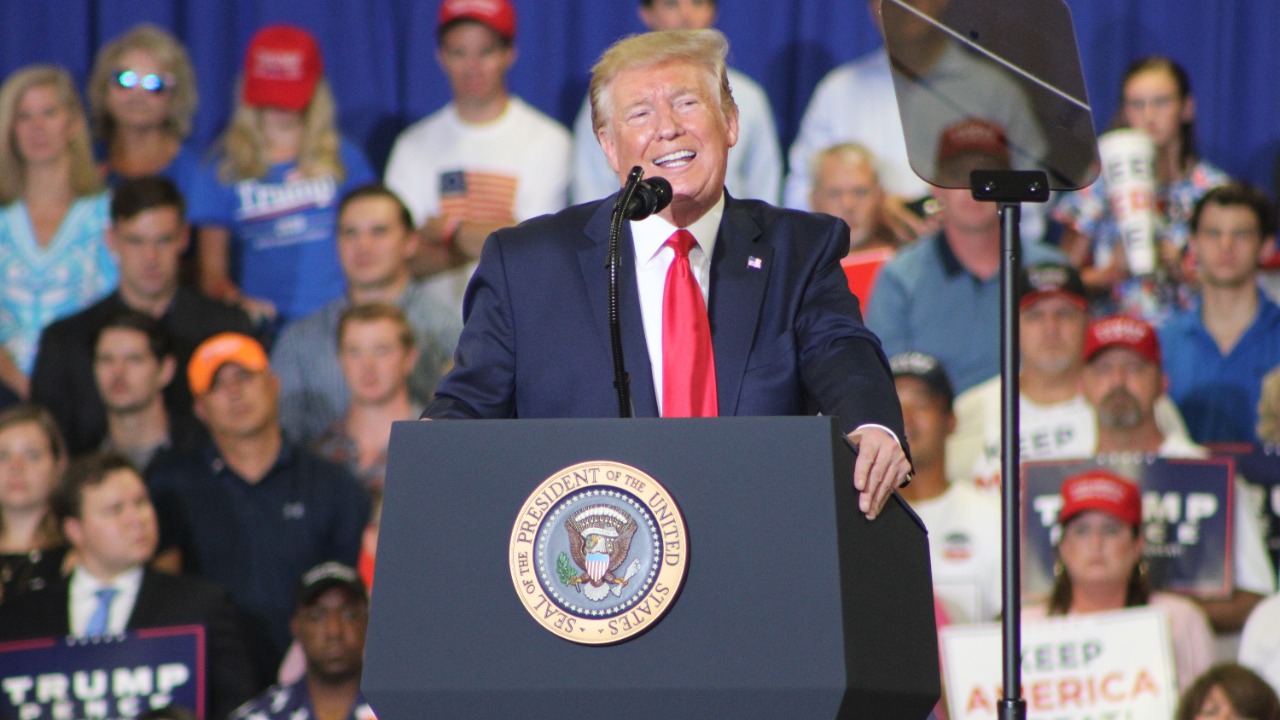

President Donald Trump is suddenly talking about Chinese electric vehicles less as an existential threat and more as a bargaining chip. In Detroit, he signaled that Chinese brands might be welcome in the United States if they play by his rules, even as his administration keeps tariffs high and funding fights alive. I see a White House trying to turn a hard-line stance into leverage, not retreat, and the global EV industry is already adjusting.
From tariff wall to conditional welcome
Trump’s latest remarks mark a shift from a simple “keep them out” message to a more transactional offer: Chinese automakers can access the American consumer if they bring factories, jobs, and technology to U.S. soil. At the Detroit Economic Club, where President Donald Trump addressed executives in Detroit, Michigan, he framed Chinese EV makers less as pariahs and more as potential investors that could be pressed into building plants and hiring American workers if they want access to the market, a stance that aligns with a broader White House signal that Chinese brands might be allowed in under strict conditions that protect domestic industry and national security, as described in a detailed account of the Detroit Economic Club event.
That conditional welcome sits on top of a very real barrier. The Trump administration has imposed a 100% tariff on all Chinese imports, including cars, which is why a leading Chinese brand like BYD remains effectively locked out of U.S. showrooms even as it sells aggressively elsewhere, a reality spelled out in a consumer-focused explanation of Why BYD’s EVs are unlikely to show up in the United States anytime soon. Trump’s message, in other words, is not that the wall is coming down, but that he is willing to build a gate for those Chinese EV Makers that agree to his terms.
Detroit speech crystallizes the new line
The pivot came into sharp focus during Trump’s appearance at the Detroit Economic Club, where he blended familiar tariff threats with a new openness to Chinese investment. In that room, packed with auto executives and suppliers, he argued that his trade pressure had given Washington leverage to demand local production from foreign brands, and he suggested that Chinese automakers could be part of that story if they committed to building in America, a message that echoed through coverage of his Detroit remarks and the broader debate over how tariffs and regulations are reshaping the market Among US automakers.
Legal and policy analysts quickly picked up on that nuance. One automotive-focused briefing noted that in remarks at a January 13 meeting of the Detroit Economic Club, President Trump repeated his openness to allowing Chinese automakers into the United States if they invest locally, while still portraying them as a competitive threat for the U.S. auto sector, a tension that was highlighted in a Foley Automotive Update. In a separate account of the same Detroit appearance, commentators described how Trump’s rhetoric on tariffs, fuel economy rules, and foreign competition is now being heard by an industry that knows Chinese EVs are coming to neighboring markets even if the U.S. border stays formally closed.
“If they build in America”: the fine print
Trump’s openness is not abstract, it is tied to a specific condition: build factories in the United States. In one widely circulated summary of his comments, Trump Signals Openness to Chinese EV Makers, If They Build in America, with a Clear Message that any Chinese brand wanting access must make “tangible investment on U.S. soil,” a phrase that captures how he is trying to turn foreign interest into domestic capital spending and jobs, as laid out in a detailed blog on Trump Signals Openness. The logic is straightforward: keep the 100% tariff as a stick, offer market access as a carrot, and insist that any Chinese EV plant look and feel like a traditional American manufacturing investment.
That approach fits with Trump’s broader trade posture, which still leans heavily on tariffs even as he entertains targeted relief. Reporting on internal deliberations has described how Trump, Donald Trump, is mulling cuts in tariffs on some Chinese auto parts to ease pressure on U.S. manufacturers that rely on imported components, even while he keeps his protectionist stance front and center, a balancing act captured in coverage of how Trump mulls tariff changes on Chinese auto parts. The message to Chinese EV Makers is clear: there may be room to negotiate, but only within a framework that keeps Trump’s leverage intact.
Global pressure builds as neighbors move first
While Trump talks about conditional access, other countries are already opening their doors to Chinese EVs, raising the stakes for U.S. policy. Argentina has just welcomed its first shipload of Chinese electric vehicles, a milestone that unfolded even as As Trump talked tariffs and industrial policy, highlighting how Latin American markets are embracing lower cost Chinese models that American consumers cannot buy, a contrast detailed in coverage of how As Trump talks tariffs, Argentina moves ahead. Analysts at the National University of San Martin have warned that this could accelerate a regional realignment in which Chinese brands gain scale and influence just outside the U.S. market.
The pressure is even closer to home in Canada. Canada PM Carney has agreed to allow 49,000 Chinese EVs into Canada at a 15 percent tariff, down from 100 percent, a decision framed as a way to make vehicles more affordable but one that drew a sharp response from Washington, which warned that Canada will regret the move and hinted at potential spillover effects for cross-border supply chains, as reported in a detailed account of the Canada decision. For Trump, the sight of Chinese EVs selling in Toronto and Buenos Aires while remaining blocked in the United States could either reinforce his argument that tariffs are needed, or strengthen the case for his new conditional opening so American workers can capture some of that investment.
Domestic contradictions: funding fights and consumer demand
Trump’s evolving stance on Chinese EVs is colliding with his administration’s record on EV infrastructure and consumer policy. A federal judge has just found that the Trump administration unlawfully froze electric vehicle infrastructure funding and ordered it to reinstate $5 billion in EV infrastructure funding that had been withheld between 2022 and 2026, a ruling that underscores how legal challenges are forcing the White House to support the charging network that both domestic and foreign EVs will eventually rely on, as reported by Monique Merrill in a detailed account of how a court order requires the Trump administration to restore funding. That decision complicates any attempt to slow the EV transition while simultaneously courting Chinese investment, because it locks in public support for the very market Trump is trying to shape through tariffs.
At the same time, consumer interest is not waiting for policy to settle. Analysts have noted that for 2026, at least one major EV maker has set a target of 1.6 m international deliveries, a figure that illustrates how global demand is surging even as U.S. rules and tariffs remain in flux, a trend highlighted in a financial analysis that credits Trump’s trade moves with accelerating some of Elon Musk’s warnings about Chinese competition, as described in a report that notes the 1.6 m target. In Detroit, commentators have also pointed out that Among US consumers, interest in hybrid vehicles continues to grow, suggesting that buyers are looking for lower fuel costs and new technology even if they are not yet ready to jump straight into a Chinese-branded EV.
More from Morning Overview