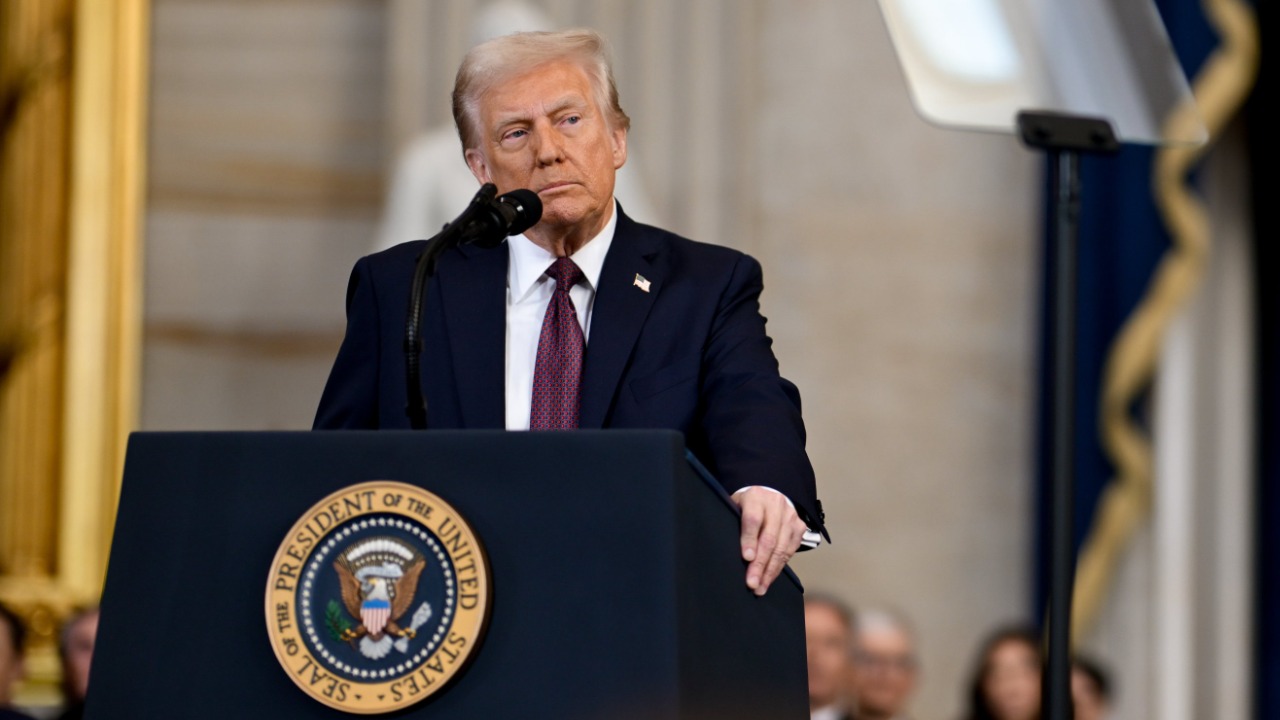

President Donald Trump has again claimed that China does not generate any wind power, turning a complex global energy story into a simple, and simply wrong, talking point. His insistence that the world’s second‑largest economy has “no windmills” collides with years of data showing China as a dominant force in wind energy and a central player in the clean‑tech supply chain. The gap between his rhetoric and the record is not just a factual error, it is a window into how energy politics, climate policy and geopolitical rivalry are being folded into a single, misleading narrative.
Trump’s latest remarks build on a long pattern of attacks on wind power and on China’s role in the energy transition. I want to unpack what he said, what the numbers show about China’s wind sector, and why this particular falsehood keeps resurfacing even as turbines continue to rise across Chinese provinces and along its coasts.
Trump’s sweeping claim and his long war on wind
Trump’s newest assertion that China produces no wind energy came as part of a broader tirade in which he portrayed wind turbines as ugly, unreliable and economically foolish. In his telling, China supposedly manufactures turbines only to ship them abroad, leaving its own landscape untouched by the machines he derides. That line reprises language he has used before, including his complaint that “They make them and sell them to suckers like Europe. And suckers like the United States before. They are the worst form of energy,” a flourish that casts wind as a scam foisted on the West while China laughs from the sidelines, a framing documented in recent fact‑checks.
His hostility to wind power is not new. Earlier coverage of a meeting with top U.S. oil executives described how, During the session, Trump again dismissed wind as an expensive failure and insisted that China had no windmills at all, a claim that one analysis noted “contradicts the facts” about the country’s energy mix and its status as a global leader in turbine deployment, as detailed in energy‑sector reporting. His rhetoric has also featured lurid, unsubstantiated claims about health effects and property values, part of a broader pattern in which he has told his Cabinet that wind is an “expensive” and unreliable source of electricity, a characterization that prompted a detailed review of the underlying facts on wind.
What the data show about China’s wind sector
The factual record on China’s wind industry is not ambiguous. China has spent years building one of the world’s largest fleets of turbines, onshore and offshore, as part of a broader push to cut air pollution and reduce reliance on coal. A global review of installed capacity found that China accounts for about 44% of the world’s wind farm capacity, ranking No. 1 globally and nearly tripling the capacity of the United States. That figure alone demolishes any suggestion that China has “very, very few” wind farms, a phrase Trump has used in the past, and it certainly leaves no room for the idea that the country has none at all.
China’s role is not limited to domestic deployment. It is also a manufacturing powerhouse for turbines and components, exporting equipment even as it continues to build out its own grid‑connected projects. When Trump paints a picture of a country that only sells hardware abroad, he ignores the reality that Chinese planners have integrated wind into national climate and energy strategies, a point underscored by Beijing’s public climate goals and the prominence of wind in its official energy plans, which are reflected in international profiles of China as a leading emitter and clean‑energy investor. Analysts who track the sector describe China’s wind industry as among the strongest in the world, a characterization echoed in coverage that notes how data show it has the world’s strongest wind sector despite Trump’s insistence to the contrary.
A pattern of repetition despite mounting rebuttals
Trump’s latest comments do not exist in isolation. Earlier this year, he told supporters that China “doesn’t have any windmills,” a line that quickly drew scrutiny from energy experts and fact‑checkers who pointed to satellite images, capacity statistics and corporate disclosures that all show extensive Chinese wind development. One detailed review of his remarks noted that he has made this “shockingly false” claim before, including during a high‑profile address to the United Nations, and that he has repeatedly tried to contrast a supposedly wind‑free China with Western countries he portrays as dupes, a pattern captured in coverage of how Trump moved from attacking Chinese exports to asserting that Beijing barely uses turbines at home.
Chinese media and officials have not let those claims pass unchallenged. A widely shared segment from a European arm of Chinese state media described how U.S. President Donald Trump’s recent claims about China’s wind power were “widely fact‑checked and dismissed as ‘lies’ by Chin,” highlighting how the narrative has become a flashpoint in the information war over climate and energy policy, as seen in a video that framed President Donald Trump’s remarks as part of a broader clash over climate goals. Social media users have also been quick to respond, with one widely circulated post mocking his claim by noting that Trump has “never seen a wind farm in China” because he ignores information that contradicts his worldview, a reaction captured in coverage of instant online fact‑checks.
How China’s climate posture undercuts Trump’s narrative
Trump’s insistence that China does not use wind power also runs headlong into Beijing’s own climate messaging. At a major United Nations summit in New York, Xi Jinping used his speech to emphasize China’s “rising determination” to curb pollution and expand clean energy, a message that stood in stark contrast to Trump’s appearance on the same stage, where he had attacked Chinese exports of “pathetic” wind turbines and cast climate action as a “scam,” a clash described in accounts of how Trump questioned why China would build turbines if it “barely” used them. In a separate appearance at the United Nations, he went further, attacking “Chinese” exports of what he called “pathetic” wind turbines and using the global platform to disparage both the technology and the countries that buy it, a moment chronicled in reports on how Trump addressed the United Nations.
Beijing, for its part, has tried to leverage its wind build‑out as proof that it is serious about meeting climate targets, even as critics point to continued coal use and rising overall emissions. Chinese officials and state‑aligned commentators have highlighted domestic wind farms and manufacturing capacity as evidence that China is not only a supplier of hardware to Europe and the United States but also a major user of the technology at home, a point that undercuts Trump’s caricature of a country that sells turbines it would never install on its own soil. That contrast between Trump’s rhetoric and China’s self‑presentation has become a recurring feature of international climate diplomacy, with each side using wind power as a symbol of either alleged Western naivety or Chinese responsibility.
Why the “zero wind” myth matters for U.S. policy
Trump’s false claim about China’s wind production is not just a stray exaggeration, it shapes how his supporters understand the trade‑offs of the energy transition. By suggesting that China avoids wind while the United States and Europe rush headlong into it, he frames clean energy as a strategic blunder rather than a competitive necessity. That framing surfaced again in coverage of his latest remarks, where fact‑checkers noted that as U.S. President Donald Trump repeated his line about China’s supposed lack of wind power, independent experts pointed out that the country has invested heavily in turbines and that his description of them as “the worst form of energy” ignores their role in cutting emissions, a disconnect laid out in a detailed review of his.
More from Morning Overview
