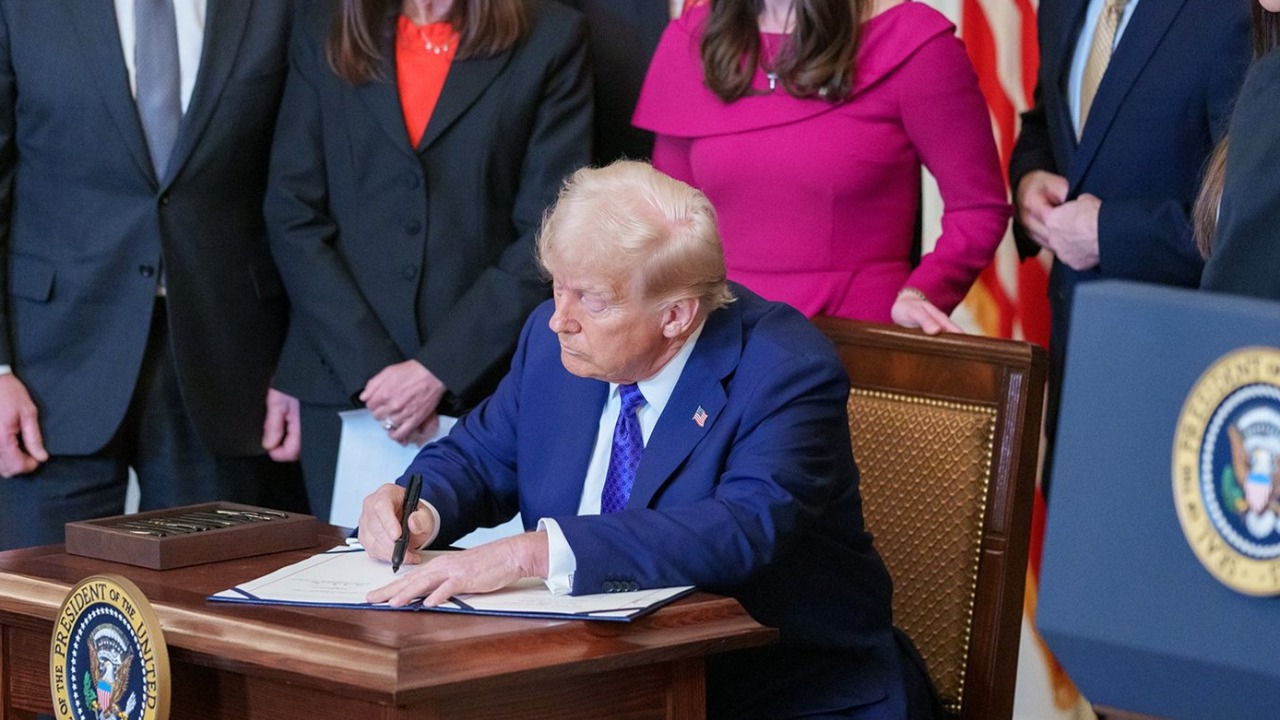

President Donald Trump has moved quickly to erase federal rules that nudged automakers and drivers toward electric vehicles, casting the shift as a win for affordability and consumer choice. By scrapping what he calls an EV “mandate” and loosening pollution standards, he is betting that cheaper gasoline models will resonate more with voters than long term climate targets. The decision has already reset the trajectory of U.S. auto policy and sharpened a political fight over who pays for the energy transition.
From EV ‘mandate’ to fossil fuel priority
The centerpiece of Trump’s reversal is an executive order that dismantles his predecessor’s framework for rapidly expanding electric vehicle sales and tightening tailpipe rules. President Donald Trump signed the directive, titled “Unleashing American Energy,” earlier in his term, promising to eliminate what he has repeatedly labeled an electric vehicle mandate, even though the earlier policy relied on emissions standards rather than an explicit sales quota. The order directs agencies to roll back federal pollution limits and to prioritize domestic production of oil, gas, coal, fossil fuels and nuclear energy, a shift that has been described as a broad rollback of the nation’s leading standards on vehicle emissions.
Trump’s allies have framed the move as a course correction after what they describe as an overreach by Democratic then President Barack Obama and his successor, who used federal authority to push automakers toward cleaner fleets. American president Donald Trump has also rescinded guidance that encouraged states to follow more aggressive EV adoption paths, arguing that the earlier approach unfairly penalized drivers who prefer gasoline models and that it was not legally binding in the first place. In that context, his decision to reverse the previous EV framework is less a one off action than part of a broader ideological campaign to slow the transition away from fossil fuels.
Affordability politics and the auto market
Trump has not only dismantled rules, he has wrapped the shift in a populist message about household budgets. At a recent appearance, President Donald Trump touted his work to scrap environmental regulations and pledged more plans to “bring back affordability,” explicitly tying that promise to looser standards for cars and trucks. He has argued that stricter emissions rules function as a hidden tax on working families by forcing automakers to load vehicles with costly technology, and he has signaled that the next phase of his agenda will further relax standards for new models.
The White House has leaned heavily on recent sales data to claim vindication. The Trump Administration has celebrated that U.S. auto sales just logged their best year since 2019, crediting its regulatory changes for the rebound. Officials point to decisions to eliminate the unpopular vehicle stop start requirement and to approve production of affordable and efficient gasoline powered cars as proof that easing rules can boost both volume and consumer satisfaction. In their telling, rolling back what they describe as Democrat imposed cost increases has helped power a broader revival of the industry, even as critics warn that the gains come at the expense of climate goals.
Clash with states, courts and the EV industry
The federal retreat from aggressive EV policy has collided with state level efforts to move faster, especially in California and other coastal markets. On June 12, 2025, President Trump followed through on a long running threat by rescinding California’s emission waivers, which had allowed the state and a coalition of others to mandate higher shares of zero emission vehicles and to phase out some internal combustion models. By pulling those waivers, the administration undercut rules that would have required a growing portion of new cars to be electric and that could have effectively prohibited certain gasoline vehicles in California and allied states. The decision to revoke the waivers signaled that Washington would not tolerate subnational mandates that move faster than federal policy.
Courts have started to push back on parts of Trump’s broader anti climate agenda, even as his team presses ahead on vehicles. Two separate rulings earlier this month represented a major setback to efforts by Trump to obstruct renewable energy initiatives and to halt clean energy projects, with judges rejecting attempts to slow or cancel developments that the administration argued would fuel what it calls the Left’s climate agenda. Those decisions, which advocates hailed as a defense of statutory requirements, show that not every element of the president’s energy strategy will survive legal scrutiny, and they highlight how the judiciary has become a key arena for fights over clean energy and fossil fuels.
The EV industry itself is caught in the middle of this policy whiplash. Tesla, which has built its business model around rapid electrification, reported a profit margin on its cars of about 16 percent during the first three quarters of 2024, nearly twice the profit margin of most of its rivals, underscoring how far legacy automakers still have to go to match its economics. Analysts note that weaker federal incentives and looser standards could slow competitors’ EV investments even as Tesla maintains an edge, complicating Trump’s promise to level the playing field. The administration’s own financial supporters have acknowledged that the executive order titled Unleashing American Energy reoriented national priorities toward fossil fuels and nuclear energy, a shift that one investment firm described as a clear EV U turn in federal strategy.
More from Morning Overview