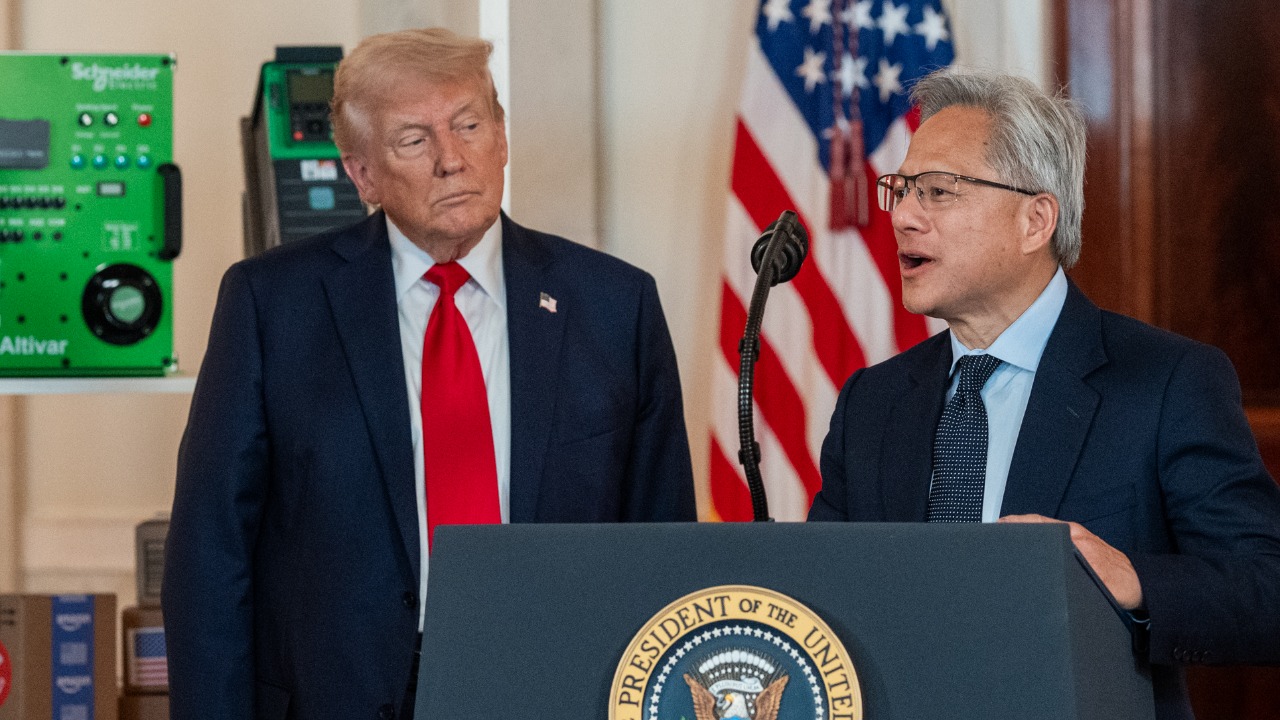

President Donald Trump’s decision to clear Nvidia’s advanced H200 artificial intelligence chips for export to China has fused two of Washington’s most combustible issues: the race for AI dominance and the long‑running confrontation with Beijing over technology. The move reopens a lucrative market for Nvidia but has triggered a rare wave of bipartisan anger from lawmakers and former officials who see cutting‑edge American AI hardware flowing to a strategic rival. At stake is not only who leads in next‑generation computing, but whether the United States can reconcile national security fears with the commercial pull of the world’s second‑largest economy.
The controversy turns on a simple but explosive question: can strict conditions and new security rules really keep these chips from strengthening Chinese military and surveillance capabilities, or has Washington just traded long‑term leverage for short‑term profit and diplomatic maneuvering?
The narrow greenlight: what Trump actually approved
The Trump administration’s decision is more calibrated than the political uproar suggests. Officials have allowed Nvidia to resume selling a powerful Nvidia AI chip into the Chinese market, but only under new export rules that carve out specific models and performance thresholds. Reporting describes the H200 as Nvidia’s second most powerful AI chip, a workhorse for training large language models and other advanced systems, while explicitly keeping even more capable designs such as Blackwell and the upcoming Rubin outside the scope of the current approvals. In practice, that means Chinese buyers can again access high‑end accelerators, but not the very top tier that Nvidia and its CEO Jensen Huang are preparing for the most demanding AI workloads, a distinction that U.S. regulators argue preserves a technological buffer.
Officials have framed the move as a controlled reopening rather than a wholesale retreat from earlier crackdowns. The Commerce Department’s Bureau of Industry and Security is applying new rules that treat exports of the H200 to China on a case‑by‑case basis, an approach that echoes earlier far‑reaching semiconductor controls that set performance caps and presumptions of denial for the most advanced chips. Under the latest guidance, Washington is effectively saying that some Nvidia AI hardware can go to buyers in China, but only if exporters meet detailed conditions and accept the risk that licenses can be tightened again if Beijing’s behavior or U.S. threat assessments change.
Case‑by‑case thaw or strategic backslide?
Inside the administration, officials have presented the H200 decision as part of a deliberate pivot rather than a one‑off concession. New guidance described as Trump Administration Approves Nvidia H200 Exports to China with New Security Requirements casts the policy as a “case‑by‑case” thaw, in which the Bureau of Industry and Security weighs individual transactions against national security concerns instead of imposing blanket bans. In that framing, the United States is trying to move from blunt, across‑the‑board restrictions toward a more surgical regime that can differentiate between commercial cloud providers, research institutions, and entities tied to the People’s Liberation Army. Supporters argue that this flexibility gives Washington more leverage to shape behavior, since licenses can be conditioned, suspended, or revoked if Chinese partners fail to comply.
Critics, however, see a strategic backslide that risks unraveling the logic of earlier controls. National security fears around Beijing’s access to American AI chips had already prompted the Biden administration to bar sales of the previous generation of high‑end accelerators, a step that was justified on the grounds that the same hardware used for commercial AI can “supercharge” military targeting, cyber operations, and surveillance. By reopening the door, even with conditions, Trump has invited accusations that the United States is prioritizing short‑term business interests over a longer‑term effort to slow China’s military modernization. The fact that the new rules arrive after intense lobbying from industry only deepens suspicions among some lawmakers that Washington is drifting away from a coherent technology containment strategy.
Backlash on Capitol Hill and beyond
The political reaction in Washington has been swift and unusually unified. Allowing China to buy Nvidia’s second most powerful AI chip has been described by critics as a “wrong path” that could “supercharge” Beijing’s military modernization, language that underscores how closely lawmakers now link AI hardware to hard power. A group of Democratic senators has already pressed the administration on why chips like Blackwell and the Rubin line are excluded from the current approvals but could still be targeted by future lobbying, while others are demanding detailed briefings on how export licenses will be monitored and enforced. For these members of Congress, the core concern is not only what is being sold today, but whether the United States is setting a precedent that will be hard to reverse if Chinese capabilities accelerate.
Opposition is not limited to one party or chamber. Reports describe bipartisan outrage after Today’s announcement, with lawmakers meeting to discuss how Beijing’s AI progress threatens U.S. national security at the very moment the administration signaled a partial reopening of the chip spigot. Former officials have joined the chorus, warning that Trump’s greenlight for Nvidia AI chips to China risks eroding the margin of advantage that U.S. forces and intelligence agencies still enjoy. Local outlets such as WTVB, which brands itself as The Voice of 1590 AM and 95.5 FM, have amplified those concerns, quoting critics who argue that the decision undercuts the goal of winning the AI race on American terms rather than by feeding advanced hardware into rival ecosystems.
Security rules, tariffs, and the “America first” tech doctrine
To defend the policy, the administration points to a web of new security requirements and parallel trade measures that it says will blunt the risks. The H200 approvals are tied to conditions that limit how and where the chips can be deployed, with the Bureau of Industry and Security reserving the right to scrutinize end users and data center locations. At the same time, President Trump has moved aggressively on the trade front, slapping 25% tariffs on high‑end Nvidia and AMD AI chips in a bid to force more U.S. manufacturing and reduce reliance on foreign fabs. Supporters argue that this combination of targeted export licenses and punitive tariffs reflects an “America first” approach to advanced computing, one that seeks to keep the most sensitive capabilities at home while still allowing U.S. firms to tap global demand under tight supervision.
Yet the broader export control landscape remains complex and contested. Recent US policy has already restricted exports of advanced GPUs to China on national security grounds, with rules that put Chinese buyers last in line for scarce capacity at leading foundries and prioritize users in the United States. Earlier far‑reaching controls on semiconductors and advanced computing set out detailed performance thresholds and made clear that some applications would be considered on a case‑by‑case basis, while others would face a presumption of denial. The H200 decision slots into that architecture but also tests its limits, since it asks regulators to distinguish between “too advanced” and “barely acceptable” in a field where incremental improvements in chip design can translate into exponential gains in AI capability.
Uncertain enforcement, market whiplash, and legal blowback
Even if the policy looks precise on paper, its real‑world impact is far murkier. Lawmakers are already asking how much the newly revised policy will benefit Chinese companies or Beijing, noting that it remains unclear how effectively U.S. agencies can track where each chip ends up once it crosses the border. Analysts have described the situation as a kind of diplomatic mind game, with one account noting that, just a day after Washington cleared Nvidia H200 exports, Chinese officials signaled resistance that may be more about leverage than genuine disinterest. The result is a foggy environment in which companies, regulators, and foreign governments are all testing how far the new rules can be stretched without triggering a fresh crackdown.
More from Morning Overview