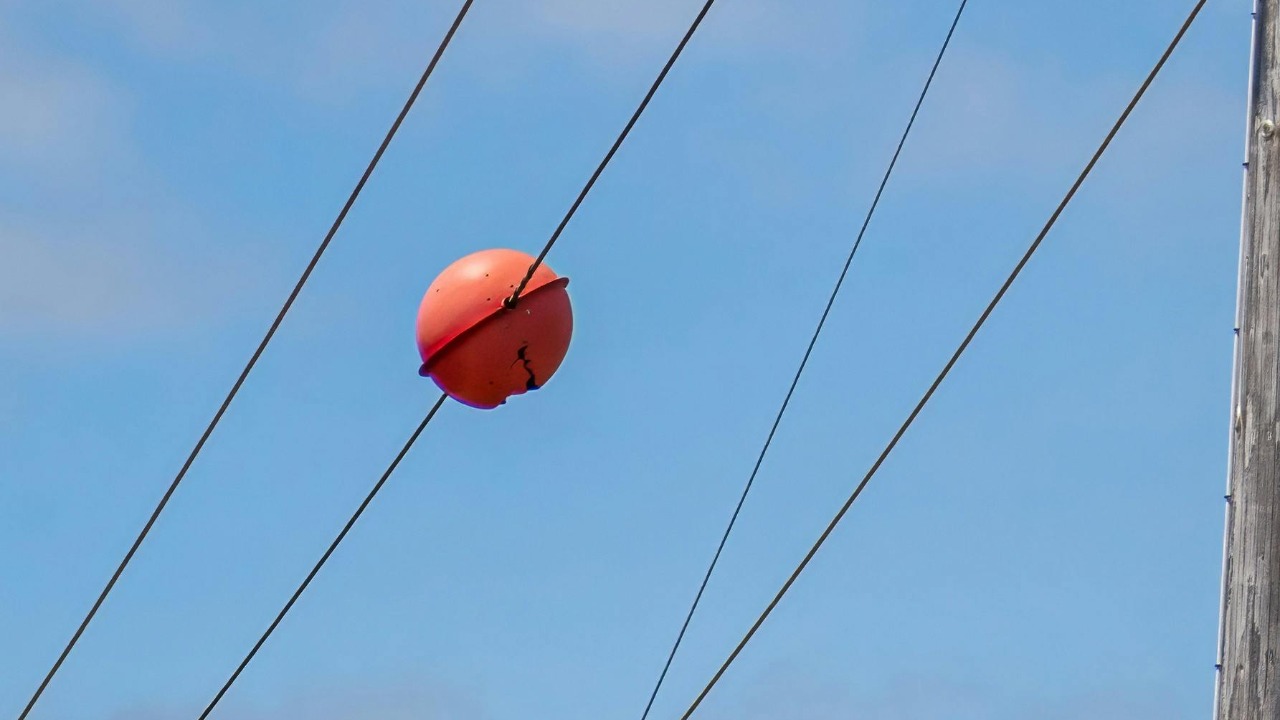

Those bright orange spheres strung along certain power lines are not decorative, and they are not there to keep the wires from sagging. They are precision safety devices, engineered to make some of the most dangerous stretches of the grid visible to pilots, drivers, and even birds. Once you understand how they work and where they are placed, they read less like roadside curiosities and more like a quiet layer of infrastructure that keeps an increasingly crowded sky from turning deadly.
Engineers call them marker balls, and they sit at the intersection of aviation safety, wildlife protection, and a power system that is being pushed harder every year. As power demand climbs and utilities string longer, higher voltage spans across rivers, canyons, and highways, those simple-looking spheres have become a frontline tool for preventing collisions and outages.
What those “mystery” balls actually do
At the most basic level, marker balls are visual highlighters for wires that would otherwise disappear into the background. Long spans of cable can be almost invisible from the cockpit of a low flying Aircraft, especially in flat light or bad weather, and the consequences of clipping a line with a rotor or wing are catastrophic. By adding large, high contrast spheres at regular intervals, utilities turn a thin, hard to see conductor into a bold, repeating pattern that jumps out against trees, water, or sky.
That is why the balls tend to appear where power lines cross major roads, rivers, or valleys, and near airports or hospital helipads, rather than on every neighborhood line. One Vermont observer writing about the orange balls over an interstate noted that it seemed odd to mark that particular crossing when others nearby were bare, but the placement reflected a specific risk calculation about aircraft routes and terrain, not an aesthetic choice, as the Dec account makes clear. In other words, if you see the spheres, you are looking at a spot where a collision would be unusually likely or unusually dangerous.
How marker balls are built and installed
For something that looks like a plastic toy from the highway, a marker ball is a carefully specified piece of hardware. Industry guides describe them as colorful, spherical shells that clamp directly around a conductor or a separate overhead wire, with internal hardware designed not to nick or crush the cable. A typical unit is large enough to be seen from a distance and, according to one utility explainer, usually weighs around 17 pounds, which is light enough for linemen or helicopter crews to handle but heavy enough to stay put in high winds.
Manufacturers emphasize that the shells are made from materials that conduct neither heat nor electricity, so they do not interfere with the line’s performance or create a new shock hazard. One technical sheet from Flight Light Inc describes “3.5 Unlighted Markers” in detail, noting that these unpowered spheres are used to identify structures and make them more visible without adding wiring or bulbs. Other suppliers stress weatherproofing and ultraviolet resistance, explaining that the composite shells must survive years of sun, ice, and wind without fading or cracking, a point underlined in a blog on the Importance and Specifications.
Why the colors and patterns matter
The classic image is an orange sphere, but the color palette is deliberate and broader than that. Aviation guidance calls for high contrast combinations, so utilities often alternate orange, white, and sometimes red or yellow along a span to create a pattern that stands out in different seasons and lighting. One weather explainer notes that Marker balls are colorful, spherical devices precisely because that mix of orange, red, and yellow is hard to miss against blue sky or green hills.
Utilities also think about how those colors read from the ground. A Southern California video that walks viewers through an installation over Yorba Belinda shows crews from SoCal Ediso hanging orange, white, or yellow balls in a repeating sequence, turning an almost invisible set of wires into a dotted line that both pilots and drivers can track at a glance. That visual rhythm is not just for aesthetics; it helps the human eye judge distance and orientation, especially when a helicopter or small plane is maneuvering close to the wires.
Where and why utilities deploy them
Marker balls are not scattered randomly across the grid; they are concentrated where the stakes are highest. Aviation safety guidance and utility practice focus on long spans over rivers and canyons, crossings near runways, and corridors used by low flying helicopters. A consumer explainer on roadside infrastructure notes that the markers may be seen on river and canyon power line crossings and other places where aircraft, including AI driven flying vehicles, are expected to operate, which is why some utilities are adding them in places that never needed them before, as described in a Jan feature.
Public power districts frame them as part of a broader effort to keep both people and wildlife safe. One Northwest utility describes the bright spheres as transmission visibility markers that help pilots and also reduce the risk of large birds colliding with lines, noting that the bright colors and spacing are designed to protect wildlife from colliding with lines. That dual role is increasingly important as conservation rules push utilities to mitigate bird strikes at the same time that air traffic, including drones and emergency helicopters, is increasing at low altitudes.
The safety stakes in a more crowded sky
Behind the simple geometry of a sphere on a wire is a serious safety calculus. One industry overview notes that power demand is surging and that longer, higher capacity lines are being built to move electricity from remote generation sites into cities, a trend summarized under headings like Power Demand Is and Importance of Power. As those spans get longer and higher, they become more likely to intersect with flight paths used by crop dusters, firefighting aircraft, and air ambulances, especially in rural areas where radar coverage is thin and pilots rely heavily on visual cues.
Manufacturers and utilities point out that the same markers that protect crewed aircraft are now being used to guide uncrewed systems as well. One product overview aimed at high efficiency transmission lines notes that Power line markers are brightly colored and strategically spaced to provide pilots with a crucial visual warning, and that this is increasingly relevant as low altitude airspace fills with new types of vehicles. Another section of the same discussion, labeled Unm, underscores the role of these devices in preventing aviation incidents, including those involving unmanned aircraft that may not carry sophisticated obstacle detection.
More from Morning Overview