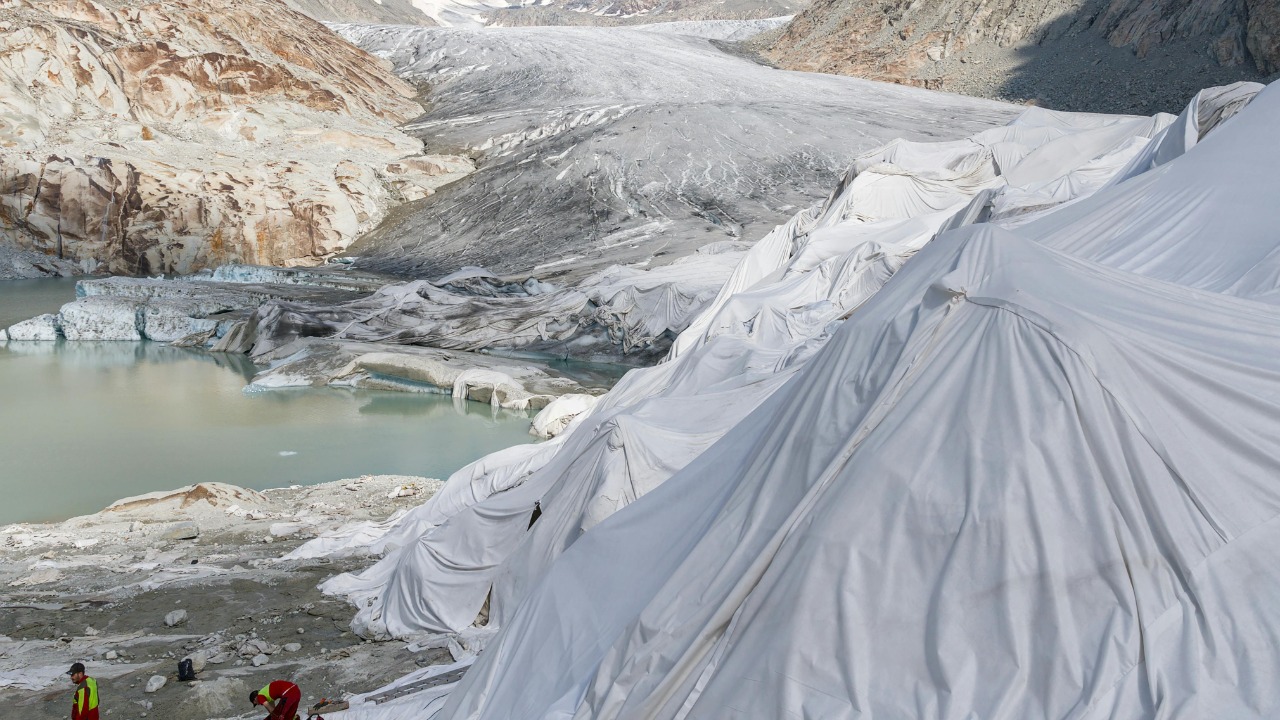

Across the Alps, ice that has locked away human stories for millennia is vanishing, and with it a new, unsettling landscape is emerging. As glaciers retreat and high mountain permafrost thaws, they are exposing everything from prehistoric tools to the bodies of soldiers and missing climbers. The result is a haunting paradox: every new discovery deepens our understanding of the past while underscoring the speed and severity of the climate crisis that is forcing these secrets to the surface.
What is happening on these peaks is not a slow geological shift but a rapid unsealing of history, compressed into a single human lifetime. Archaeologists now speak of a race against time, as artifacts that were once safely frozen are suddenly lying in the open, at risk of decay, looting, or being swept away by rockfalls and floods.
The Alps are losing their ice, and stability with it
Glaciers in the Swiss Alps have already lost nearly two-thirds of their ice volume over the past century, a transformation that is reshaping entire valleys and watersheds. Researchers describe Swiss Alps glaciers as a bellwether for Europe, which they call the fastest-warming continent, and warn that the loss of ice is already altering river flows that millions of people depend on. In practical terms, this means less predictable meltwater in summer, more erratic floods, and a growing risk that hydropower systems and downstream agriculture will be thrown off balance.
The physical stability of the mountains themselves is also being undermined as the frozen “glue” that holds rock faces together begins to fail. Scientists describe high mountain ground that stays below freezing as Permafrost, and they note that this natural cement is now melting in summer at multiple Alpine sites. As ice within cracks thaws, water seeps in, refreezes, expands and widens the fractures, a process that is already triggering more frequent rockfalls and slope failures. In some regions, authorities are tracking these changes from the air, and They fly helicopters over the region’s 180 g glaciers to monitor new crevasses and unstable seracs that could collapse without warning.
Hikers and archaeologists on the front line of “ausgeapert”
As the ice retreats, ordinary mountaineers are becoming accidental witnesses to deep time. In the Hikers and community of the Swiss Alps, climbers are stumbling across leather straps, wooden tools and fragments of clothing that have no business lying on the surface of a modern glacier. Melting glaciers in the Swiss Alps are revealing objects left behind over the ages, from lost mountaineering gear to ancient travel routes that once threaded through now-vanished passes.
Local languages have evolved to describe this eerie process. As one report notes, There is even an Alpine German term, “ausgeapert,” for the moment when something emerges from the ice after being buried for centuries. The word captures the unsettling feeling of walking across a glacier and suddenly seeing a shoe, a bone, or a woven strap appear at your feet, a reminder that these mountains have been busy corridors of human movement for at least 6,000 years.
From Ötzi to a 4,500-year-old lunch box
The most famous Alpine discovery remains Ötzi the Iceman, whose body and equipment emerged from Europe’s mountain ice and transformed our understanding of prehistoric life. One of the most famous finds from One of the these sites is his 5,300 year old body, preserved with clothing, tools and even the contents of his stomach. Scientists at a University calculated that the iceman lived and died 5,300 years ago, opening a door into Copper Age diets, medicine and violence that no written record could provide.
More recently, researchers have reported finding a 4,500 year old wooden container in the Alps that they describe as a kind of prehistoric lunch box. In video coverage of the discovery, the narrator explains how, after years of anticipation, the object was finally brought to a church service and described as the happiest day of their life, a moment captured in the clip linked as Sep. A separate reference to the same find, framed as Sep, underlines how emotionally charged these moments can be for the people who have spent years combing the ice for traces of early Alpine travelers.
War dead and missing climbers emerging from the ice
The same process that reveals ancient tools is also returning the bodies of those who vanished in far more recent tragedies. In the Italian Alps, the Italian Alps have yielded the remains of two World War I soldiers after an unusually intense summer thaw, a reminder that high-altitude battlefields never truly stopped shifting. Another report describes how the World War dead were entombed in ice for more than a century before the glacier finally gave them back.
Officials have also confirmed that the Body of WWI soldier was discovered in the Italian Alps when a glacier melted, part of a broader pattern in which the remains of World War combatants are resurfacing as the ice thins. A separate account of the same phenomenon notes that the body of a World War I soldier was found in a receding ice field, reinforcing how the World War front lines are being redrawn by climate change. For families of missing climbers, similar discoveries can finally close decades-old cases, as in the story of a Swiss couple whose disappearance was solved when a glacier retreated and, Upon closer inspection, rescuers found weathered items including a pair of bowls, an old backpack, a glass bottle and two mismatched shoes.
Glacial archaeology comes into its own
What was once a niche pursuit has now become a fully fledged field. As one overview notes, glacial archaeology, the study of objects retrieved from glaciers and ice patches, has recently come into its own as a discipline. When the first systematic programs began, the finds were mainly When the program started, the finds were mainly Iron Age and medieval, from 500 to 1,500 years ago, but as the melting widens, even older layers are being exposed. That shift is forcing archaeologists to rethink how quickly they must respond to reports from hikers and guides.
The scale of the opportunity, and the risk, is stark. In the north, Archaeologists in Norway are uncovering ancient artifacts on the country’s melting glaciers, revealing items from the Stone Age, Iron Age and Viking period, and planning to return for further exploration. Another survey notes that Norway‘s melting glaciers have yielded over 4,500 items spanning thousands of years, a figure repeated in a separate account that describes 4,500 artifacts as a window into human history. The Alps are part of this same story, a network of ice patches that are suddenly behaving like open-air museums with no security or climate control.
More from Morning Overview