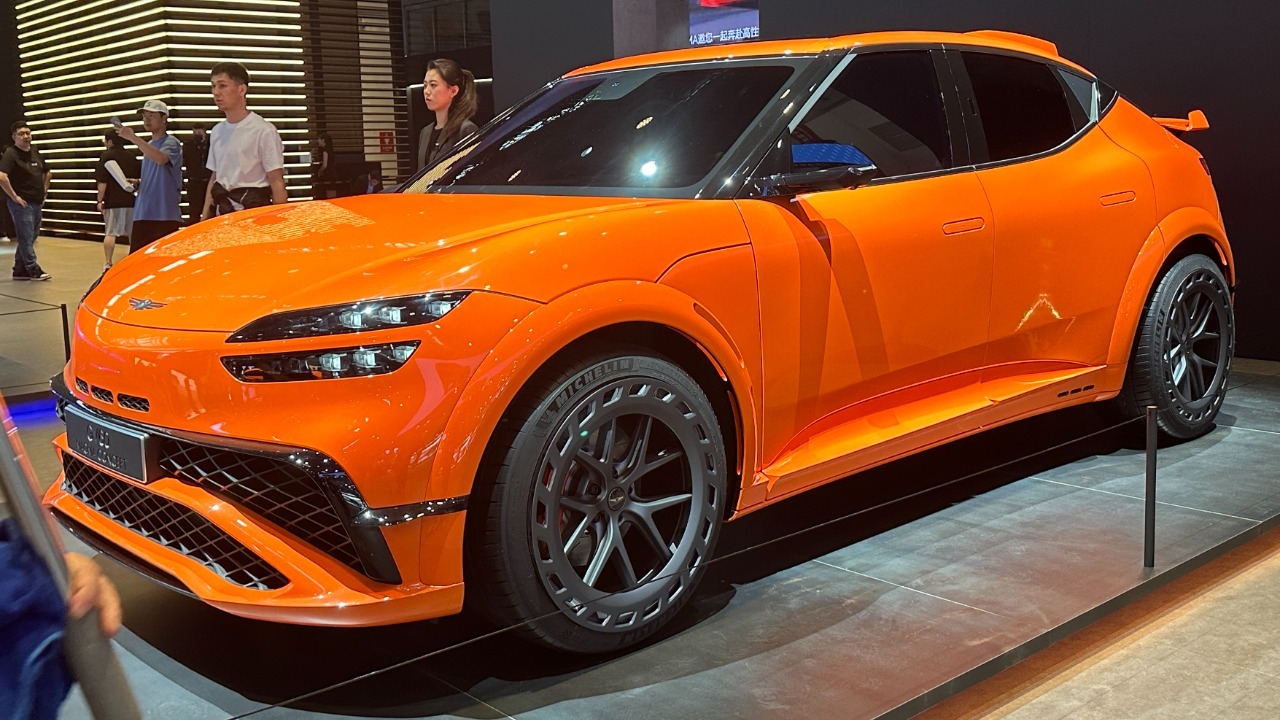

The hottest version of Genesis’s compact electric crossover is no longer a concept sketch or a show car. The 2027 GV60 Magma is entering production with a headline output of 641 hp, a dual-motor all-wheel-drive layout, and a mission to push the Korean luxury brand directly into the same conversation as Europe’s most established performance divisions. Rather than chasing lap records alone, it blends that power with a luxury-focused cabin and everyday usability that signal how Genesis now defines a modern performance EV.
What makes this model significant is not just the number on the spec sheet, but the way it crystallizes the new Magma sub-brand as a serious performance pillar. With aggressive aero, track-influenced hardware, and software tricks like simulated gearshifts, the GV60 Magma arrives as a rolling manifesto for how Genesis intends to compete with AMG, M, and RS in the electric era.
Genesis turns up the heat with the Magma sub-brand
Genesis has been building toward a performance identity for several years, but the GV60 Magma is the first time that effort has coalesced into a dedicated sub-brand with a clear brief. Earlier concepts previewed the Magma design language and promised that at least one of those wild show cars would make the leap to showrooms, a commitment that is now being fulfilled as the 2027 GV60 Magma moves from prototype to production reality, as detailed in reporting on how the model “sprints into production” with a focus on track capability and even references to future competition in the Le Mans Hypercar class on GV60 Magma production.
That shift from design exercise to showroom car also formalizes Magma as more than a trim level. Coverage of the launch frames Magma as a performance spearhead for Genesis, with the GV60 Magma debuting as a high-output EV positioned to challenge European benchmarks and to serve as a halo for the broader lineup, a role underscored in analysis of the model’s market positioning and power output on high-performance EV launch. In other words, this is not a one-off experiment, but the first in a series of hotter Genesis models that will wear the Magma badge.
Powertrain: 641 hp, dual motors, and serious numbers
The core of the GV60 Magma story is its output. Reporting on the production car’s specs confirms that the dual-motor powertrain delivers 641 hp, a figure that plants it squarely in the realm of established performance EVs and gives Genesis a clear headline number to market, as laid out in a detailed breakdown of the car’s acceleration and launch strategy in the Key Takeaways that cite 641 and a 3.4-second 0-to-62 mph time. That 3.4-second sprint to 62 m per hour puts the GV60 Magma in the same performance band as many dedicated sports cars, not just other crossovers.
Under the skin, the hardware is carefully apportioned. One report notes that the GV60 Magma uses two motors, with 222 hp at the front axle and 378 hp at the rear, figures that can climb to 234 hp and higher outputs in specific modes, a layout that emphasizes rear bias and dynamic balance according to technical details on Magma dual-motor power. Another specification sheet translates that into metric terms, listing Magma Confirmed Specifications of 448 k W and 740 Nm in standard form, rising to 478 k W and 790 Nm in Boost Mode, with a 264 km per hour top speed, all of which underlines how aggressively Genesis has tuned this compact EV, as set out in the Magma Confirmed Specifications for the car.
From Performance Edition to Magma: a big step up
To understand how radical the GV60 Magma is within its own family, it helps to compare it with the existing hot version of the crossover. The current Genesis GV60 Performance Edition is already a quick dual-motor EV, but reporting on the Magma’s arrival points out that the Performance Edition delivers 429 hp and 516 lb-ft of torque, figures that now look modest next to the new flagship, as highlighted in a comparison that explicitly cites 429 and 516 when contrasting the two trims on Genesis Performance Edition. That gap in output illustrates how Magma is not just a mild power bump, but a full reimagining of the GV60’s performance envelope.
Genesis itself leans into this escalation in its official materials, describing the GV60 Magma as delivering up to 640 hp of intense EV output and a 0 to 60 mph time that underscores its straight-line pace, language that appears in the brand’s own positioning of the car as CAPTIVATING CONTROL and an invitation to Engage the road with that power, as set out on the official CAPTIVATING CONTROL page. When I look at those numbers side by side, the Magma reads less like a trim step and more like a separate model that happens to share a body shell with the standard GV60.
Design and aero: functional aggression, not just flair
The GV60 Magma’s styling makes its intent clear before the driver even presses the start button. Coverage of the production car emphasizes that the most striking element is a functional rear wing that serves as the centerpiece of the design, providing more downforce at speed and working in concert with a reprofiled rear diffuser, while the chrome trim from the regular GV60 is Gone in favor of darker, more purposeful finishes, details that are spelled out in a design-focused report on the functional rear wing. That combination of aero hardware and visual de-chroming signals that Magma is meant to be read as a performance tool rather than a purely cosmetic package.
Other walkaround coverage reinforces that impression. Photo galleries of the 2027 Genesis GV60 Magma note that the production model looks nearly identical to the concept, with bulging fenders, a more aggressively styled front bumper, and a stance that is racier, lower, and wider than the standard car, a continuity that is highlighted in a piece inviting readers to View Photos of the car from every angle on View Photos of the. I read that as a sign that Genesis trusted its original Magma design enough to carry it almost unchanged into production, which is not always the case with concept cars that start out more dramatic than the eventual showroom versions.
Inside the cabin: luxury twist on a track-ready EV
While the exterior leans into motorsport cues, the interior of the GV60 Magma aims to preserve the brand’s luxury credentials. Official material describes the cabin as finished with bold accents that complement the performance theme while still delivering the comfort and refinement expected of a premium EV, language that appears alongside the CAPTIVATING CONTROL tagline and the invitation to Engage the driver with up to 640 hp on the official Genesis GV60 Magma product page. That balance between visual drama and everyday usability is crucial if Genesis wants Magma to appeal to buyers who might otherwise gravitate toward more traditional luxury crossovers.
Independent first-look coverage adds more texture to that picture. One early drive story notes that Inside, the GV60 Magma receives sport seats, unique trim, and performance-oriented controls that differentiate it from the standard GV60 while still feeling like a fully realized luxury environment, a point made in a detailed preview that also touches on pricing expectations and how the car may end up nudging higher price brackets on Inside the Magma. To my eye, that approach positions the GV60 Magma as a car that can handle a track day on Saturday and a long, quiet commute on Monday without feeling compromised in either role.
Simulated gearshifts and driver engagement tech
Beyond raw power, the GV60 Magma leans heavily on software and control systems to shape the driving experience. One of the most intriguing features is a system of Simulated Gearshifts that aims to give drivers a more tactile sense of acceleration, pairing virtual shift points with changes in power delivery and feedback so that the car feels more like a traditional performance machine even though it is fully electric, a feature highlighted in coverage that describes how the 2027 Genesis GV60 Magma EV Brings 641-HP and Simulated Gearshifts with a Luxury Twist, a phrase that appears in a detailed report by Bengt Halvorson on Magma EV Brings. That same report underscores how Genesis is trying to make the car engaging for enthusiasts who might miss the rhythm of shifting gears.
Other performance tech rounds out the package. The dual-motor layout and rear-biased power delivery enable advanced drive modes, including settings that prioritize agility and even playful behavior, with one technical breakdown noting that the GV60 Magma’s software allows for a drift mode that exploits the 222 hp front and 378 hp rear motors, and their potential climb to 234 hp and higher outputs, to rotate the car on command, as described in the engineering-focused analysis on The Rad Behind the Magma. When I put those elements together, the GV60 Magma reads as a car that uses software not just for efficiency, but to craft a specific, enthusiast-friendly character.
Chassis, brakes, and track focus
Power alone does not make a performance EV credible, so Genesis has backed up the GV60 Magma’s output with substantial chassis and braking upgrades. Reports on the car’s development emphasize that the suspension has been retuned for higher cornering loads, with stiffer components and revised geometry that work with the wider stance and functional aero to keep the car stable at the 264 km per hour top speed cited in the Magma Confirmed Specifications, a figure that appears alongside the 448 k W and 478 k W outputs in Boost Mode on Boost Mode. That kind of top speed is not just a marketing number; it demands serious attention to cooling, stability, and braking.
Visual walkarounds and technical previews also highlight larger brakes and performance tires as part of the Magma package. One detailed photo feature notes that the dual-motor powertrain produces a substantial surge of torque that can be temporarily increased for 15 seconds in a dedicated boost function, a capability that requires robust braking hardware and thermal management to handle repeated hard use, as described in the gallery that focuses on how the powertrain delivers that extra hit of torque for short bursts on dual-motor powertrain. Taken together, those details suggest that Genesis expects some owners to explore the car’s limits on track, not just on the highway on-ramp.
Positioning against AMG, M, and Europe’s best
Genesis is not shy about where it wants the GV60 Magma to compete. One in-depth preview explicitly frames the car as a direct challenge to the likes of AMG and M, noting that the 640 hp output and aggressive chassis tuning are intended to put those established performance divisions on notice, a positioning that is spelled out in a first-look analysis of how the 640-HP Genesis GV60 Magma stacks up against European rivals on puts AMG and M on notice. That framing matters, because it signals that Genesis sees Magma not as a niche experiment, but as a core part of its strategy to be taken seriously alongside German luxury brands.
At the same time, the GV60 Magma is part of a broader push by Genesis to use performance EVs to expand its footprint in Europe. Reporting on the launch notes that Genesis is debuting the GV60 Magma performance EV with 641 hp and a 3.4-second 0-to-62 mph time as part of a Launch move aimed at taking on Europe’s premium players, a strategy that is laid out in the Genesis Magma Launch coverage. When I look at that context, the GV60 Magma reads as both a product and a statement: Genesis is betting that a high-performance EV with a Luxury Twist can win over buyers who might otherwise default to German badges.
Production timing and what comes next for Magma
The timing of the GV60 Magma’s arrival is as strategic as its specs. Reports dated Nov 20, 2025, consistently describe how Genesis is moving the car into production as a 2027 model, with coverage emphasizing that the production version stays remarkably close to the original concept and that the brand is using this moment to cement Magma as a long-term performance sub-brand, a narrative that runs through the Nov reporting on Genesis Magma. Those same Nov 20, 2025 stories also underscore that the GV60 Magma is set to go on sale as a 2027 model year vehicle, giving Genesis time to ramp up production and marketing.
Looking ahead, the GV60 Magma is widely seen as the first in a series of Magma-branded models that will span multiple segments. Early coverage of the sub-brand’s debut referenced four concept cars and hinted that at least one would evolve into a competition-focused machine, potentially even targeting the Le Mans Hypercar class, a possibility mentioned in the Nov 20, 2025 report on how the 2027 Genesis GV60 Magma Sprints Into Production With 641 hp on Nov 20, 2025. If Genesis follows through on that trajectory, the GV60 Magma will be remembered not just as a fast crossover, but as the spark that lit an entire performance lineage for the brand.
More from MorningOverview