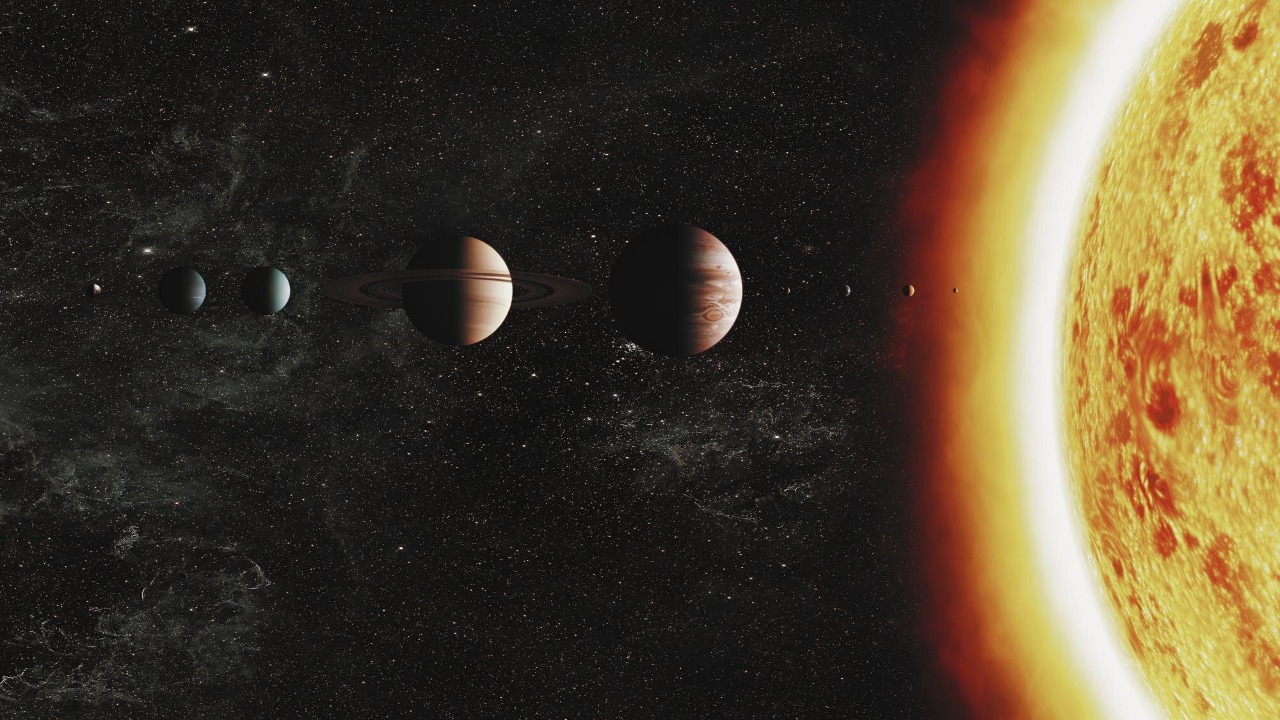

The most unsettling space images are not of black holes or distant galaxies, but of stars that look eerily like our own Sun in its final moments. Astronomers can now map, almost step by step, how our familiar solar system will unravel when the Sun swells, sheds its skin and shrinks into a stellar corpse. The result is a kind of cosmic crime scene diagram, tracing which worlds burn, which escape and which might briefly become havens for life.
Those maps are not guesswork. They are built from precise observations of dying stars, “polluted” stellar graveyards and even a distant planetary system that mirrors our own. Taken together, they show how the Sun’s death will erase Earth, scramble the orbits of the surviving planets and leave a glowing white dwarf surrounded by the wreckage of what used to be home.
The Sun’s slow march to catastrophe
The story begins quietly, with the Sun steadily fusing hydrogen into helium in its core, as it has for more than 4 billion years. Models of stellar evolution indicate that About 5 billion years from now the Sun will exhaust that core hydrogen and swell into a red giant, a phase that will radically reshape the inner solar system. As the outer layers expand, the surface will cool and redden, but the total energy output will soar, turning our star into a bloated, unstable giant that stretches far beyond today’s orbit of Mercury and Venus.
Long before that final expansion, Earth will already be in deep trouble. As the Sun brightens with age, oceans will evaporate and the climate will shift into a runaway greenhouse state. One analysis notes that Without water on Earth, the tectonic plates will completely stop moving, ending the carbon cycle that helps stabilize climate. By the time roughly 7.6 billion years have passed and Earth and the Moon are deep inside the red giant’s reach, the planet’s surface will be unrecognizable, a desiccated rock on the verge of being swallowed.
Inner worlds consumed, outer worlds transformed
As the Sun swells, the inner planets will face a brutal sequence of events. Calculations suggest that tidal forces and drag inside the Sun’s extended atmosphere will cause orbits to decay, so Mercury and Venus are almost certain to be engulfed. Several projections, including work highlighted by NASA, indicate that Earth is likely to be swallowed as well once the red giant reaches its maximum size. By that stage, the extreme energies emitted by the Sun will be intense enough to vaporize rocks, leaving behind nothing more than dense metallic remnants in the inner region.
Farther out, the picture is less about direct impact and more about atmospheric stripping and orbital chaos. As the Sun loses mass, its gravity weakens, and the orbits of Mars, Jupiter and Saturn will expand and distort. One analysis notes that But the damage will not stop with the inner planets, since Mars, Jupiter and Saturn will have their atmospheres eroded and their moons blasted by radiation. For now, our Solar System is stable, but Billions of years from now the same gravitational ballet will play out under far harsher conditions.
Gas giants, icy moons and the chance for new oceans
The fate of the gas giants is one of the most striking parts of the endgame map. As the Sun expands and then sheds mass, the orbits of Jupiter and Saturn will drift outward, but they are expected to survive as intact planets. Detailed modeling of Gas Giant Planets the Sun becomes a red giant suggests that some material from the destroyed inner worlds will rain down onto these giants, slightly contaminating their outer layers. At the same time, When the Sun loses its outer layers in the last million years or so of its life, it will shed about half its mass, a change that one analysis of When the Sun notes will push Jupiter’s orbit farther out and loosen its grip on some smaller bodies.
Paradoxically, the outer solar system may briefly become more hospitable just as the inner system dies. As the red giant brightens, the extra heat could thaw frozen moons like Europa and Enceladus, turning them into temporary ocean worlds. One scenario, described in a vision of The Last Days on Earth, imagines future humans migrating to the moons of the outer system, where the enlarged red giant Sun would heat Europa, Enceladus, Ganymede and Callisto, melting their ice and giving them atmospheres of vapor. Another analysis asks What will happen to the outer reaches and suggests that this warming could create a window in which life, perhaps with help from technology, might thrive far from the dying Sun.
From red giant to white dwarf graveyard
After the red giant phase, the Sun will shed its outer layers into space, creating a glowing shell of gas known as a planetary nebula. At the center, the core will collapse into a white dwarf, a stellar ember roughly the size of Earth but with about half the Sun’s mass. Initially, this white dwarf may be Initially 100 times as luminous as the Sun is now, before it cools over trillions of years and eventually becomes a black dwarf. The surrounding nebula will be rich with elements forged in the Sun’s core, seeding interstellar space with carbon and oxygen that could one day be recycled into new stars and planets.
We already have a Glimpse of the in this future state by studying other stars. Observations of the Helix Nebula and similar objects show a Distant Future Webb view of a Sun-like star that has shed its outer layers, leaving a hot white dwarf at the center. A closer look at the Helix Nebula and its complex structure reveals knots, arcs and filaments of gas that trace how the dying star’s winds sculpted its surroundings. These images are effectively snapshots of our own solar system’s far future, captured in real time around another star.
A “polluted” crystal ball for our Solar System
To understand what happens to planets after the white dwarf forms, astronomers have turned to stellar graveyards that are anything but pristine. Some white dwarfs show heavy elements like iron and silicon in their atmospheres, even though those elements should sink quickly, which means they are actively accreting debris. One study of a Polluted white dwarf uses this contamination as a Poll of the rocky bodies that once orbited the star, suggesting that asteroids and fragments of planets are being shredded and consumed. It is a stark preview of how our own Solar System will look after the Sun’s implosion, with the white dwarf slowly eating the rubble of its former planets.
We also have a living analogue of our future in a distant system that closely resembles our own. Observations of a white dwarf with surviving giant planets show a configuration so similar that, as one report notes, Moreover, the Keck Observatory has called it a crystal ball for our own fate once the Sun turns into a white dwarf. The system’s central star is roughly as massive as the Sun, and its surviving planets trace wide orbits reminiscent of Jupiter and Saturn, reinforcing the idea that the outer giants in our Solar System will endure long after the inner worlds are gone.
More from Morning Overview