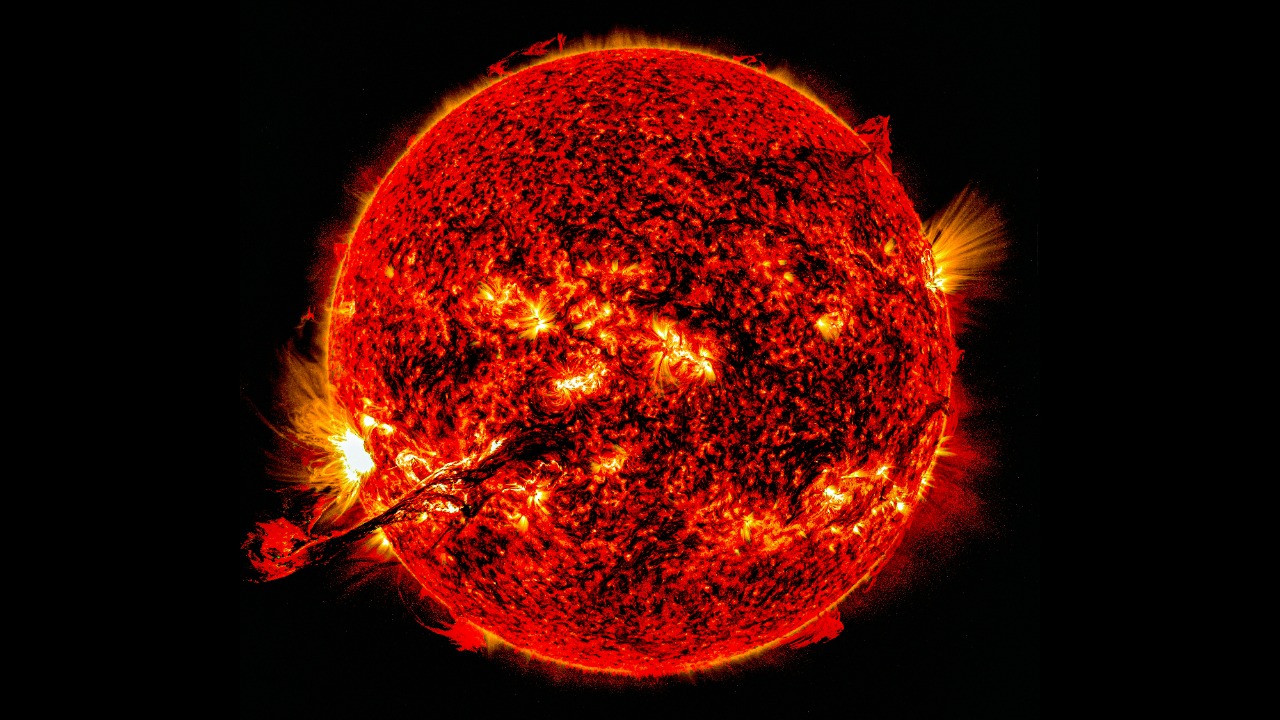

The Sun has hurled the most intense burst of radiation at Earth in more than two decades, a reminder that our star can flip from serene to violent in a matter of hours. The storm has pushed radiation levels in the upper atmosphere to extremes not seen since the early 2000s, disrupted technology that underpins modern life, and carved new structures into the near‑Earth environment that scientists are still racing to understand.
What might sound like a distant astrophysical event is already a very terrestrial story, from farmers coping with broken guidance systems to airlines rerouting flights away from the poles. I see this storm as a stress test of our space‑age infrastructure, and a preview of how the rest of this solar cycle could play out.
From dazzling auroras to dangerous radiation
The current radiation storm did not arrive in isolation, it is the latest and most extreme chapter in a solar cycle that has been building toward this kind of outburst. Earlier in the cycle, a cluster of eruptions in May 2024 sent charged particles racing toward Earth and produced auroras that spilled far beyond their usual haunts, with a VIIRS image capturing the aurora borealis draped over much of the Northern Hemisphere. Those displays were the visible tip of a much larger disturbance in the planet’s magnetic shield, a disturbance that set the stage for the even harsher radiation environment measured in the latest storm.
What makes the new event stand out is not just the light show but the sheer spike in energetic particles. Researchers tracking aviation exposure report that Scientists have recorded the highest levels of radiation from a solar storm at aviation altitudes in 20 years, a benchmark that underscores how far this episode sits from routine space weather. A separate analysis of a Rare solar flare found that radiation in Earth’s atmosphere spiked to the highest levels in nearly 20 years, confirming that the storm’s particle flux has pushed deep into the layers of air that commercial jets and high‑altitude research aircraft routinely traverse.
How the storm reshaped near‑Earth space
Extreme solar storms do not just wash over Earth and vanish, they can reconfigure the architecture of near‑Earth space in ways that linger long after the auroras fade. During the great storm of May 2024, scientists found that the onslaught of particles and magnetic energy was intense enough to create two new radiation belts around Earth, one of which still remained months later. Those temporary belts, packed with high‑energy electrons, effectively rewired the Van Allen region that satellites must cross, turning familiar orbits into more hazardous territory.
The same storm also stripped away part of the planet’s upper atmosphere. Analyses of the Extreme G5 geomagnetic storm between May 10–12, 2024, show record ionospheric depletion that disrupted the charged layer essential for radio communication for more than two days. That kind of depletion changes how signals from navigation satellites bend and scatter, a key reason GPS receivers struggled during and after the event. When I look at the latest radiation storm, I see it as part of this same pattern, a sequence of eruptions that are not only brighter but structurally more disruptive to the space environment we rely on.
Ground truth: farmers, flights and fragile systems
The most striking measure of impact is not in space but on the balance sheets and daily routines on the ground. A detailed study of the May 2024 storm found that it cost farmers $500 million in damages, largely because precision agriculture equipment suddenly lost its bearings. During the peak of that storm, GPS receivers were off by up to 230 feet, a staggering error for planters and sprayers that normally steer within inches. For growers who had invested heavily in satellite‑guided tractors, that meant crooked rows, wasted seed and fertilizer, and a ripple of lost yield that added up to $500 m in losses.
Aviation and power operators are watching the current radiation spike with similar concern. At cruising altitudes, the heightened particle flux recorded by Your support instruments has forced airlines to revisit polar routes where shielding is thinnest and exposure highest. Grid managers, looking back at how the biggest solar storm in more than two decades struck Earth on May 10 and 11, have been running drills to ensure transformers can ride out geomagnetically induced currents. I see the latest radiation storm as a warning shot that the vulnerabilities exposed in 2024 are still very much with us, only now under even harsher particle bombardment.
How scientists watched the storm unfold
One reason we can speak so confidently about the scale of this storm is that the observing network around the Sun and Earth has never been more capable. When the earlier May 2024 eruption hit, NASA used its Solar Dynamics Observatory to capture high‑resolution images of the solar flares that launched the storm, tracking how magnetic fields twisted and snapped on the Sun’s surface. Those observations fed into models that predicted when the coronal mass ejections would reach Earth and how they might couple with the planet’s magnetic field, giving operators precious hours to prepare.
Closer to home, ground‑based and regional networks have been decoding the fine structure of the disturbances. A detailed reconstruction of the Solar blasts that lit up Ladakh Skies May last year shows how a series of powerful eruptions from a single active region on the Sun combined to produce the great geomagnetic storm that followed. In India, Astronomers have pieced together how those eruptions propagated through interplanetary space, a template that is now being applied to the current radiation storm to understand why its particle output has been so extreme. From my vantage point, the story here is not just about a violent Sun, but about a scientific community that is finally equipped to watch that violence unfold in real time.
Memories of auroras, warnings for what comes next
For many people, the first hint that something unusual was happening with the Sun came not from instruments but from the sky itself. Social media feeds filled with images of curtains of light over places that rarely see them, including a vivid ray of aurora streaming down over Helena, Montana that observers described as almost surreal. A year on, enthusiasts are still Rewinding to those nights, when the sky over mid‑latitude towns briefly resembled the Arctic. In Canada, storm chasers in Omemee Ontario Canada shared images of Northern lights glowing green and red through thin cloud, a visual reminder of just how far south the auroral oval had been dragged.
Forecasters are now using those memories as a communication tool as they warn of new disturbances. A recent Jan alert for a severe G4 geomagnetic storm watch explicitly pointed back to the May 10, 2024 event as a benchmark, noting that a similar setup could again affect agriculture and infrastructure during the growing season. Broadcasters explaining a fresh NOAA warning have reminded viewers that One of the most significant solar activity outbreaks in recent history, the so‑called Halloween storms of 2003, caused power issues and satellite anomalies that remain cautionary tales. When I weigh the beauty of those auroras against the economic and technological fallout, the message is clear: the same physics that paints the sky also tests the resilience of the systems we have built beneath it.
Supporting sources: What Happened During.
More from Morning Overview