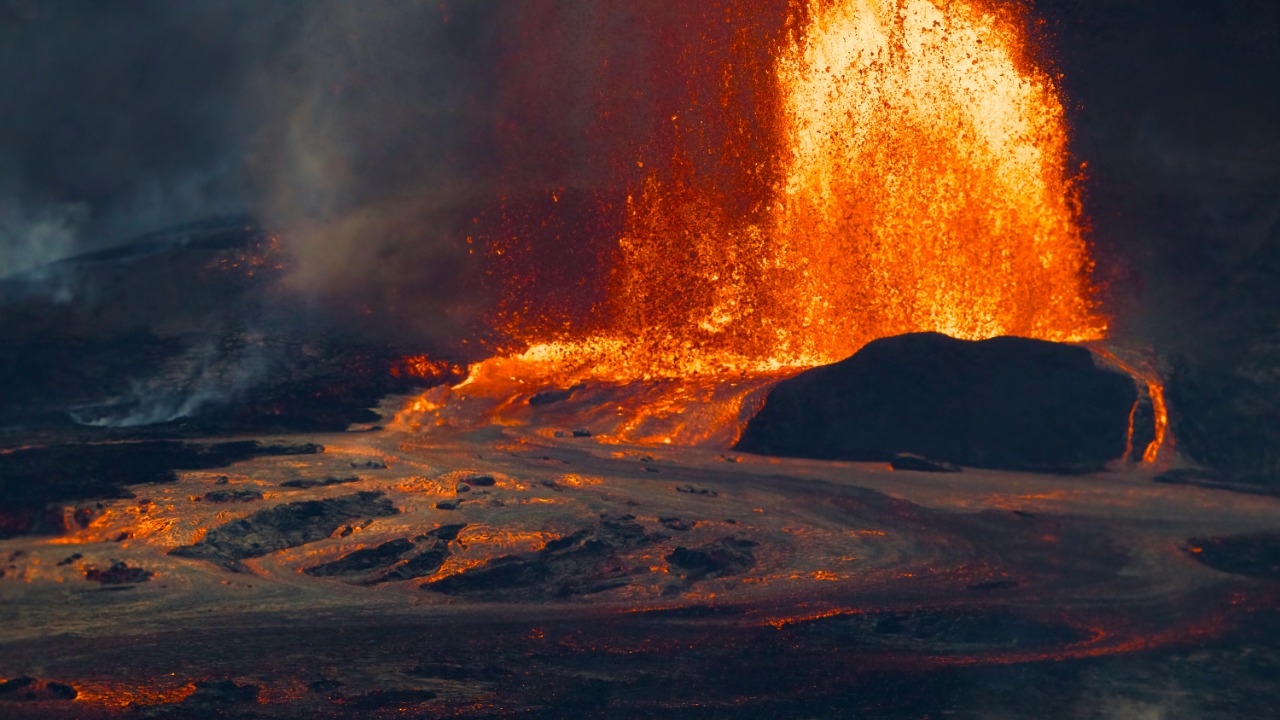

A towering lava fountain at the summit of Kilauea has turned Hawaii’s most closely watched volcano into a live theater of fire, drawing a crush of onlookers who packed viewing areas for a rare front‑row look at the planet remaking itself. The display, driven by a sustained burst of molten rock and gas, has combined raw spectacle with a sobering reminder that this beauty is inseparable from real volcanic risk.
From the crater rim, the scene has been almost unreal: incandescent jets arcing into the night, a glowing lake spreading across the crater floor, and a plume rising high into the upper air while crowds murmur, cheer, and quietly edge closer to the railings.
The eruption that lit up the summit
The latest summit activity at Kilauea has been defined by height and duration, a pairing that helps explain why so many people felt compelled to see it in person. Earlier this week, lava from the active vent surged in a continuous column that climbed an estimated 800 feet into the air, a scale that turns the fountain into a kind of natural skyscraper of fire. That vertical reach, combined with the relative accessibility of the summit within Hawaii Volcanoes National Park, transformed a routine eruption into a landmark event for visitors who happened to be on the island at the right moment.
What unfolded at the summit was not a brief spurt but a structured episode in a longer eruptive sequence. Volcanologists tracking the activity identified it as part of Kilauea’s ongoing pattern of numbered events, with the current burst cataloged as Episode 40 in the recent series. That episode of lava fountaining persisted for nearly 10 hours, long enough for the fountain to build broad, glowing flows across the crater floor and for word of the spectacle to spread far beyond the park’s boundaries.
Episode 40 and the mechanics behind the show
From a scientific perspective, Episode 40 is a case study in how a basaltic volcano can shift gears from simmering to spectacular without much warning. At the summit, magma rising through the conduit found an efficient pathway to the surface, allowing gas‑rich molten rock to escape in a sustained jet rather than in short bursts. That behavior produced the classic firehose effect, with the fountain feeding overlapping sheets of lava that advanced across the crater floor while the vent roared like a jet engine. For geologists, the episode offers a window into how pressure, gas content, and conduit geometry interact inside Kilauea’s shallow plumbing system.
The United States Geological Survey has been documenting this evolution in near real time, posting detailed volcano updates that track changes in tremor, gas emissions, and surface activity. Those observations show how the fountain’s intensity waxed and waned over the course of the episode, with the north vent dominating the display while intermittent spattering continued from the south vent. The pattern underscores that even within a single labeled event, Kilauea’s summit is a complex, multi‑vent system rather than a single, simple blowtorch.
A global audience for a remote crater
What set this eruption apart was not only the physics but the people. Crowds converged on Kilauea from across Hawaii and far beyond, turning the summit overlook into a kind of international grandstand. Local reporting described how lava fountains at Kilauea drew global crowds, with visitors speaking a mix of languages as they lined the railings and trail edges for a glimpse of the glowing crater. For many, the eruption became the unplanned centerpiece of a trip, a once‑in‑a‑lifetime chance to see an active volcano performing at full intensity.
That surge in interest did not come out of nowhere. Over the past year, the summit eruption has steadily built a reputation for reliable drama, with a steady stream of Visitor photos and videos circulating online and fueling a feedback loop of curiosity. By the time Episode 40 ignited, social media feeds were primed for another round of viral images, and tour operators were ready to pivot itineraries so guests could catch the show. The result was a crowd that felt less like a random gathering and more like a global audience that had been quietly assembling for months.
Social media turns lava into a shared experience
In the age of smartphones, a lava fountain is never just a local event. Within minutes of the first sustained jets, short clips of molten rock blasting skyward from Kilauea’s summit were circulating on platforms that reach far beyond Hawaii. One widely shared video captured huge lava fountains shooting out of Mount Kilauea inside Hawaii Volcanoes National Park, framing the eruption against the dark crater walls and the silhouettes of onlookers at the rim. Those few seconds of video compressed the scale, sound, and danger of the event into a format that could be replayed endlessly on phones around the world.
Scientists and agencies joined that digital chorus, using social platforms to share both awe and information. An official clip of the summit eruption, posted by a federal volcano monitoring account, showed lava fountains from the north vent soaring over 800 feet high and feeding growing flows across the crater floor, while the caption noted that the post had drawn 5,384 likes. That kind of engagement turns technical observations about gas emissions, plume height, and tephra fall into widely shared public knowledge, blurring the line between scientific documentation and mass entertainment.
Beauty, risk, and the challenge of managing the crowd
For all its visual appeal, a summit eruption on this scale is not a harmless light show. The same vent that sends lava 800 feet into the air also releases large volumes of volcanic gas, which can form vog that drifts downwind and affects air quality for communities far from the crater. During Episode 40, monitoring data highlighted high emission rates and a plume that climbed more than 13,000 feet into the sky, a reminder that the eruption’s footprint extends well beyond the glowing crater floor. Tephra, or fragments of lava that fall through the air, was reported on the western and southern rim of Halemaʻumaʻu, underscoring the need for visitors to respect closures and stay out of zones where falling debris can become a hazard.
Park managers and scientists have been trying to strike a balance between access and safety as the summit eruption matures. Over the past year, the steady activity has prompted repeated safety reminders as visitor numbers climbed, with officials urging people to stay on marked trails, heed air quality advisories, and prepare for rapidly changing conditions at the rim. Real‑time Kilauea monitoring, combined with on‑the‑ground rangers and clear signage, has so far allowed thousands to witness the spectacle without major incident. The challenge now is to maintain that record as word of the lava fountain’s power spreads and even more people arrive hoping to stand, for a few minutes, at the edge of a living volcano.
More from Morning Overview