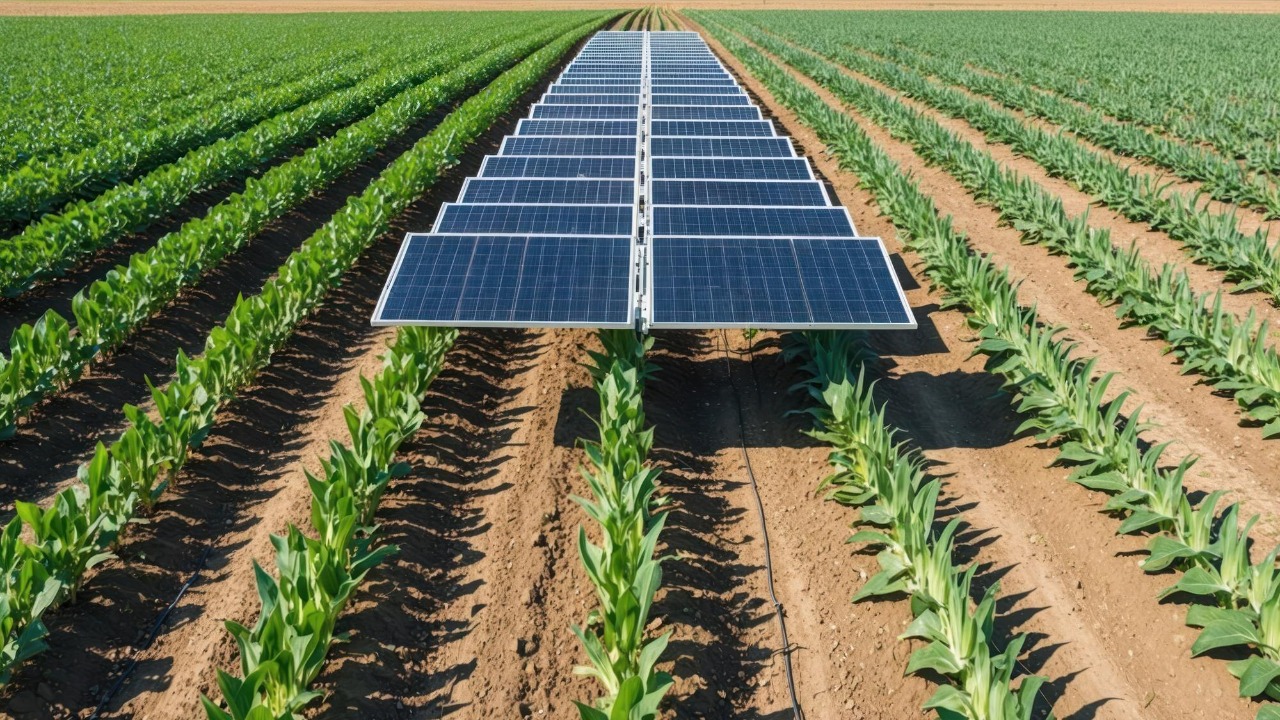

Solar panels are no longer just lining barn roofs and field edges, they are rising directly above rows of vegetables, orchards and vineyards, reshaping how food and power are produced on the same piece of land. Early results from these solar-panel crops point to a surprising outcome that could change farming: in the right conditions, yields, water use and worker safety can all improve while electricity flows from the same acreage. As agrivoltaic projects scale up from pilot plots to commercial fields, the question is shifting from whether this can work to how quickly farmers and policymakers can adapt.
From land competition to land sharing
For years, the debate around rural solar projects has been framed as a zero sum contest between food and energy, with every new array seen as land taken out of production. Agrivoltaics, the practice of growing crops under and around elevated panels, turns that logic on its head by treating sunlight as a resource that can be split rather than claimed outright. Instead of forcing farmers to choose between a harvest and a power purchase agreement, the same field can now host both, with the panels tuned to let through just enough light for plants while capturing the rest as electricity.
That shift is especially significant in regions where arable land is already under pressure from urban growth or climate stress. Researchers studying how solar panels and crops can coexist describe agrivoltaics as a way to relieve land use conflicts, but they also highlight how complex the design choices are, from panel height and spacing to local soil and weather patterns. The emerging consensus is that there is no single template that fits every farm, yet the core idea of sharing land between kilowatts and calories is proving robust across very different landscapes.
The technique behind the “stunning” results
The most striking results so far come from experiments that treat agrivoltaics as a carefully engineered system rather than a simple add-on to existing fields. In these projects, panels are raised higher than typical utility-scale arrays and spaced to create alternating bands of light and shade, with crops selected and planted to match that microclimate. This technique is not just about bolting hardware over plants, it is about balancing photosynthesis, soil moisture and power output so that neither the farm nor the solar installation is compromised.
In one widely cited trial, researchers testing crops grown under solar panels reported that this agrivoltaic technique allowed them to generate electricity and harvest food without sacrificing either side of the equation. The team behind these stunning discovery emphasized that the key was active design, not luck: panel tilt, row orientation and crop choice were all tuned so that the plants received enough diffuse light while the modules still produced competitive power. Their findings are helping to move agrivoltaics from a curiosity to a replicable model that can be adapted to different regions and farm types.
Shade, heat and the physiology of crops
At the heart of agrivoltaics is a deceptively simple insight: many crops do not actually want full, unfiltered sun all day, especially as heat waves become more frequent. Leaves can overheat, soil moisture can evaporate faster than irrigation systems can replace it and fruit can suffer sunburn that ruins market value. By casting partial shade, solar panels can moderate these extremes, creating a cooler, more stable microclimate that keeps plants within their comfort zone for longer each day.
Researchers working in hot, dry regions have documented how crops such as lettuce, peppers and berries respond positively when panels cut peak radiation and reduce wind stress. One analysis of the unexpected reason farmers are planting crops under solar panels notes that many crops grown in these systems, including vegetables and specialty fruits, benefit from the moderated temperatures and lower evapotranspiration beneath the arrays. In some cases, the panels are even being used to green former deserts, where direct exposure would otherwise make cultivation nearly impossible.
Water savings and resilience in a hotter world
Water is where the agrivoltaic story becomes especially compelling for climate adaptation. As temperatures rise and droughts intensify, farmers are under pressure to stretch every liter of irrigation while still maintaining yields. The shade from solar panels reduces direct evaporation from the soil surface and helps keep root zones cooler, which means plants lose less water through transpiration and can maintain growth with fewer irrigation cycles.
Evidence from field trials shows that this is not just a theoretical benefit. In one study carried out with several organizations, including the Center for International Forestry Research and Wo, researchers found that pairing solar panels with crops improved yields while also cutting water demand. The team reported that the incredible results of pairing solar panels with crops included better soil moisture retention under the arrays and reduced irrigation needs thanks to the protective canopy provided by the panels. For farmers facing shrinking water allocations, that kind of efficiency gain can be the difference between staying in business and fallowing fields.
Apple orchards, vineyards and the “Apple Harvest” effect
While much of the early agrivoltaic work focused on vegetables and field crops, perennial systems such as orchards and vineyards are now emerging as some of the most promising test beds. Trees and vines already create layered canopies, and their long lifespans make it easier to justify the capital cost of solar infrastructure that will sit above them for decades. When panels are integrated thoughtfully, they can shape fruit development, protect blossoms from frost and hail and even influence flavor profiles.
A French agrivoltaics specialist, Sun’Agri, has reported particularly striking outcomes from its 2024 Apple Harvest at two pilot agrivoltaic sites. According to the project data, the Apple Harvest results showed a yield boost of 20 percent to 60 percent in apples grown under the adjustable panels, which were programmed to optimize light and temperature for the trees. The same approach has been applied to vineyards, where grape yields under solar panels increased while irrigation needs were reduced and aroma profiles in the resulting wines improved, suggesting that agrivoltaics can be a tool not just for quantity but for quality in high value crops.
On-the-ground experience from working farms
Beyond research plots and pilot orchards, working farmers are starting to report their own experiences with solar-panel crops, and their stories help ground the science in day to day reality. One vegetable grower who installed panels above rows of greens and herbs initially expected only a modest side income from electricity sales. Instead, the farmer found that the partial shade changed how both plants and people handled the hottest part of the season.
According to this farmer, the protection from the sun allowed workers to do their jobs more comfortably, with temperatures under the panels dropping by roughly 15 to 20 degrees compared with fully exposed sections of the field. The same installation also shielded delicate crops from heat stress and heavy rain, creating a more predictable environment for harvest scheduling. As the farmer put it in a reflection on unexpected benefits of solar panels on cropland, the system became a way to protect both people and plants while still helping the planet through clean energy generation. That kind of lived experience is starting to carry weight in rural communities where neighbors watch closely to see whether new ideas actually pay off.
The complexity behind choosing what to plant where
For all the optimism, agrivoltaics is not a plug and play solution that can be dropped onto any field with guaranteed success. The performance of solar-panel crops depends on a tangle of variables, including local climate, soil type, crop species, panel height, tilt angle and the spacing between rows. A configuration that works beautifully for leafy greens in a temperate valley might fail for grains on a windy plateau or for root vegetables in heavy clay soils.
An in depth analysis of how solar panels and crops can coexist underscores just how many of these factors need to be considered before a project breaks ground. The researchers behind that work catalogued the trade offs between maximizing energy output and maintaining crop yields, noting that panel density, orientation and tracking systems all influence how much light reaches the plants. They also pointed out that local regulations, grid connection rules and farm labor patterns can shape what is feasible, which means agrivoltaics must be tailored not only to biology and physics but also to policy and economics.
Economic stakes for farmers and rural communities
The financial logic of agrivoltaics is as important as the agronomy. Farmers operate on tight margins, and any new system has to justify itself in terms of cash flow, risk reduction or both. Solar-panel crops offer multiple revenue streams, combining power sales or lease payments with continued harvests, but they also require upfront investment in structures that are taller, more widely spaced and more complex than standard ground mounted arrays.
Where the numbers work, the payoff can be significant. The yield boost of 20 percent to 60 percent reported in the Apple Harvest projects, combined with reduced irrigation costs and premium prices for improved grape aroma profiles, illustrates how agrivoltaics can enhance the value of each hectare rather than simply stacking two mediocre uses on top of each other. At the same time, the experience of farmers who have seen cooler working conditions and more resilient crops under panels, as described in accounts of agrivoltaic vegetable farms, suggests that the technology can also function as a form of insurance against climate volatility. For rural communities, that combination of diversified income and climate resilience could help stabilize local economies that are otherwise vulnerable to droughts and commodity price swings.
What still needs to be learned
Despite the promising data, agrivoltaics is still in its early stages, and there are important gaps in knowledge that need to be filled before it can be deployed at scale with confidence. Long term impacts on soil health, pest dynamics and pollinator behavior under panel shade are not yet fully understood. There are also open questions about how different panel technologies, such as bifacial modules that collect light from both sides, interact with crop canopies and ground cover over time.
Researchers who have conducted broad analysis of agrivoltaic systems stress that more field trials are needed across diverse climates and farm sizes, from smallholder plots to large commercial operations. They argue that standardized metrics for comparing yield, water use, energy output and economic returns would help farmers and investors make informed decisions. Until that evidence base is built out, agrivoltaics will remain a patchwork of pioneering projects rather than a mainstream option, even as the early results hint at a transformation in how we think about the relationship between solar power and agriculture.
More from MorningOverview