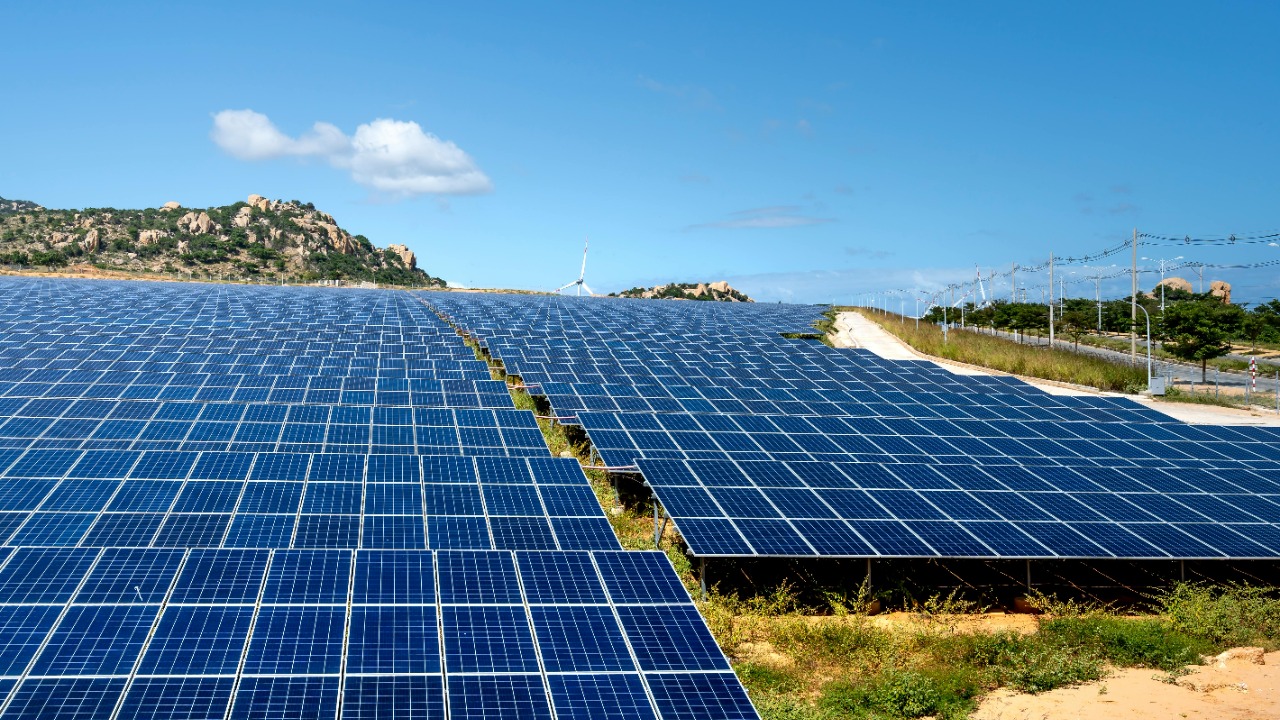

The Mojave Desert is often portrayed as empty space waiting to be filled with solar panels, but the ground beneath those arrays can be as biologically rich as any national park. New research on a delicate wildflower called threecorner milkvetch suggests that, with care, utility‑scale solar farms can double as refuges for rare plants instead of wiping them out. I see in this story a preview of how the clean energy buildout might evolve, from a blunt land grab into a more careful negotiation with the ecosystems it occupies.
At the heart of that shift is the Gemini Solar Project outside Las Vegas, where developers tried to keep the desert’s living crust intact rather than scraping it away. The results, tracked by scientists over multiple seasons, show threecorner milkvetch not only persisting but in some cases flowering and fruiting more vigorously under the panels than in nearby open desert. For a plant once seen as collateral damage in the energy transition, that is a remarkable plot twist.
The Mojave Desert’s “empty” land is anything but
From a distance, the Mojave Desert can look like a blank beige canvas, which is one reason it has become a magnet for large solar projects. Up close, that canvas resolves into a dense community of shrubs, cryptobiotic soil, insects, reptiles, and rare annuals like threecorner milkvetch that appear only in the right combination of rain and temperature. Reporting on the ostensibly barren Mojave Desert underscores how much life is packed into what many maps still label as “vacant” land. When I look at the satellite images of these valleys, I now see not emptiness but a living archive of seeds and roots waiting for their chance.
Threecorner milkvetch, a rare Astragalus species, is part of that archive. It spends most years as a seed in the soil, then erupts into a brief flush of stems and pods when conditions align. Scientists studying the plant at Gemini initially assumed that building a utility‑scale solar facility on its habitat would doom the population. Their formal hypothesis was that threecorner milkvetch would show lower survival, reproduction, and growth, and a later phenology, inside the fenced array compared with outside it, and that construction would erode the ability of the site to maintain viable seed banks, as outlined in a USGS study. That expectation, rooted in decades of experience with heavy grading and vegetation removal, set a low bar for what “success” might look like.
Gemini Solar Project’s gentler construction experiment
What happened at the Gemini Solar Project is notable precisely because it broke with that older playbook. In the desert outside of Las Vegas, the Gemini Solar Project was built with a deliberate effort to preserve as much of the native ecosystem as possible. Instead of scraping the site flat, crews left patches of vegetation standing, drove posts between shrubs where they could, and tried to minimize disturbance to the soil crust that holds the seed bank. That approach is echoed in other accounts that describe how, unlike many utility‑scale solar projects, developers at Gemini avoided heavy grading in some areas and preserved topsoil, a choice highlighted in coverage of how Unlike projects that bulldoze entire sites, Gemini tried to work around the desert’s existing fabric.
At the time of construction, the Gemini Solar Project (hereafter, Gemini) was the largest USSE photovoltaic and battery storage facility of its kind, which meant any deviation from standard construction practice carried financial and engineering risk. Yet the decision to keep topsoil and microhabitats in place created a kind of living laboratory under and between the rows of panels. Later reporting on In the desert outside of Las Vegas, where Gemini sits, notes that the survival of the seed bank was “phenomenal,” a word that captures how far the outcome diverged from the grim expectations many ecologists had going in.
Surveys show threecorner milkvetch thriving, not vanishing
The real test of Gemini’s experiment came when botanists returned to count plants. Surveys at one of the largest solar energy facilities in the Mojave Desert indicate that a rare annual plant is not only persisting but thriving amid the array, according to SolarDaily. Those surveys documented threecorner milkvetch plants both inside and outside the fenced project, giving researchers a rare before‑and‑after snapshot of how a specific species responds to construction. Instead of the predicted collapse, the plant’s numbers and reproductive output held steady or improved in many of the microhabitats under the panels.
Another account of Surveys at Gemini emphasizes that the rare Mojave milkvetch, as it is sometimes called, has persisted through the installation of the solar array. A separate analysis of the same project reports that the results were striking, with 93 plants found on site in 2024 compared to 12 plants found before construction in 2018. For a species whose entire known population can be counted in the dozens, that jump is not a rounding error, it is a sign that the combination of preserved soil, partial shade, and reduced off‑road vehicle traffic inside the fence may actually be improving conditions for germination and flowering.
Science behind a solar‑powered refuge
To understand why threecorner milkvetch is doing well at Gemini, it helps to look at the experimental design. Researchers working on rare milkvetch persistence at a utility‑scale solar site divided the habitat into zones, including open interspaces, panel driplines, and under‑panel areas, and then tracked survival, growth, and phenology of individual plants in each zone, as described in the USGS paper. They expected the altered light and moisture regime under the panels to delay flowering and reduce seed set. Instead, some of the plants under the structures produced more flowers and fruits than their counterparts in full sun, a pattern also noted in reporting on how the Mojave Desert population responded.
At the same time, ecologists studying Gemini have been careful not to over‑interpret a single good year. One account of the work stresses that the findings on plant survival and reproduction come from just one year of monitoring after construction, and that teasing apart the effects of the solar array from background changes in weather patterns will require more data, a caveat spelled out in coverage of Findings on plant survival. I read that caution as a reminder that even promising results need to be grounded in long‑term monitoring, not just a single wet or dry season.
Conservation lessons and trade‑offs for the clean energy buildout
For me, the most important part of the Gemini story is what it suggests about how to build the next wave of solar. Conservation efforts at Gemini Solar Project show that it is possible to generate large amounts of electricity while still preserving key elements of desert plant communities, a point underscored in reporting that describes how Conservation at the Gemini Solar Project helped threecorner milkvetch rebound. The Gemini Solar Project is unique because it made efforts to preserve the desert plant community rather than treating it as waste material, and that choice appears to have paid off in both biodiversity and public perception.
At the same time, researchers like Pereira have been explicit that Gemini does not erase the broader tension between habitat protection and the land footprint of renewable energy. Future research and habitat trade‑offs are front and center in their comments, which emphasize that even with careful design, some impacts cannot be avoided, a nuance captured in coverage of Future research and habitat trade‑offs Pereira is calling for. Another account of the same work notes that The Gemini Solar Project is being watched closely as a model for how to integrate large‑scale solar with sensitive habitats, highlighting how Gemini Solar Project could influence permitting and design standards far beyond Nevada.
More from Morning Overview