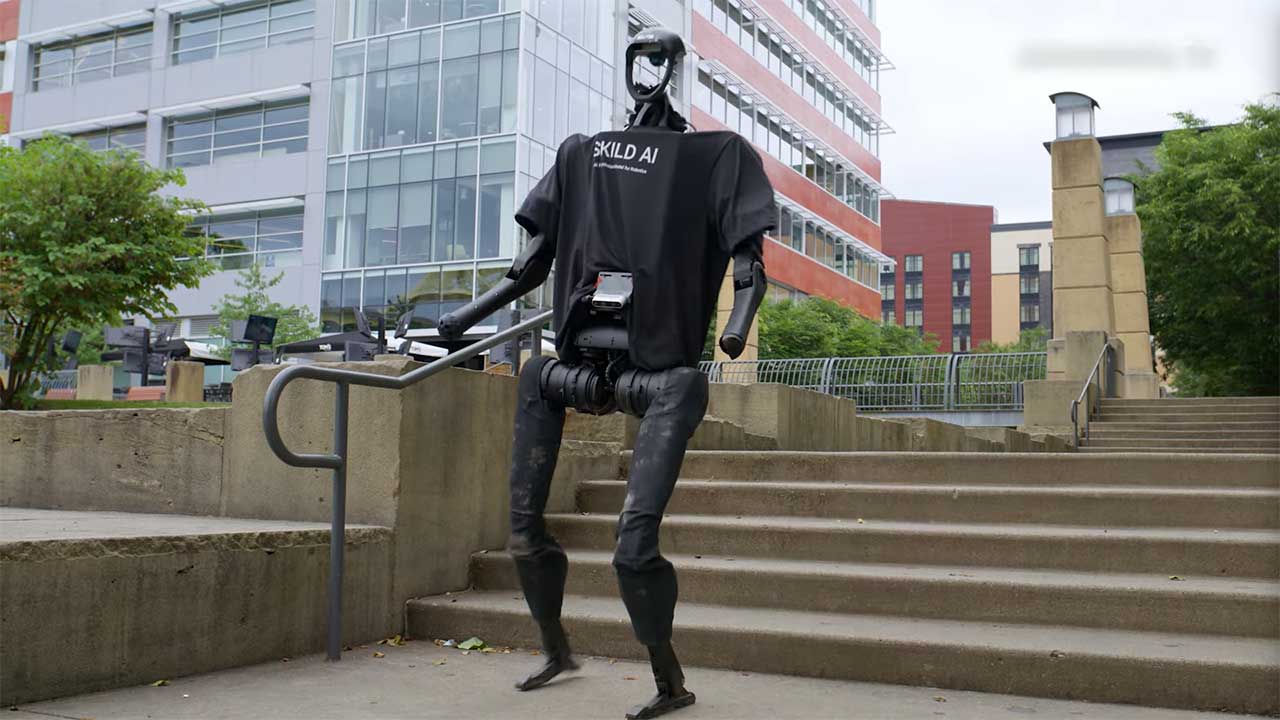

Skild AI has just reset the bar for robotics funding, pulling in a colossal $1.4 billion to build what it pitches as a general-purpose software brain for machines. The round vaults the Pittsburgh startup to a valuation north of $14 billion and signals that investors now see robotic intelligence as the next frontier after large language models. I see this deal as a bet that the same foundation-model playbook that reshaped software will now do the same for physical work.
Behind the headline number is a simple but sweeping promise: if Skild AI is right, a single model could eventually control everything from warehouse arms to household helpers, learning new tasks on the fly instead of being painstakingly programmed. That vision, and the speed of the company’s rise, is what makes this funding round feel less like a routine mega-deal and more like a turning point for the robotics industry.
Inside Skild AI’s monster round and surging valuation
The core facts are stark. Skild AI has raised $1.4 billion in fresh capital, lifting its valuation to over $14 billion and instantly placing it among the most richly valued private robotics companies on record. The company, based in PITTSBURGH, describes itself as an AI robotics player building a scalable foundation model for robotics, a software layer meant to sit above the hardware and generalize across many different machines, according to its own funding announcement. For a sector that has long struggled to attract the same capital as pure software, the size of the check alone is a signal that robotics is moving into the center of the AI story.
The new round is structured as a Series C and is led by SoftBank Group, with participation from NVIDIA Ventures and Macquarie Capi, according to a separate funding breakdown. Another investor-focused summary notes that the company has just announced raising $1.4 in Series C funding at a $14B valuation led by SoftBank, with participation from NVID and other backers, underscoring how central both capital markets and chip suppliers now are to the robotics stack on social media. In practical terms, that combination gives Skild AI not just money but also privileged access to compute and strategic partners, two ingredients that have proven decisive in the rise of large AI models.
A valuation that tripled in months
What makes this deal even more striking is the speed of Skild AI’s ascent. Earlier this year, the company closed a $135 million Series B at a $4.5 billion valuation, a figure that already placed it in rarefied startup territory. In less than a year, that valuation has effectively tripled to more than $14 billion, a trajectory that one investor-focused report describes as Skild raising $135 million in a prior round and then using the new capital to triple its worth in just seven months relative to that. For a robotics company, which typically faces long hardware cycles and slower revenue ramps, that kind of re-rating is almost unheard of.
To me, the numbers suggest that investors are no longer valuing Skild AI as a niche automation vendor but as a potential platform company for the entire robotics ecosystem. The jump from $4.5 billion to over $14 billion in such a short window implies that backers see the company’s foundation model as something that could be licensed, integrated, and extended across many industries, not just a single vertical. It also reflects a broader shift in venture capital, where the biggest checks are now flowing to companies that can credibly argue they are building the “operating system” for a new class of intelligent machines rather than a single robot or application.
The foundation model bet: one brain, many robots
At the heart of Skild AI’s pitch is the idea that robotics can follow the same pattern as language and vision models, with a single large model that learns from vast amounts of data and then adapts to new tasks through prompts and examples. The company describes its approach as Scaling Robot Intelligence with In-Context Learning, emphasizing that Over the past year it has focused on training a model that can generalize across different environments and tasks rather than being hard-coded for one job at a time technical overview. In practice, that means a robot could be shown a few demonstrations or given a high-level instruction and then infer how to complete a new task, much like a language model can respond to a novel prompt.
Skild AI says its technology is already being applied to a wide range of hardware, from industrial systems to more experimental platforms. The company highlights that its model is designed to work across robot arms, tabletop arms, and mobile manipulators, aiming to provide a unified control layer that abstracts away the specifics of each machine product description. If that approach holds up in real-world deployments, it could dramatically reduce the cost and time required to bring new robots online, since developers would not need to build bespoke control software for each new configuration.
From warehouses to households: what Skild AI wants robots to do
The company’s ambitions extend well beyond factory floors. Skild AI says its technology gives robots the ability to perform simpler tasks such as household chores like cleaning and other routine activities that today still rely heavily on human labor. In its own description, Skild AI frames this as a step toward robots that can handle both structured industrial work and more chaotic home environments, using the same underlying intelligence to adapt to different contexts across use cases. That is a far cry from the single-purpose machines that have dominated robotics for decades, such as fixed automotive welding arms or simple vacuum robots.
In industrial settings, I expect Skild AI to target logistics hubs, manufacturing lines, and fulfillment centers first, where robots can be trained to pick, pack, and move goods with relatively consistent layouts. Over time, the same model could be adapted to service robots in hospitals, hotels, or retail, and eventually to consumer devices that help with laundry, dishwashing, or elder care. The company’s own messaging, including the claim that its goal is to power any robot for any task, suggests that it sees no hard boundary between these domains, only different levels of complexity that a sufficiently capable model should be able to handle over time. If that vision pans out, the line between industrial and consumer robotics could blur, with a shared intelligence layer spanning both.
Why investors are crowding into robotic intelligence now
The scale and speed of Skild AI’s funding reflect a broader shift in how investors view robotics. For years, capital tended to favor software-only AI, where models could be deployed instantly to millions of users without touching the physical world. Now, with large language models maturing and infrastructure like NVIDIA GPUs becoming central to both software and hardware AI, backers appear more willing to fund companies that bridge the gap between code and machines. The fact that Skild AI Raises $1.4B and is Now Valued Over $14B, with a Round led by SoftBank Group and participation from NVIDIA Ventures, shows how closely robotics is now tied to the same compute and capital pipelines that power generative AI across the sector.
More from Morning Overview