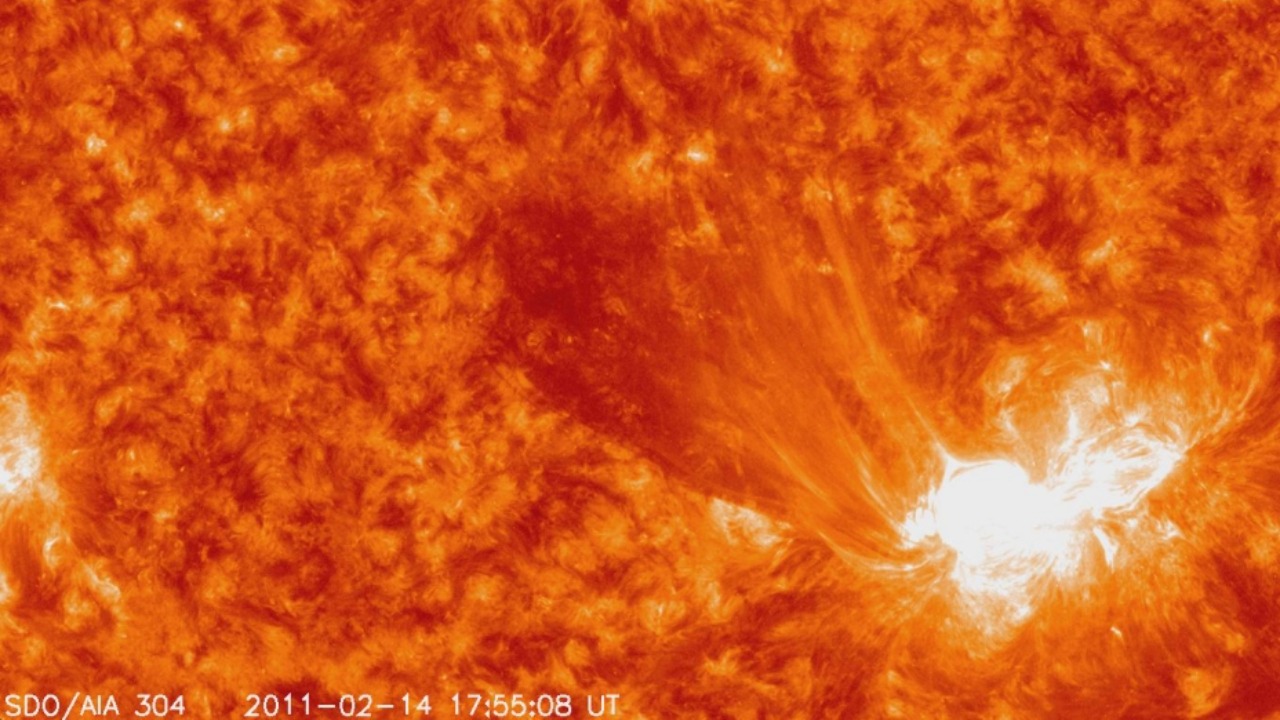

A rare burst of solar fury is slamming into Earth tonight, and forecasters warn it is strong enough to disrupt satellites, GPS and high‑frequency communications while lighting up skies with vivid auroras. The event ranks among the most intense space‑weather episodes in more than two decades, and the combination of radiation and geomagnetic storms is expected to keep conditions unsettled for hours, possibly days.
At the same time, the spectacle could be extraordinary, with Northern Lights visible far beyond their usual haunts if clouds cooperate. The challenge for governments, airlines, power grid operators and anyone who relies on precise navigation is to ride out the disturbance without letting a celestial light show turn into a technological stress test.
What tonight’s severe solar storm actually is
Forecasters have confirmed that an S4 (Severe) Solar Radiation Storm is in progress, a level that space‑weather experts reserve for the most extreme events. The alert notes an S4 (Severe) Solar Radiation Storm in Progress on Jan 19, issued on a Monday in the evening hours UTC, and it explicitly references the benchmark “Halloween” space weather storms, underscoring how unusual it is to see conditions reach this tier again with a severity index of 54. In practical terms, that means a torrent of high‑energy particles from the Sun is flooding near‑Earth space, a hazard that is invisible from the ground but very real for spacecraft and anyone above most of the atmosphere.
Radiation at this level brings an Increased exposure risk for astronauts and for flights that cross polar routes, and it comes with an Enhanced threat to satellites, especially those in geosynchronous orbits that sit squarely in the firing line of energetic particles. Official guidance highlights that the Increased radiation exposure risk for astronauts and flights on polar routes, along with Enhanced risk to satellites in key orbits, is already being observed as the storm unfolds, with knock‑on effects for high‑frequency communications in polar regions that depend on the upper atmosphere behaving predictably, according to detailed radiation and communications assessments.
From X‑flare to geomagnetic storm: how we got here
The radiation storm did not appear out of nowhere, it is the direct result of powerful activity on the Sun that has been building. Earlier, the Sun unleashed a strong X‑class flare accompanied by a huge coronal mass ejection, or CME, a massive expulsion of plasma threaded with magnetic fields that can travel from the Sun to Earth in a matter of hours. When a CME is directed at Earth and its magnetic field orientation lines up just wrong, it can couple efficiently with our planet’s own field and drive a geomagnetic storm, a process that forecasters flagged as a serious possibility as they watched a large CME race toward Earth.
That warning has now materialized in the form of a G4 (Severe) geomagnetic storm, one step below the maximum on the standard scale. Officials report that G4 Severe Geomagnetic Storm Levels Reached on Jan 19, with the event associated with S1 or greater solar radiation conditions and a 10% chance of even stronger episodes, and they caution that G4 Geomagnetic Storm Levels Reached could persist, with G4 levels remaining possible as the night wears on. In other words, the planet is currently enveloped in a combined radiation and geomagnetic disturbance that is already strong enough to disturb the upper atmosphere and induce currents in long conductors, according to the latest storm bulletin.
Satellites, GPS and aviation in the crosshairs
For most people, the immediate concern is not the radiation itself but what it can do to the infrastructure that orbits above us or depends on the ionosphere. Satellite operators are already contending with an Enhanced risk to spacecraft in geosynchronous and other high orbits, where energetic particles can charge surfaces, damage electronics and degrade solar panels, as highlighted in the official S4 Severe Solar Radiation Storm in Progress alert. That same environment can interfere with the signals that satellites send to Earth, including the timing and navigation beacons that underpin everything from smartphone maps to container ship routing, a vulnerability that becomes acute when a Severe Solar Radiation Storm in Progress coincides with a G4 geomagnetic event on Jan.
Navigation systems are particularly sensitive. In calm conditions, single‑frequency GPS receivers can locate a device to within about a meter or less, but During a severe space‑weather episode, the same GPS signals can be delayed or distorted by the disturbed ionosphere, turning that meter‑level precision into errors of tens of meters or more. That kind of degradation can ripple through sectors that depend on centimeter‑level accuracy, from precision farming to automated port operations, and it is exactly the sort of impact that space‑weather specialists warn about in their guidance on GPS systems.
Power grids, flights and the glow of Northern Lights
On the ground, the same geomagnetic forces that paint the sky with auroras can induce currents in long power lines and pipelines, stressing transformers and control systems. Analysts note that the interference could cause issues with the power grid, radio communications and other technology, even as people look up to enjoy the Northern Lights, and they are already fielding questions about What the possible health impacts might be from such a strong radiation storm. So far, the main health concern remains focused on those at high altitude or in space, but grid operators are on alert for the kind of geomagnetically induced currents that have, in past storms, tripped protective relays and knocked out power, according to detailed assessments of potential interference.
Aviation is already adjusting. With Increased radiation exposure risk for astronauts and flights on polar routes, airlines are reviewing whether to reroute some long‑haul flights away from the highest latitudes, where both radiation and radio blackouts are most intense. Space‑weather forecasters have warned that the storm could produce an aurora or what is called the Northern Lights, and Despite the increased severity, NOAA has emphasized that the Northern Lights risk to the general public on the ground is low, even as high‑frequency communications in polar regions face more serious disruption, according to updated guidance from NOAA.
Where the aurora could appear, and how to watch safely
For skywatchers, the same conditions that worry engineers offer a rare chance to see the aurora far from the Arctic. Forecasters say a G4‑level geomagnetic storm is impacting Earth, according to NOAA’s Space Weather Prediction Center, and The Brief from regional meteorologists notes that a blast of charged particles is already interacting with Earth’s magnetic field. That setup means people as far south as Texas are asking whether they will see shimmering curtains of light, and some outlets are explicitly asking Will Texas be able to see the Northern Lights as the storm, according to the NOAA Space Weather Prediction Center, continues overnight.
Elsewhere, the aurora footprint could be even broader. In the U.S., skies as far south as Illinois, Pennsylvania and Oregon may glow with Northern Lights, with the best chances in darker rural areas away from city glare, according to regional forecasts that describe how In the U.S., skies as far south as those states could light up under the current storm, a scenario illustrated in maps shared by In the forecast. Another outlook notes that Northern lights may be visible unusually far south tonight, with Here’s where maps showing potential visibility into parts of California, the central Plains and the Mid‑Atl region, underscoring how rare it is to have an event at more southerly latitudes, according to a detailed Here breakdown.
Supporting sources: Area circled has.
More from Morning Overview