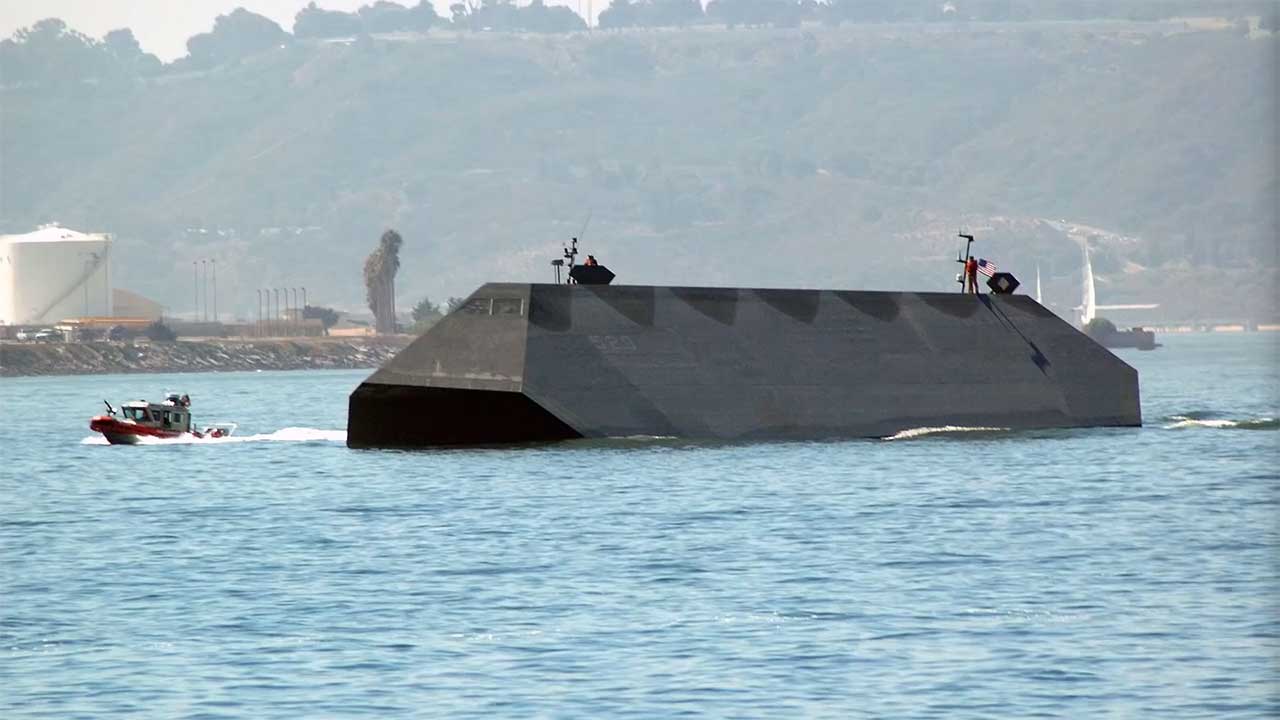

Long before angular stealth jets became icons of modern warfare, the United States quietly built a ship that looked like a floating aircraft wing. Conceived in the depths of the Cold War and completed roughly 40 years ago, the experimental vessel known as Sea Shadow stayed hidden for years inside a covered barge, then slipped into view only briefly before vanishing again into storage and, eventually, scrap. I see its story as a rare window into how radically the Navy was willing to rethink the shape, size, and even the crew of a warship to make it nearly disappear from radar.
Today, with stealthy drones and low‑observable fighters treated as standard tools, the rediscovery of Sea Shadow’s details feels less like a curiosity and more like a missing chapter in the evolution of maritime technology. The ship’s jet‑like silhouette, compact 156‑foot frame, and experimental automation foreshadowed debates that still define naval design: how small a crew is acceptable, how much secrecy is justified for cutting‑edge projects, and how far to push radical forms before they become politically impossible to field.
The Cold War gamble that birthed Sea Shadow
Sea Shadow, formally designated Sea Shadow (IX‑529), emerged from a moment when the United States was racing to shrink its radar signature on every front, from bombers to surface ships. The Navy and its contractors treated the ocean as the next frontier for low‑observable technology, and they were willing to fund a vessel that looked nothing like a destroyer or frigate. According to official histories, the project was entrusted to Lockheed for the United States Navy as a pure testbed, not a frontline combatant, which freed engineers to prioritize stealth and stability over cargo space or heavy weapons.
To keep that work out of public view, the Navy had Sea Shadow built inside a covered dry dock known as HMB, a floating barge in California that could be sealed like a hangar. One account notes that Sea Shadow was an experimental stealth ship built inside the secret HMB 1 barge in California, with the barge’s roof opened only under tightly controlled conditions. That level of secrecy meant the ship could be constructed, modified, and tested at night without coastal observers ever getting a clear look, a level of operational concealment that mirrored the hush around early stealth aircraft programs.
A jet-style hull that barely touched the waves
What set Sea Shadow apart visually was its twin‑hull configuration and sharply faceted outer shell, which made the vessel look more like a stealth bomber perched on stilts than a traditional ship. The initial design, according to company histories, consisted of a cigar‑shaped hull shielded by an outer wall of flat, angular surfaces, a geometry chosen to scatter radar energy away from hostile sensors rather than reflect it back. That faceted shell sat atop a Small Waterplane Area Twin Hull, or SWATH, arrangement that kept most of the ship’s volume below the surface, reducing motion in rough seas and further complicating radar returns, a combination that later inspired fictional designs in popular culture.
One technical description notes that Sea Shadow was about 50 m long, an experimental stealth ship designed by DARPA to test low radar profiles and high‑stability hulls. Another analysis translates that into a length of 156 feet and emphasizes that it was far from a massive vessel, just 156 feet in length, with a crew of four that included a commander, helmsman, engineer, and technician, according to detailed reporting. That compact footprint and tiny crew were part of the experiment: if automation and stealth could be proven at this scale, the logic went, the lessons might be scaled up to larger combatants.
Built in secret, revealed in Californian waters
Sea Shadow’s construction and early trials were shrouded in secrecy, but its eventual appearance off the West Coast turned it into a fleeting public spectacle. One historical account notes that Sea Shadow was built in a covered floating dry dock during construction and testing, then later photographed sailing through Californian waters near San Francisco. By the time those images circulated, the vessel had already been operating for years, its angular silhouette cutting a stark profile against the Pacific as it moved on its submerged twin hulls.
Other accounts describe how, to maintain secrecy, any operation that required opening the roof of HMB was tightly choreographed, with Sea Shadow often moved at night or under low‑visibility conditions. According to Maritime National Park Association, cited in a technical retrospective, the crew even had to consider how camera lenses might capture the ship when the barge roof opened, a detail highlighted in an analysis of Sea Shadow on. When the Navy finally acknowledged the program and allowed limited photography, the images of the black, wedge‑shaped hull confirmed that the same stealth logic shaping aircraft like the F‑117 had migrated to the sea.
Inside the experimental program
From the outset, Sea Shadow was never meant to deploy as a regular fleet unit, and that freed its designers to treat the ship as a floating laboratory. One retrospective notes that Sea Shadow (IX‑529) was an experimental stealth ship built by Lockheed for the United States Navy, and its purpose was to test stealth and automation technology rather than carry missiles or large crews. That focus on experimentation meant the vessel could push boundaries in crew reduction, sensor integration, and hull form without the burden of meeting every operational requirement that a destroyer or cruiser would face.
Company histories describe how the initial design work drew on lessons from stealth aircraft, with engineers at Lockheed adapting radar‑absorbing shapes and materials to a marine environment. One official account explains that the initial design consisted of a cigar‑shaped hull shielded by an outer wall of flat, angular surfaces, and that this configuration became a model for a stealthy ship, as detailed in a technical history from Sep. Another overview of the program from Lockheed Martin emphasizes that the project was as much about learning how to build and maintain such a vessel as it was about the ship’s performance at sea, a reminder that stealth is a lifecycle challenge, not just a design trick.
From Cold War secret to cultural touchstone
Although Sea Shadow remained largely hidden during its active testing years, its existence eventually seeped into public consciousness and even popular culture. One social media retrospective notes that the Sea Shadow, also known as the “IX‑529,” was an experimental stealth ship developed by Lockheed, and that its construction and testing phases were conducted under tight secrecy. Another historical note points out that the vessel was completed in 1984 and kept largely secret until the mid 1990s, created as a test platform during the height of the Cold War, which helps explain why its radical form did not immediately translate into a new class of warships.
Over time, the ship’s distinctive silhouette inspired fictional interpretations, including a stealth vessel in a James Bond film that drew on the same Small Waterplane Area Twin Hull, or SWATH, design. Behind the Scenes The design of the ship was partly based on the Sea Shadow (IX‑529) built by Lockh, a rare case where a classified test platform directly shaped the look of a blockbuster villain’s hardware. That cultural echo underscores how visually disruptive Sea Shadow really was: even in an era saturated with futuristic military imagery, its jet‑like, faceted hull still reads as something from the near future rather than the early 1980s.
More from Morning Overview