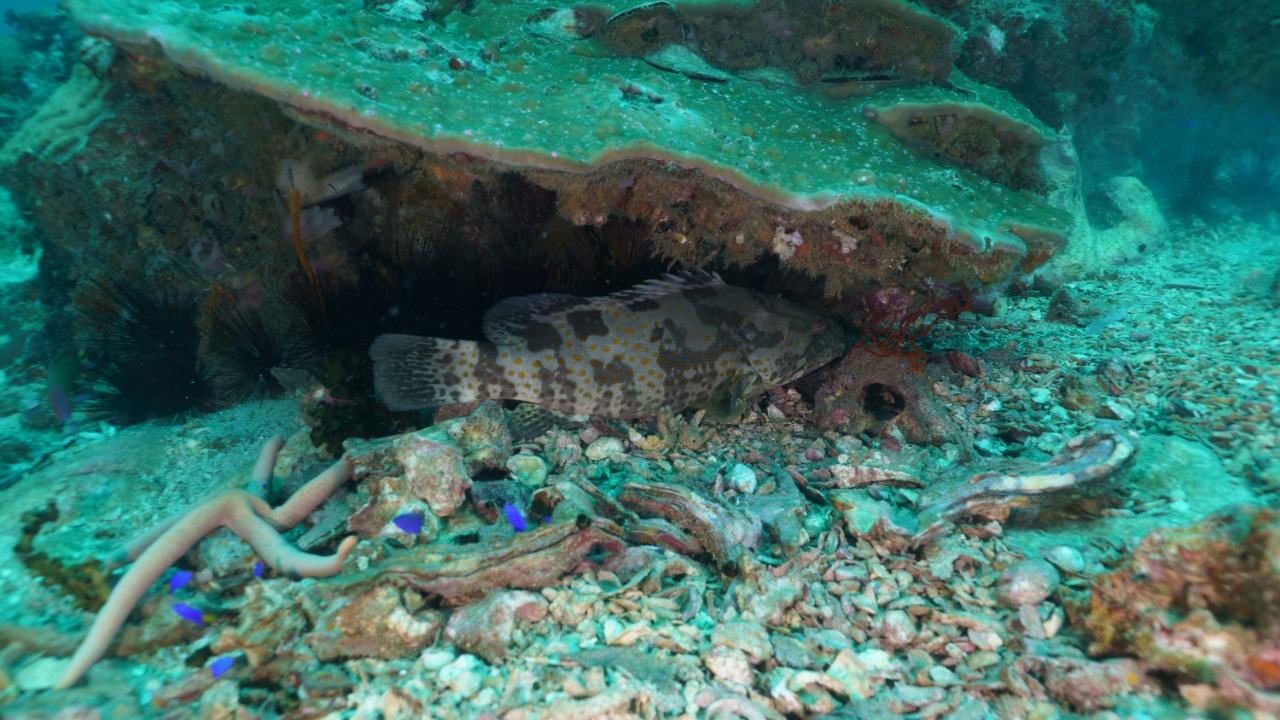

Far below the surface of the Pacific, scientists have stumbled on a colossal coral colony that has been quietly growing for roughly 300 years, rivaling cathedrals and sports fields in scale. The single organism, longer than a blue whale and visible from space, has survived centuries of storms and warming seas to become a living archive of ocean history. I see it as a rare piece of good news from the deep, a reminder that even as reefs decline, some giants are still holding on.
The discovery, made off the Solomon Islands, reveals a massive coral that sprawls across an area comparable to two basketball courts and rises like a submerged mesa from the sea floor. Its age, size and apparent health challenge assumptions about how fragile coral life must be, and they offer a powerful new reference point for understanding what it takes for marine ecosystems to endure.
The chance encounter that revealed a hidden giant
The mega coral came to light almost by accident, during a survey that was not even looking for record breakers. A team working in the waters of the Solomon Islands was reportedly following up on a shipwreck when they noticed an enormous mound on the seabed that did not match the surrounding terrain. As the divers approached, what first looked like a rock outcrop resolved into a living colony, a single coral head so expansive that Scientists realized they were looking at something unprecedented in their careers.
Subsequent measurements showed that the organism stretches across an area roughly equivalent to two basketball courts, a scale that makes it stand out even in satellite imagery. Researchers estimate that it is around 300 years old, meaning it began growing long before modern industrial activity started reshaping the climate. The colony lies a few hundred metres off the east of one of the islands, and one scientist described it as “enormous,” comparing its footprint to the size of a cathedral to convey just how outsized this single coral has become in an otherwise typical stretch of reef habitat, which was highlighted in more detail by the size comparison.
A single creature, not a reef
What makes this find so striking is that it is not a reef in the usual sense, but one vast organism. Unlike a coral reef, which includes a network of different corals, algae and other species, this structure is a standalone colony made up of nearly 1 billion genetically identical polyps that have grown together into one continuous skeleton. That distinction matters, because it shows how much biomass a single coral can accumulate when it is left undisturbed, a point underscored by reports that described how, Unlike a typical reef, this giant is essentially one creature.
The colony belongs to a type of hard coral known as Pavona clavus, sometimes called shoulder blade coral because its thick columns can resemble human shoulders. It is a conglomerate of individual coral polyps that have grown over hundreds of years into a single massive skeleton. Instead of forming a patchwork of many colonies, this one has expanded uninterrupted, which is why, Instead of a typical reef, it presents as a single dome-like structure that has persisted while other corals around it have faced bleaching and breakage.
Older than empires, larger than whales
Age is one of the most arresting details about this coral. Scientists estimate that it has been growing for roughly three centuries, placing its origin in an era when sailing ships were still the main way humans crossed oceans. That makes it at least 300 years old, older than many modern nation states and older than the industrial-scale burning of fossil fuels that is now heating the seas around it. In a statement about the coral discovery to National Geographic, Sala captured the sense of deep time by saying that Finding this mega coral is like discovering the tallest tree in a forest that has been standing since before modern records.
Its dimensions are just as staggering as its age. The gigantic standalone coral is about 600 feet in circumference, longer than a blue whale and towering over the surrounding seabed like a submerged plateau. Scientists have described it as close in scale to a cathedral, and satellite imagery confirms that the colony is large enough to register as a distinct feature from orbit. For me, that combination of size and longevity turns it into a kind of living monument, a structure that has been quietly recording changes in water temperature, chemistry and storm patterns in its growth rings for centuries.
A window into the resilience of coral life
Despite its age, the mega coral appears to be in relatively good health, which is remarkable given the widespread bleaching and disease that have hit reefs across the tropics. Surveys suggest that the colony has grown uninterrupted for hundreds of years, weathering marine heatwaves and local disturbances that have damaged nearby corals. That resilience hints at a combination of factors, from the specific microclimate of the site to the inherent hardiness of Pavona clavus, that may have buffered it against the worst impacts of warming seas.
Researchers have noted that, Unlike a reef, which consists of many colonies, this coral is a single specimen that has grown continuously for centuries, a detail that has been emphasized in coverage of how it differs from typical reef structures and was highlighted in reports that stressed how it has grown continuously. That continuity means any damage would not just chip away at a reef system, it would directly harm a single, irreplaceable organism. I see that as a stark reminder that conservation is not only about protecting ecosystems in the abstract, but also about safeguarding individual giants that carry unique genetic and ecological value.
Why this mega coral matters for the rest of the ocean
The discovery has already been framed as a New Discovery moment for marine science, a Largest Coral that shifts the baseline for what a single coral colony can become. The team that documented it has described how their work in the region, including the World Found survey in the Solomon Islands, is part of a broader effort to map and protect remaining strongholds of ocean health. Photograph evidence captured by Manu San Félix, referred to in the reporting as Manu San, shows the coral’s massive bulk surrounded by schools of fish, underlining its role as habitat as well as geological curiosity.
For me, the mega coral functions as both warning and inspiration. On one hand, its survival suggests that pockets of the ocean still offer the stability needed for complex life to thrive over centuries. On the other, its rarity underscores how much has already been lost, and how vulnerable even the largest structures can be to rapid climate shifts. The fact that World records like this are now being set in an era of accelerating ocean change should sharpen the urgency around protecting them, not just as curiosities, but as anchors for future recovery if global emissions and local pressures can be brought under control.
More from Morning Overview