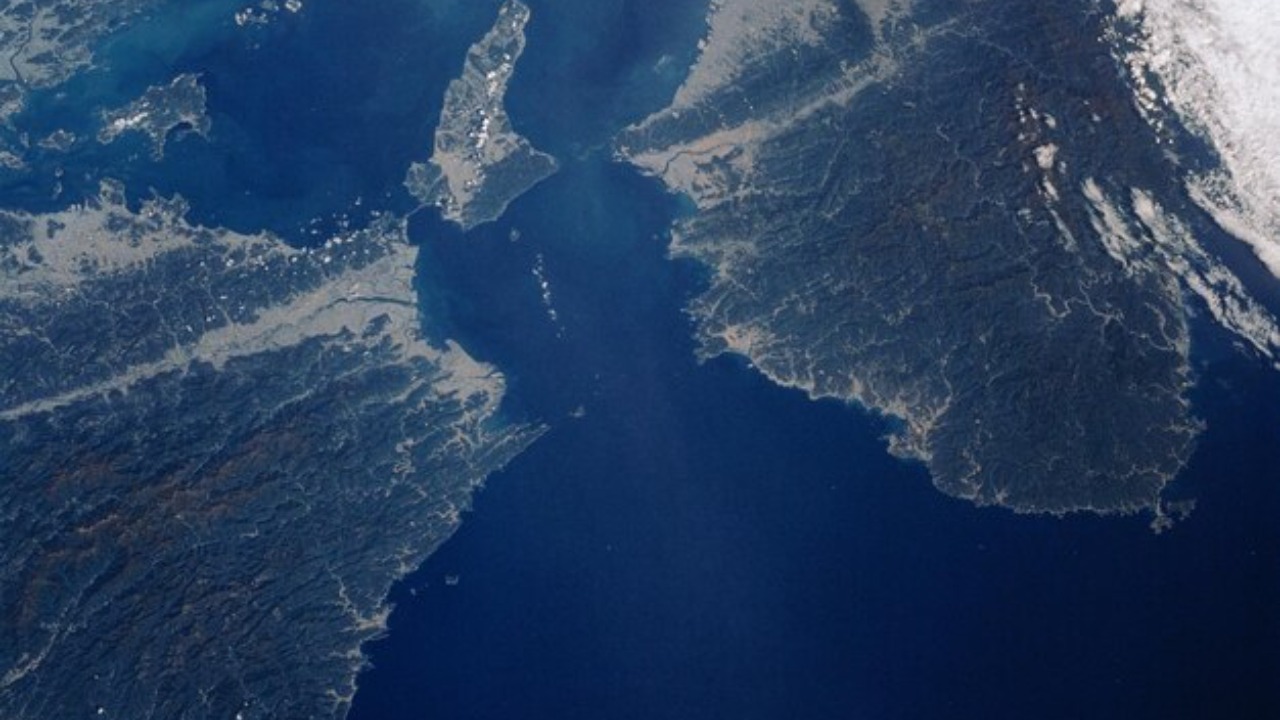

The Atlantic Ocean has long been treated as a permanent fixture on world maps, a blue expanse separating North America from Europe and Africa. Yet a growing body of research suggests this basin is far more dynamic and fragile than it looks, from the slow drift of continents to the delicate machinery of its currents. When scientists say the Atlantic is “shrinking,” they are pointing to deep tectonic forces and climate driven changes that could, over vastly different timescales, redraw coastlines and disrupt life on both sides of the water.
I see two overlapping stories emerging. One is the almost unimaginable, hundreds of millions of years in the future, when plate movements could literally close the Atlantic. The other is unfolding now, as warming, melting ice and shifting winds alter the Atlantic’s circulation and upper layers, with consequences that will be felt within a human lifetime.
Plate tectonics and an ocean with an expiration date
On geological timescales, the Atlantic Ocean is not a permanent gap but a temporary phase in the life cycle of continents. Researchers studying a newly identified crack in the crust between North America and Europe have argued that this structure could evolve into a major subduction zone, where ocean floor is pushed back into the mantle and continents converge. In that scenario, North America and would slowly move toward each other, and the Atlantic Ocean would eventually vanish as Earth’s plates rearrange into a new supercontinent.
This is not a prediction for the next century or even the next million years, but for roughly 200 million years from now, a span that makes human history look like a rounding error. Yet the mechanism is well grounded in plate tectonics, the same process that once tore apart earlier supercontinents and opened the Atlantic in the first place. The idea that the Atlantic could close again fits into what geologists call the Wilson cycle, a repeating pattern in which oceans open, widen and then close as plates split and collide. In that sense, the Atlantic is already on the clock, even if the countdown is measured in the slow grind of events known as rather than in years we can easily grasp.
A “Ring of Fire” for the Atlantic
While the Pacific is famous for its Ring of Fire, a belt of subduction zones and volcanoes that girdle that ocean, some scientists now argue that the Atlantic is developing its own version. A recent study, highlighted earlier this year, suggested that a chain of subduction zones could form a kind of Atlantic counterpart, gradually consuming the ocean floor and pulling the surrounding continents together. In that work, researchers proposed that the Atlantic Ocean may already be transitioning from a widening phase into one where it starts to contract.
One focal point of this emerging picture is a major subduction system some scientists have dubbed the Ring of structures around the Atlantic basin. The idea is that as these zones strengthen and migrate, they will act like a tightening belt around the ocean, slowly dragging its edges inward. That process would not be smooth or uniform, and it would unfold over tens to hundreds of millions of years, but the direction of travel is clear in the models. If the Pacific’s fiery ring is a symbol of an ocean in its closing act, the Atlantic’s nascent ring hints that this younger basin is already entering the next chapter of its life story.
Climate, currents and a weakening Atlantic engine
On far shorter timescales, the Atlantic is also changing in ways that have nothing to do with plate boundaries and everything to do with Climate. At the heart of this story is the Atlantic meridional overturning circulation, or AMOC, a vast conveyor belt that moves warm surface water northward and returns colder, deeper water south. Reconstructions of past conditions and modern measurements suggest that AMOC is sensitive to changes in temperature and freshwater input, and that it has already weakened compared with its strength in earlier centuries.
Scientists warn that continued greenhouse gas emissions could push this system toward a tipping point. One recent analysis argued that the Atlantic meridional overturning is no longer a low probability concern, but a system that could cross a critical threshold within decades if warming continues. Another study projected that a Key Atlantic current could begin collapsing as early as 2055, with the full transition unfolding 50 to 100 years later. Expert commentators have described these findings as alarming, noting that They forecast a potential collapse of the Atlantic Meridional Overturning by the end of the century if human caused emissions remain high.
From Hollywood disaster to measurable slowdown
For many people, the idea of the Atlantic currents shutting down evokes scenes from The Day After Tomorrow, the film that turned a stalled Gulf Stream into instant global catastrophe. In reality, the physics are more complex and the timeline far slower, but the underlying concern is not fiction. Observational studies have concluded that the Atlantic Gulf Stream system, which is part of AMOC, is now at its weakest in at least 1,600 years and may be edging closer to critical thresholds. One analysis noted that the current made famous in Day After Tomorrow is in fact dangerously close to tipping points, even if the real world consequences would unfold over decades rather than days.
Public discussion of these risks has spread beyond academic journals into broader media and commentary. Analysts have warned that the Atlantic Gulf Stream, also known as the Atlantic Meridional Overturning Circulation, is under threat of slowing or even stopping, with profound implications for regional climates. A sharp weakening would likely cool parts of northwestern Europe, raise sea levels along sections of the North American coast and disrupt rainfall patterns in the tropics. In that sense, the Atlantic’s “shrinkage” is not just about the geometry of the basin, but about the contraction of its climatic influence as its great engine falters.
Upper ocean layers thinning in a warming world
Even without a full scale collapse of AMOC, the Atlantic’s internal structure is already changing as it absorbs heat and carbon dioxide. The upper layers of the ocean act as a buffer, soaking up much of the excess warmth trapped by greenhouse gases and storing large amounts of dissolved CO₂. Research on specific water masses has found that some of these layers are literally shrinking in volume. One study focused on subtropical mode water, a relatively uniform layer that plays a key role in heat storage, and concluded that Although some STMW loss is expected from recent atmospheric conditions, those conditions do not fully explain the observed decline.
The implication is that human driven warming is eroding one of the Atlantic’s key shock absorbers. As STMW and similar layers thin, the ocean’s capacity to take up additional heat and carbon may diminish, leaving more of that burden in the atmosphere and on land. The study’s authors noted that STMW is a crucial reservoir for heat and carbon dioxide, and its contraction is a warning sign that the Atlantic’s role as a climate buffer is under strain. In practical terms, that means more frequent marine heatwaves, stressed fisheries and coastal communities facing both rising seas and more volatile weather.
More from Morning Overview