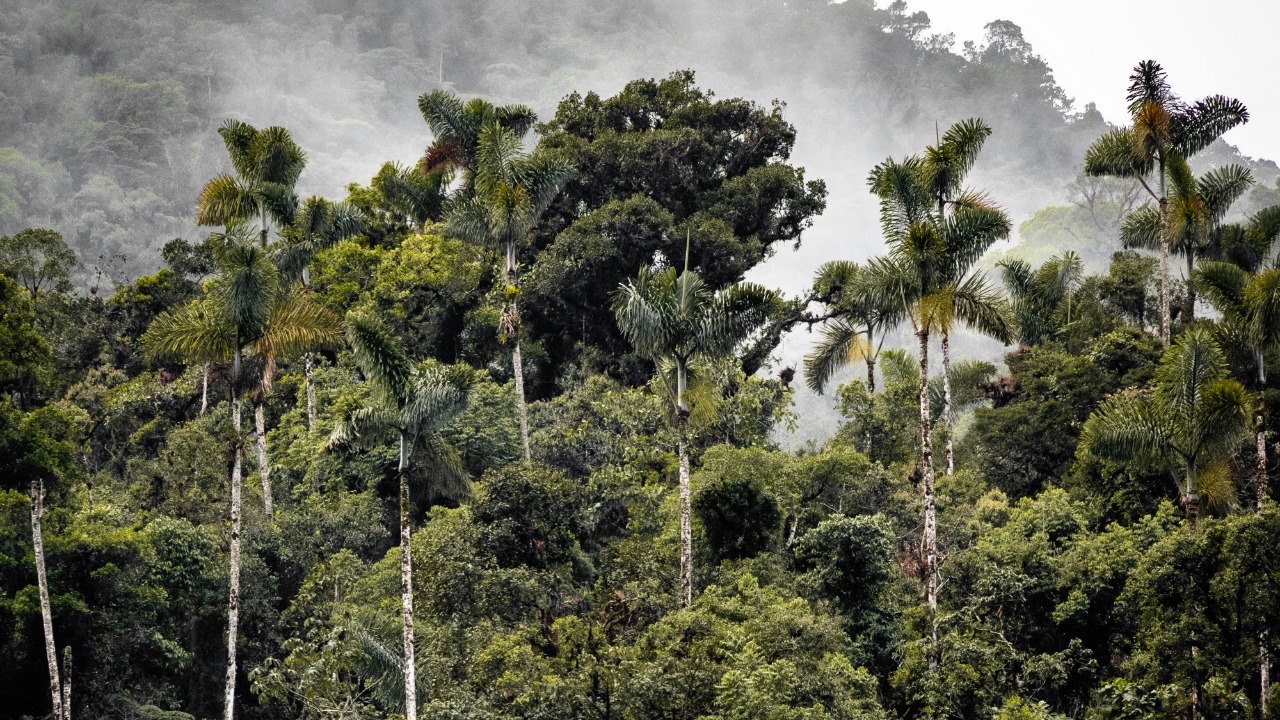

The world’s climate math increasingly hinges on a surprisingly specific variable: whether the Amazon’s biggest trees are left standing. As governments and companies promise net-zero emissions, new research shows that a small fraction of giant trunks holds a wildly disproportionate share of the forest’s carbon, and that cutting them down could unravel global climate plans. Scientists now argue that saving these towering elders is not a side issue but a central condition for any credible net-zero pathway.
At the same time, the Amazon’s trees are literally bulking up, growing thicker as atmospheric carbon dioxide rises. That growth offers a rare sliver of good news, but only if policy catches up with the science and stops treating the largest trees as expendable timber rather than irreplaceable climate infrastructure.
Why the biggest trunks matter most for net-zero
Climate models often treat forests as a uniform green block, but the Amazon’s carbon is anything but evenly spread. Recent field work shows that felling trees with a diameter at breast height of at least 41 centimeters, depending on species, releases disproportionately large amounts of stored carbon into the atmosphere. These are not just big trees, they are living reservoirs that have quietly banked decades, sometimes centuries, of emissions that humans never had to count. When those trunks fall, the carbon ledger flips overnight from asset to liability.
Researchers tracking forest plots across the basin have found that the majority of above-ground carbon, between 88% and 93% depending on species, is concentrated in these largest individuals. Taken together, the massive trunks that tower over the canopy function like the keystones in an arch: remove a few and the whole structure of net-zero assumptions starts to wobble. That is why scientists are now urging a reversal of current logging rules that still allow the removal of such giants under the banner of “sustainable” management.
A forest that is fattening up, for now
Paradoxically, the same climate pollution that threatens the Amazon is also helping its trees grow. Long-term monitoring plots show that the average size of trunks at chest height has been increasing as the forest absorbs more carbon dioxide. According to previous research by the RAINFOR network, the Amazon Forest plays a key role in taking up carbon that would otherwise stay in the atmosphere, and its capacity to do so has been rising as trees thicken. That extra growth effectively buys the world time, shaving a little off the net emissions that would otherwise drive temperatures higher.
Multiple lines of evidence now point in the same direction. One set of studies reports that many trees in the Amazon have grown about 3.3% thicker per decade, partly due to higher atmospheric carbon dioxide. Another analysis finds that average tree size across the Amazon has increased by 3.2% every decade, in line with rising carbon dioxide levels. A separate team reports that trunks at chest height have gained a measurable amount of girth over time, confirming that trees in monitored plots are thicker than they once were, a trend detailed in new measurements.
Resilient giants on a knife edge
The sight of ever taller crowns might tempt policymakers to assume the forest can look after the climate on its own. One recent paper on the Amazon’s tallest trees was welcomed as evidence of resilience, with researchers noting that these giants are capturing more carbon as they grow. Yet the same work warns that the big trees remain acutely vulnerable to heat, drought and human disturbance, and that the forest’s ability to absorb more carbon than it emits is not guaranteed to last, a caveat underscored in new analysis. The message is blunt: the giants are helping to stabilize the climate, but they are also the first to suffer when that climate destabilizes.
Field scientists are now documenting this tension tree by tree. Detailed plot work shows that trunks are not only thicker but structurally different, with the average size at chest height gaining steadily over the monitoring period, as described in recent findings. According to Professor Oliver Phillips, what happens to big trees, including how they cope with increasing heat and drought, will determine whether the Amazon remains a net carbon sink. His warning comes with a condition: the forest can keep helping to cool the planet only if the Amazon ecosystem stays connected, which means curbing fragmentation from roads, logging and fires that disproportionately kill the largest individuals.
On the ground with the Amazon’s tallest trees
Behind the statistics are researchers who spend their days craning their necks in the understory. In one project, a Swansea-based scientist known as Dr Rosette used handheld laser technology to measure the enormous girth required to hold up a massive Amazonian tree. Those painstaking measurements help refine estimates of how much carbon is stored in each trunk, turning abstract percentages into real, physical dimensions that can be tracked over time. One thing that is clear from this work, she has said, is that these giants are crucial allies in tackling climate change.
Other teams are pairing such ground-based surveys with satellite and drone imagery to map where the tallest trees cluster and how quickly they are being lost. Studies of the tallest stands reveal that these trees often anchor entire micro-ecosystems, shading streams, hosting epiphytes and providing nesting sites for birds and insects that in turn support forest regeneration. When a single giant is logged, the damage ripples outward, weakening the forest’s ability to bounce back from drought or fire and eroding the very resilience that net-zero plans increasingly rely on.
From summit pledges to logging rules
The science is now colliding with politics. At the COP30 climate summit in Belém, Brazil, one of the country’s most prominent researchers, Carlos Nobre, has argued that the world is running out of time to prevent the Amazon from tipping toward a drier, savanna-like state. In a separate interview, he urged countries to agree not only to zero deforestation by 2030 but also to phase out fossil fuel emissions entirely, a plea captured in a widely shared video. His core point is that protecting the forest’s climate role and decarbonizing the global economy are inseparable tasks, not parallel tracks.
That message is echoed by researchers calling for a specific policy shift to save the Amazon’s largest trees. They argue that current “reduced impact” logging rules still allow the removal of the very trunks that store between 88% and 93% of above-ground carbon, and that regulations must be rewritten to prioritize the protection of these giants as a distinct class of natural capital, a case laid out in new recommendations. In practical terms, that could mean setting strict diameter limits that forbid cutting trees above thresholds like 41 centimeters, expanding protected areas around clusters of tall trees, and tying international climate finance to verifiable reductions in the loss of large-diameter trunks.
As governments refine their net-zero roadmaps, the emerging science leaves little room for ambiguity. The Amazon’s biggest trees are not just another line item in biodiversity strategies, they are the structural beams holding up the global carbon budget. If policy fails to keep them standing, no amount of clever accounting elsewhere will make the numbers add up.
More from Morning Overview