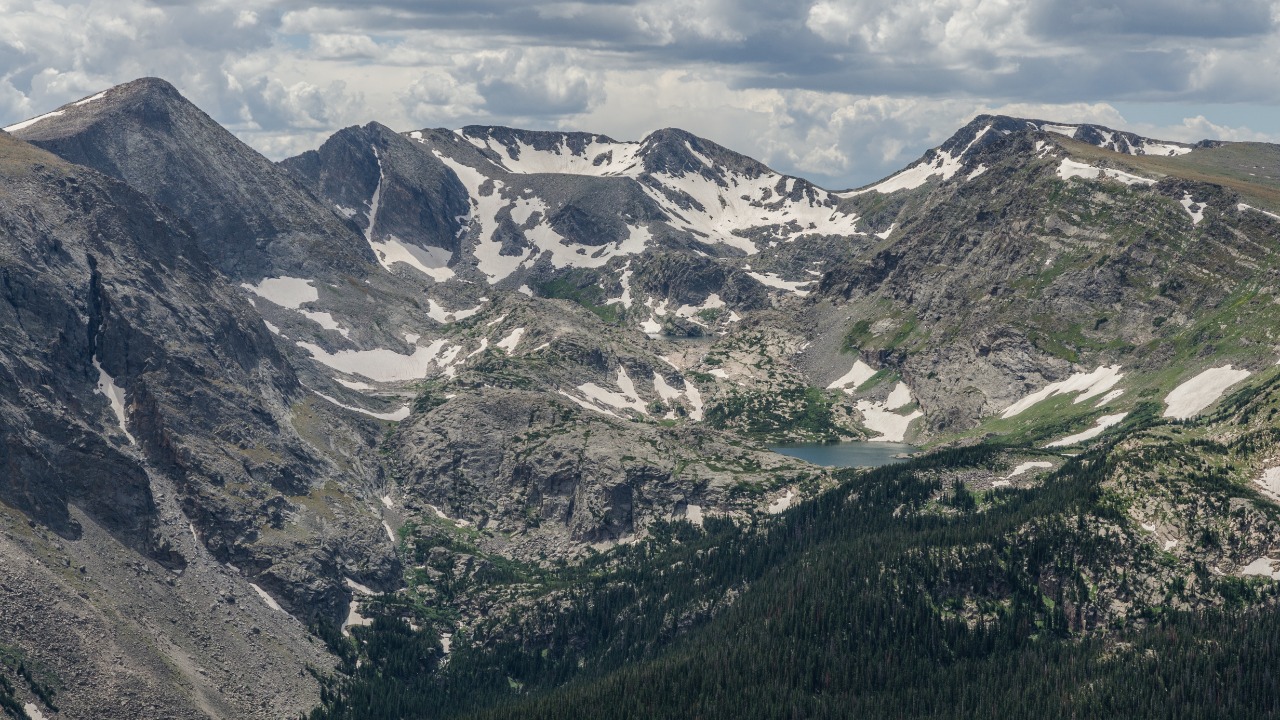

The Rocky Mountains have always looked like a geological non sequitur, a towering spine of peaks sitting far from the grinding edge of any modern tectonic plate boundary. For decades, geologists tried to force that oddity into standard mountain-building playbooks and kept running into contradictions. Now a new wave of research argues that the Rockies owe their existence to a stranger, more intricate sequence of deep Earth collisions than anyone had mapped before.
Instead of a single ancient crash, scientists are converging on a story in which the continent’s interior was reshaped from below, in stages, by slabs of rock that dove in at shallow angles and then broke apart. That emerging picture does not just tidy up a few academic debates, it rewrites how I think about the stability of continents and the hidden forces that can rearrange landscapes thousands of kilometers from the nearest coast.
The long‑standing Rocky Mountains puzzle
For most of the twentieth century, the Rockies were treated as an awkward fit inside a familiar script: mountains rise where plates collide, so a range in western North America must trace back to a straightforward crunch along the Pacific margin. The problem was that the highest peaks in Colorado, Wyoming and Montana sit hundreds of kilometers inland, perched on crust that should have been too thick and too old to crumple so dramatically. Classic models of the Laramide orogeny, the mountain‑building episode that lifted the Rockies, could not fully explain why deformation reached so far into the continental interior or why it produced such steep, localized uplifts instead of a broad, even swell.
Earlier attempts to solve that mismatch leaned on the idea of a flat, or shallow, subducting slab of oceanic crust sliding beneath North America, a concept that helped explain why compressive forces might be transmitted deep into the continent. Yet even that framework left nagging questions about timing, heat flow and the chemistry of rocks exposed at the surface. As one influential analysis put it, until relatively recently no one had convincingly suggested that the “undersides” of a continent, the structure of its deep lithosphere, could be the dominant factor in making mountains appear where no obvious collision is visible at the surface, a point underscored in a widely cited discussion of the Rockies mystery.
A two‑stage collision that breaks the mold
The latest work argues that the Rockies did not rise in a single tectonic drama but in a two‑act play, with each collision reshaping the deep architecture of the continent in a different way. In this view, the first event involved an oceanic plate sliding beneath western North America at an unusually shallow angle, scraping and underplating material beneath what is now the interior of the United States. That geometry would have pushed stresses far inland, warping the crust and priming it for uplift without the classic, tightly focused crunch of a boundary‑hugging mountain belt. The second act came when that buried slab fragmented and sank, allowing hotter, more buoyant mantle to well upward and further hoist the overlying crust.
Researchers who support this scenario emphasize that it is not just a tweak to the old flat‑slab idea but a wholesale rethinking of the sequence and style of deformation. Instead of a single, continuous subduction episode, they propose two distinct collisions separated in time, each leaving a different imprint on the rocks and the deep lithosphere. One detailed account of this model notes that, instead of a one‑off event, the Rocky Mountains were formed during a two‑stage process involving two separate collisions that unfolded along the western margin of North America, a conclusion laid out in a technical analysis of the region’s tectonic history.
What CSUN geologists found inside the rocks
The most vivid support for this two‑stage story comes from geologists who have spent years dissecting the mineral record locked in the Rockies and the crust to their west. At California State University, Northridge, a team led by Joshua Schwartz and Elena Miranda has focused on the chemistry and deformation patterns of rocks that were once buried deep beneath the surface and later exhumed. By tracking how minerals like garnet and feldspar record pressure, temperature and strain, they have reconstructed a timeline that points to distinct pulses of tectonic activity rather than a single, drawn‑out squeeze. Their work suggests that pieces of oceanic crust were not only subducted but also underplated and then peeled away, leaving behind a patchwork of altered lithosphere.
Those findings have direct implications for where the Rockies’ building blocks came from. Schwartz and Miranda argue that some of the crust now sitting beneath the interior West was originally part of a plate margin that lay closer to what is now Southern California, then was transported and reconfigured as subduction geometry changed. In one summary of their research, the work by CSUN geologists Joshua Schwartz and is described as having blown a hole in the long‑accepted hypothesis that the Rocky Mo story could be told with a simple, single collision, instead pointing to material that may have originated somewhere along Southern California’s coast before being dragged beneath the continent.
Rewriting the Rockies’ origin story
When I put these strands together, the Rockies start to look less like an anomaly and more like a case study in how messy continental growth can be. The two‑stage collision model, grounded in field data and petrology, explains why deformation is focused in discrete uplifts, why some ranges sit atop unusually buoyant crust and why magmatism in the region flickered on and off instead of following a smooth arc. It also helps reconcile the Rockies with patterns seen in other mountain belts, where deep imaging and geochemistry increasingly reveal slabs that have broken, sunk and even detached entirely from the overlying plate. In that sense, the Rockies are not breaking the rules of plate tectonics, they are exposing a more complicated rulebook.
The researchers behind this work are explicit that their goal is to replace a simplistic origin tale with one that matches the complexity of the evidence. One institutional summary notes that their research effectively rewrites the Rocky Mountains origin story by challenging the idea that a single, long‑duration subduction event could account for the observed structures and rock histories. Instead, they argue that only a sequence of collisions, changes in slab angle and eventual slab removal can produce the mix of uplift, crustal thickening and metamorphism seen across the range today.
Why a “bizarre” origin matters far beyond Colorado
Understanding how the Rockies formed is not just an exercise in tidying up a geological footnote, it changes how I think about the risks and resources tied to the deep structure of continents. If mountains can rise far from plate boundaries because of processes unfolding in the lithosphere’s “undersides,” then regions that look tectonically quiet at the surface may still be shaped by hidden forces. That has implications for how scientists interpret patterns of intraplate earthquakes, volcanic fields and even the distribution of mineral deposits that depend on ancient magmatic plumbing. The Rockies, in this light, become a laboratory for testing how deep slabs interact with the mantle and how those interactions ripple upward over tens of millions of years.
The new origin story also reframes the Rockies as part of a broader narrative about North America’s evolution, connecting peaks in Colorado to vanished ocean basins and shifting plate boundaries along the Pacific margin. By tying specific rock signatures to events like shallow subduction, slab break‑off and underplating, geologists can better trace how the continent assembled, thickened and stabilized. That, in turn, feeds into models of how other ranges, from the Andes to interior Asian uplifts, might have been built through similarly intricate, multi‑stage processes. The Rockies may still look bizarre on a map, but in the deep Earth they now sit squarely inside a growing family of mountains born from collisions that unfolded in more than one act.
More from Morning Overview