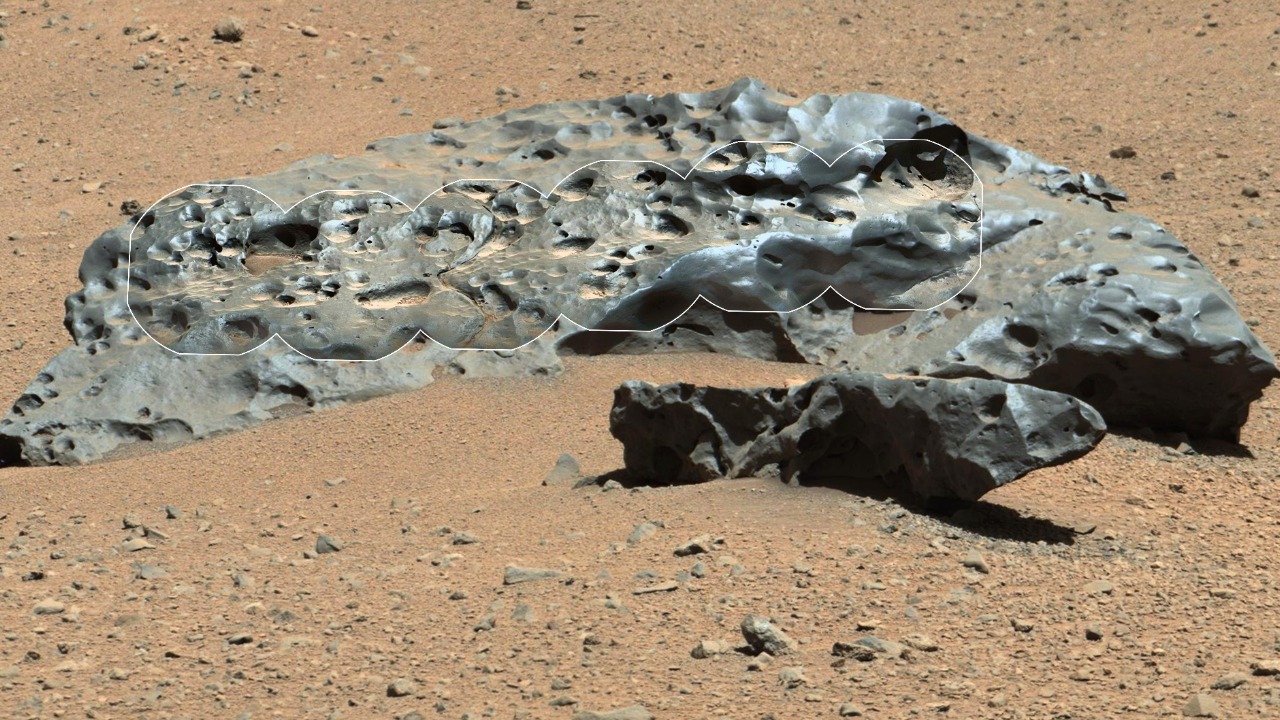

NASA’s Perseverance rover has spent years combing Jezero Crater for traces of ancient water and potential biosignatures, but its latest find is something far more alien to the local bedrock: a dark, metallic-looking rock that appears to be a meteorite. The object, sitting alone on the dusty plain, is giving mission scientists a rare chance to study a fresh piece of planetary debris on the Martian surface itself rather than in a terrestrial lab.
By catching this apparent meteorite in place, Perseverance is turning a routine drive into a natural experiment in how space rocks weather on Mars, how they interact with the thin atmosphere, and what they can reveal about the violent traffic of material through the inner solar system. I see this discovery as a reminder that even on a mission defined by carefully planned sampling campaigns, some of the most intriguing clues arrive unannounced.
Perseverance’s long road to an unexpected visitor
Perseverance was sent to Mars to do something no rover had done before: collect and cache rock cores for a future sample-return mission, while also carrying the first helicopter ever flown on another world. The six-wheeled robot landed in Jezero Crater, a basin that once hosted a river delta, with a payload of instruments designed to read the planet’s geological history in microscopic detail, from its SuperCam laser to its SHERLOC spectrometer, all mounted on a chassis derived from earlier rovers but upgraded for this more ambitious campaign, as detailed in mission overviews of Perseverance’s design. Its daily routine has been dominated by drilling, imaging, and driving between carefully chosen outcrops that might preserve signs of ancient habitability.
That is why the solitary rock that recently appeared in Perseverance’s navigation camera frames stood out so sharply from the surrounding terrain. After more than five years of traversing Jezero’s crater floor and delta deposits, the rover’s science team has built up a detailed sense of what the local bedrock should look like, and this object did not fit the pattern. Reporting on the encounter describes how the rover’s cameras captured a compact, dark-toned boulder with a smooth, sculpted surface that contrasted with the lighter, more fractured native rocks, prompting mission scientists to flag it as a likely meteorite and share the images widely through outlets that track Perseverance’s first meteorite candidate.
Why this rock looks nothing like Jezero’s bedrock
The case for calling the object a meteorite starts with its appearance. In the rover’s color and close-up images, the rock shows a dark, almost bluish hue, with rounded edges and shallow pits that resemble the regmaglypts seen on iron meteorites that have fallen on Earth. Those thumbprint-like depressions are carved as a meteoroid’s surface partially melts and ablates during its fiery passage through an atmosphere, leaving behind a sculpted shell that is very different from the angular, fractured blocks that dominate Jezero’s sedimentary and igneous outcrops, a contrast that mission scientists highlighted when they described this “stranger” in the rover’s midst in a detailed mission blog.
Beyond color and texture, the rock’s isolation is another clue. Jezero’s native rocks tend to appear in clusters, layers, or boulder fields that can be traced back to local bedrock or erosion patterns, but this object sits alone on a relatively flat patch of terrain, as if it had been dropped there. Coverage of the find notes that the team quickly compared its morphology with previous Martian meteorites and saw strong similarities to known iron-rich specimens, which have also been spotted by earlier rovers, a line of reasoning that underpins reports describing Perseverance’s view of a mysterious visitor that likely arrived from space rather than emerging from the crater floor.
How the team is probing the meteorite from millions of miles away
Once the rock was flagged as a likely meteorite, the rover team shifted into a familiar investigative mode, using Perseverance’s remote-sensing tools to gather as much data as possible without physically disturbing the target. The SuperCam instrument, perched atop the rover’s mast, can fire a laser at specific points on the rock and read the resulting plasma with a spectrometer, a technique that reveals elemental composition at a distance and has already been used extensively on Jezero’s bedrock. Mission updates describe how this same toolkit is now being turned on the newcomer so that scientists can test whether its chemistry matches the iron-rich meteorites seen elsewhere on Mars, an approach that has been explained in public briefings and visualized in mission videos that walk through Perseverance’s science operations.
Closer to the ground, the SHERLOC and WATSON instruments on the rover’s robotic arm can capture microscopic images and ultraviolet spectra that reveal fine-scale textures and mineral signatures. By comparing those data with the surrounding soil and nearby rocks, the team can estimate how long the meteorite has been sitting on the surface and how much it has been altered by Martian weathering. Public-facing mission explainers have emphasized that this kind of in situ analysis is crucial for deciding whether a target is worth sampling, and the same logic applies here as the team weighs the scientific payoff of devoting precious time and resources to a rock that, while exotic, may not fit the core sample-return strategy laid out in earlier mission planning videos that detail how Perseverance chooses targets.
What Martian meteorites have already told us back on Earth
Even before Perseverance landed, scientists had been studying Mars through a different kind of sample return: meteorites that were blasted off the planet by ancient impacts and eventually fell to Earth. These Martian meteorites, identified by their distinctive gas signatures and mineralogy, have revealed that Mars once hosted active volcanism, a magnetic field, and complex interactions between rock and water, long before any rover touched down in Jezero. Researchers have used them to reconstruct the planet’s thermal history and to infer the composition of its mantle and crust, insights that were summarized in a pre-landing analysis of how much we already knew about the Red Planet from meteorites found on Earth.
Those samples, however, come with a major limitation: by the time they reach terrestrial laboratories, they have been filtered by multiple selection effects, from the violence of ejection to the survivability of passage through Earth’s atmosphere and the luck of being found by human collectors. A meteorite that Perseverance can study in place on Mars sidesteps some of those biases, because it preserves the rock where it landed, in the environment that has been shaping it ever since. That context allows scientists to connect the chemistry and texture of the meteorite to local climate conditions, dust deposition, and even wind patterns, a level of environmental detail that complements the more global but less contextualized picture drawn from the curated collections of Martian rocks that have been cataloged on Earth.
Why meteorites on Mars are such valuable scientific outliers
On a planet where most rocks record local volcanic eruptions, sedimentary cycles, or lake deposits, a meteorite is a literal outsider, carrying information from a different part of the solar system. If the newly spotted rock is confirmed as an iron meteorite, it would represent material from the core or mantle of a differentiated parent body, perhaps an asteroid that once had its own internal layering before being shattered. Studying such a sample on Mars allows scientists to compare how metallic meteorites weather in a thin, cold atmosphere with low oxygen, as opposed to the more corrosive conditions on Earth, a contrast that helps refine models of how quickly exposed metals rust, fracture, and accumulate coatings in different planetary environments, a topic that mission scientists have touched on in their public discussions of Martian surface processes.
There is also a practical reason to care about these outliers. Meteorites can act as natural calibration targets for rover instruments, because their compositions are often well understood from laboratory studies of similar samples on Earth. By comparing the rover’s spectral readings of the Martian meteorite with known reference values, engineers can check for subtle drifts or biases in their sensors over time. That dual role, as both scientific treasure and engineering benchmark, helps explain why the team took the time to document the rock thoroughly and share high-resolution images and commentary through social channels that regularly highlight Perseverance’s most unusual finds.
Public reaction and the growing culture around rover discoveries
One striking aspect of this meteorite sighting is how quickly it migrated from raw rover frames to a shared cultural moment among space enthusiasts. Within hours of the images being posted, online communities dedicated to Mars exploration were circulating annotated versions, debating the rock’s classification, and comparing it with earlier meteorites seen by rovers like Opportunity and Curiosity. In one active discussion thread, members of a Mars-focused group traded theories about whether the rock’s surface sheen pointed to a high metal content or to a coating of dust and varnish, illustrating how citizen scientists and casual fans alike are now part of the informal peer review that follows each new Perseverance image drop.
That rapid, participatory response reflects a broader shift in how planetary missions communicate. Rather than waiting for formal papers or press conferences, mission teams now release raw images and short updates in near real time, inviting the public to follow along as they puzzle through each new anomaly. I see this as more than just outreach; it is a way of distributing curiosity across a global audience, so that a single rock on a distant crater floor can spark conversations that range from basic geology to the mechanics of atmospheric entry, amplified by news coverage and social posts that treat the meteorite as a fresh chapter in the rover’s ongoing exploration narrative.
What this “stranger” means for the rest of Perseverance’s mission
For all its novelty, the meteorite encounter fits neatly into Perseverance’s broader mandate to understand Mars as a dynamic, evolving world. Every time the rover documents an impact feature, whether a fresh crater or a foreign rock, it adds another data point to the story of how often material rains down on the planet and how those impacts reshape the surface. That information feeds into models of impact rates that are crucial for dating Martian terrains and for planning future human missions, which will need to account for the ongoing hazard posed by incoming debris, a connection that mission scientists have drawn in their more reflective essays about unexpected finds along the traverse.
At the same time, the meteorite is a reminder that exploration rarely follows a straight line. Perseverance’s path through Jezero is guided by carefully prioritized science targets, but the most memorable moments often come from unplanned encounters like this one, when the landscape offers up something that does not fit the existing map. I find that tension between planning and serendipity to be one of the mission’s defining strengths: a rover built to execute a precise sampling strategy, yet flexible enough to pause for a solitary rock that hints at stories from far beyond its crater home, stories that continue to unfold in each new frame and each new spectrum beamed back from the Red Planet.
More from MorningOverview