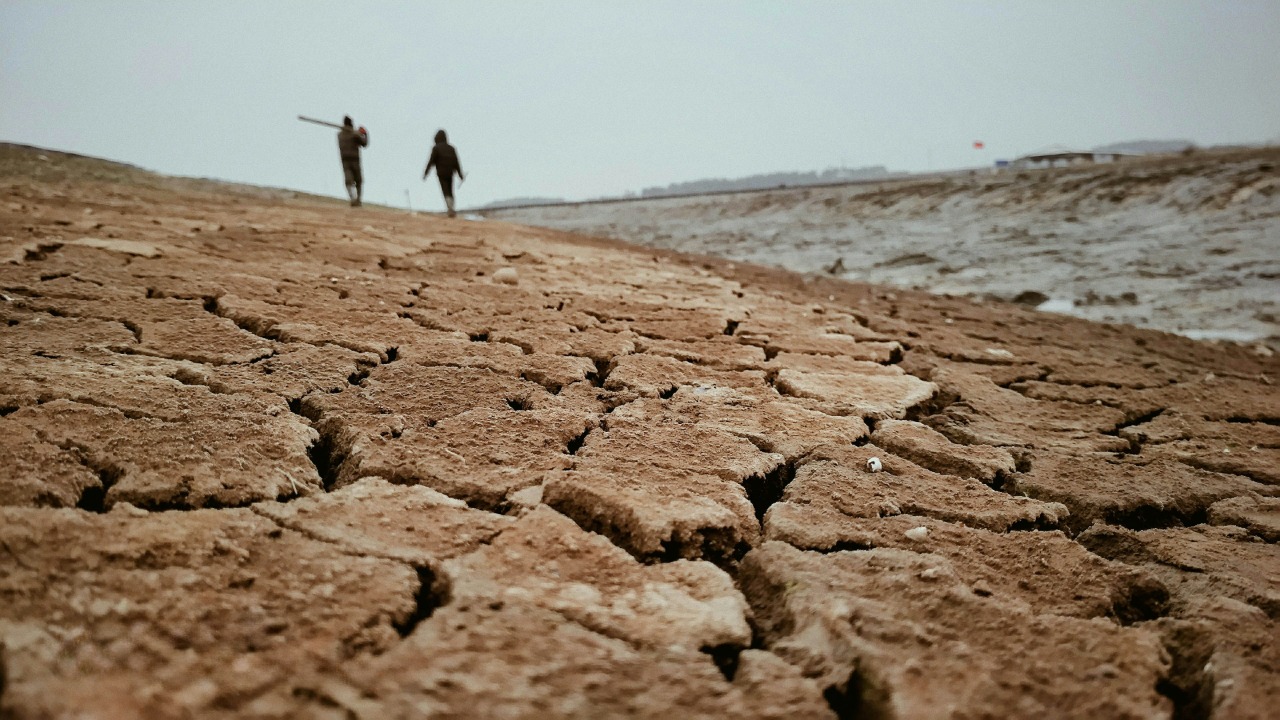

The world is no longer inching toward dangerous warming, it is accelerating into it. Global temperatures are brushing up against the 1.5 degree Celsius guardrail that governments once treated as a hard limit, and scientists now warn that overshooting that line is increasingly likely. The question is shifting from whether humanity can avoid crossing it to how far we go past it and how much permanent damage is locked in along the way.
That shift in framing, from prevention to damage control, is what makes the current moment feel like a genuine point of no return. The physics of greenhouse gases, the record heat of recent years, and the first observable climate tipping points all point in the same direction: unless emissions fall sharply and fast, the overshoot will not be brief or gentle.
Heat records signal a looming breach of 1.5°C
Over the past few years, the planet has been running a fever that no longer looks like a temporary spike. Climate monitors report that 2025 ranked among the hottest years ever recorded, with global surface temperatures now consistently far above the preindustrial baseline. One analysis finds that 2025 was roughly the 3rd warmest year since 1850, and that projections for 2026 fall within a forecast range that is expected to be accurate about 95% of the time, underscoring how firmly the warming trend is entrenched. Another dataset shows that the three year average for 2023 to 2025 is on track to exceed 1.5°C above the 1850 to 1900 level for the first time, a symbolic crossing that turns a political target into a lived reality.
Short term forecasts now suggest that the coming years will not offer a reprieve. International projections anticipate that in 2026 the global average temperature could reach 1.46 °C above preindustrial conditions, just below the historic maximum of 1.55 °C recorded in recent decades. Another assessment warns that 2026 will mark the fourth consecutive year in which global surface temperature exceeds 1.4 °C above the 1850 to 1900 benchmark, which means the world is not just flirting with the 1.5 threshold but hovering uncomfortably close to it year after year.
Overshoot is becoming the central climate scenario
What was once framed as a worst case is now treated as the baseline. A global climate update finds an 86% chance that at least one of the next five years will be more than 1.5°C above the 1850 to 1900 average, and that the five year mean will continue to climb as greenhouse gases accumulate in the atmosphere and oceans. Another analysis of near term warming warns that the 1.5 target could be breached before 2030, with 2025 already among the three hottest years on record and climate impacts intensifying across societies and natural systems, according to global monitoring. In that context, the idea that the world might briefly overshoot and then glide back under the line starts to look optimistic.
Scientists who track tipping points now argue that with warming set to pass 1.5 degrees Celsius, the risk of triggering irreversible changes rises sharply. Climate leaders have begun to speak openly about overshoot into a warming danger zone, warning that as temperatures climb, so does the chance of drying out the Amazon rainforest, accelerating ice sheet melt and destabilizing carbon rich ecosystems. A separate assessment from the United Nations Environment Programme warns that the world is likely to exceed a key warming target soon and that if emissions do not fall, the consequences will be severe, shifting the policy debate from avoidance to managing the depth and duration of the overshoot.
Tipping points are moving from theory to lived experience
The most unsettling development is that some climate tipping points are no longer hypothetical. Researchers now say the world has reached its first climate tipping point as global warming drives widespread diebacks of warm water coral reefs, a finding highlighted in an assessment that describes this as a point of no return for many reef systems. Another report concludes that one such point has already been crossed, with warm water coral reefs experiencing unprecedented dieback and more than half of these ecosystems expected to disappear as temperatures rise to 1.5°C above preindustrial levels, according to a global review. For coastal communities that depend on reefs for fisheries, tourism and storm protection, this is not an abstract threshold but a collapse already underway.
Other Earth systems are showing signs of strain that could foreshadow similar breaks. A climate adaptation analysis highlights the risk of a slowdown or collapse of the Atlantic Meridional Overturning, or AMOC, a vast ocean conveyor that helps regulate temperatures in Europe, Africa and the Americas. Scientists warn that if warming continues unchecked, this circulation could weaken significantly, disrupting rainfall patterns, intensifying regional heat and reshaping agricultural zones. At the same time, climate officials like Simon Stiell have urged governments to move much faster on both emissions cuts and resilience, arguing that the window to prevent cascading tipping events is closing quickly.
Human systems are lagging behind the physics
While the climate system responds to the laws of thermodynamics, human institutions are still behaving as if incremental change is enough. A psychological analysis of climate responses notes that at both the individual and societal level, action has been insufficient, and that Even the Paris is unlikely to keep warming at safe levels without far more ambitious follow through. That gap between promises and physics is visible in the steady rise of atmospheric carbon dioxide, which a recent global risk assessment notes has reached a new high, rising to about 150 percent of preindustrial levels according to the latest data. That concentration effectively locks in additional warming for decades, regardless of short term weather patterns or economic cycles.
Short term climate variability is still shaping how people perceive the crisis, sometimes obscuring the long term trend. Recent reporting notes that 2025 was Earth’s 3rd warmest year even as La Niña conditions persisted into early 2026, with the possibility of an El Niño event later in the year that could push temperatures even higher. A separate climate adaptation briefing warns that global temperature could breach 1.5°C for the first time in the near term, reinforcing the need for both rapid mitigation and robust adaptation, as highlighted in adaptation planning. The risk is that societies treat each record year as an outlier rather than part of a new baseline that demands structural change.
What avoiding a deeper point of no return still requires
Even as overshoot becomes more likely, the range of possible futures is still wide. A detailed analysis of warming trajectories explains that as long as emissions remain high, temperatures will keep rising, but if greenhouse gases are cut sharply, temperatures will eventually stabilize and could even decline slightly as some pollutants fade, according to climate leaders. That is why the United Nations Environment Programme frames the coming overshoot not as a fixed destiny but as a warning that without rapid cuts, the consequences will be severe, from more intense heatwaves and floods to deeper food and water insecurity. The scale of the challenge is reflected in the latest global risk assessment, which uses the metaphor of a clock set close to midnight to convey how little time remains to avert the worst outcomes, as detailed in the Doomsday Clock statement.
More from Morning Overview