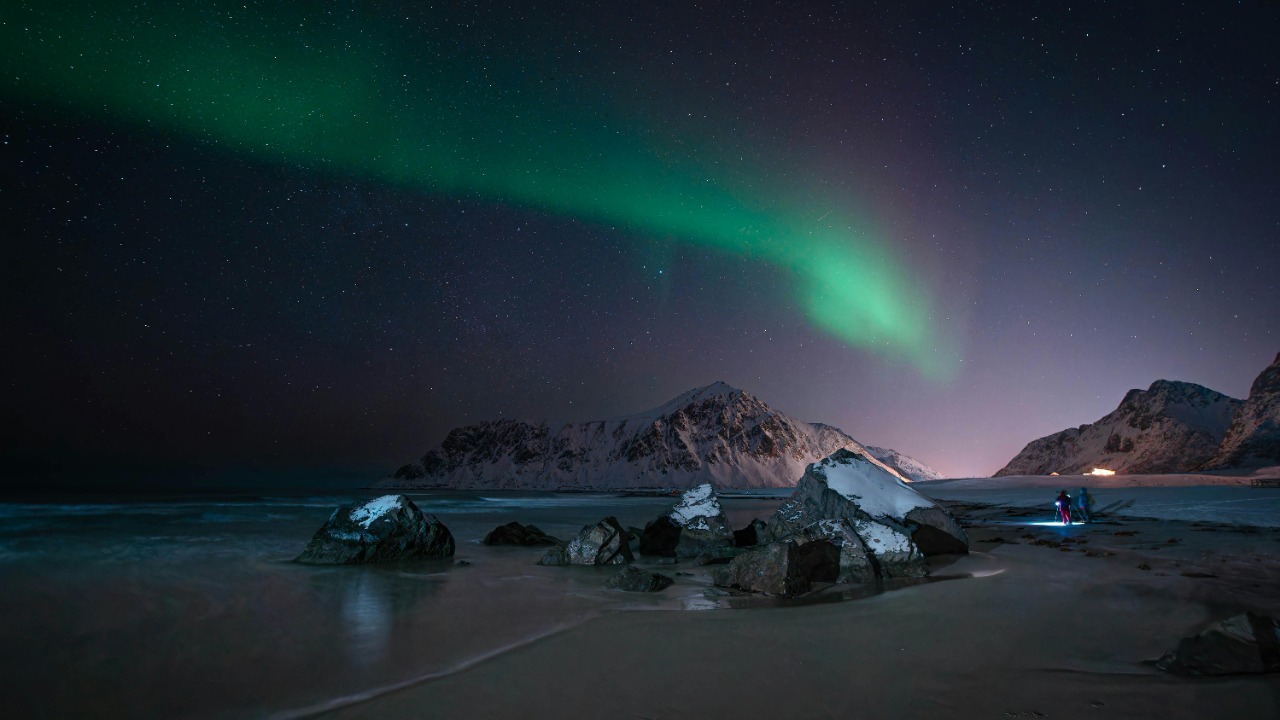

Skywatchers across the northern United States are being handed a rare midwinter gift, with forecasters warning that auroral activity could spill far beyond its usual Arctic haunts. A minor geomagnetic storm is expected to energize Earth’s upper atmosphere, raising the odds that shimmering curtains of green and red light will be visible from multiple regions if clouds cooperate. For many communities, the prospect of seeing the aurora borealis without leaving home is turning a technical space weather forecast into a shared cultural moment.
The latest projections suggest that the auroral oval could dip deep into the Lower 48, putting parts of the Midwest, Great Lakes and Northeast on alert alongside the usual northern stalwarts. While the display is never guaranteed, the combination of an active Sun and long winter nights means conditions are lining up for one of the broadest viewing opportunities in recent months.
How far south the aurora could reach
Forecasters at the National Oceanic and Atmospheric Administration have outlined a “view line,” the southern boundary where people still have a realistic chance of spotting the glow low on the horizon. That experimental guidance, available through NOAA’s view line, shows the auroral zone comfortably covering high latitudes and occasionally dipping into the northern tier of the contiguous United States. The same pattern is reflected in social updates that describe a predicted “view line” as the southernmost spot where skygazers might still be able to catch the show if they have a clear northern horizon and patience to let their eyes adjust, a point underscored in a recent Aurora Alert.
That means the usual aurora strongholds, including Alaska and the Pacific Northwest, are once again in play, but the excitement this time is how far the potential extends into the continental interior. Forecast discussions shared with the public suggest that more than a dozen states could be in the zone, with one widely circulated update noting that “More than a dozen states in the U.S. could catch a glimpse of the northern lights this weekend,” a message amplified in a More post that credits The National Oceanic and Atmospher for the underlying forecast.
Which states are in the spotlight
The core of the opportunity stretches from the Pacific Northwest across the northern Plains and into the Great Lakes and Northeast, a swath that includes Washington, Idaho, Oregon and interior mountain states such as Montana and Wyoming. Farther east, the auroral oval is expected to brush the northern Plains, putting North Dakota, South Dakota and Nebraska on watch. One national forecast framed the event as a chance for “More than a dozen states along the northern contiguous U.S.” to catch the lights, a description that matches the broad corridor highlighted in recent USA coverage by Melina Khan.
Closer to the Great Lakes, forecasters are particularly focused on Minnesota, Wisconsin, Iowa and Michigan, where dark rural skies could give residents a front row seat if the storm intensifies. A regional briefing for Michigan, written by Jenna Prestininzi, notes that the northern lights “may be visible across Michigan” under the right conditions, a point that has been widely shared in local What coverage. To the south, even Illinois is on some watch lists, with one national broadcaster noting that the aurora could be visible “as far down as Iowa,” a line that underscores how unusual this setup is and that appears in a detailed Where breakdown.
Great Lakes and New England: prime viewing corridor
East of the Great Lakes, the potential viewing zone arcs into the Northeast, where population centers sit much closer to the auroral oval than usual. Forecasts circulating among skywatchers highlight New York, Vermont, New Hampshire and Maine as states where residents should keep an eye on the northern horizon once it gets dark. One regional report focused on Vermont notes that “A minor geomagnetic storm means Vermont – and many other northern states – have a chance to see the northern lights on Jan. 16,” while cautioning that snow may block the view, a nuance spelled out in a detailed Vermont alert.
National roundups have gone further, listing 15 or even 16 states that could see the aurora as soon as it gets dark, and urging people, “Look up, Americans, it’s time,” language that appears in a widely shared Look forecast that specifically calls out New York. Another national explainer framed the event as “15 States Could See Northern Lights This Weekend — Check Best Viewing Times and Locations,” describing how The Earth will be experiencing an incoming burst of solar particles that could make the aurora visible in the night sky, a description that appears in a States Could See guide that doubles as a primer on when to step outside.
What the space weather numbers really mean
Behind the colorful maps and viral social posts sits a technical backbone that determines whether the aurora actually materializes. NOAA’s Aurora Dashboard pulls together real time data on solar wind and geomagnetic activity, translating it into an easy to read probability map. A key metric in that system is the Kp index, which measures how disturbed Earth’s magnetic field is on a scale that NOAA labels with specific storm levels. In a recent update, the agency noted that “Updated Time: 2026-01-15T15:00:00.000Z. The greatest expected 3 hr Kp for Jan 13-Jan 15 2026 is 4.00 (below NOAA Scale levels),” language that appears verbatim in a technical Updated Time note explaining how changes in Kp affect the aurora.
Even a Kp of 4.00, which is below formal NOAA Scale storm thresholds, can be enough to push the auroral oval into the northern United States if other conditions line up, especially during long winter nights. One detailed explainer on auroral visibility stresses that “But remember, auroras can be very fickle,” warning that the list of states is based on current forecast data and that the farther south you are, the lower and dimmer the glow will appear on the northern horizon, guidance that appears in a practical But guide. Another national analysis, written by Jamie Carter as an Updated Northern Lights Alert, explains how charged particles from the Sun interact with Earth’s magnetic field and then release energy as shimmering light, a process described in detail in Carter’s Updated Northern Lights for which he is listed as a Senior Contributor at Forbes.
How to actually see the show
Even in states where the aurora is technically overhead, success often comes down to basic observing discipline. Veteran skywatchers advise getting away from city glare, giving your eyes at least 20 minutes to adjust and scanning the northern sky for faint grayish arcs that may only reveal their color in photographs. One practical guide notes that to increase your chances of witnessing it, you should seek out dark skies far from city lights and be patient, and it recommends using NOAA’s Aurora Dashboard, a platform that includes real time predictions, advice that appears in a step by step Auroras explainer. Another commentary from the Air and Space community reminds readers that even if you cannot see the aurora with the naked eye, that does not mean it is not there, and that it is neat that your phone can reveal that faint glow in long exposure images, a point made vividly in an AirSpace discussion of how Auroras appear in modern photography.
More from Morning Overview