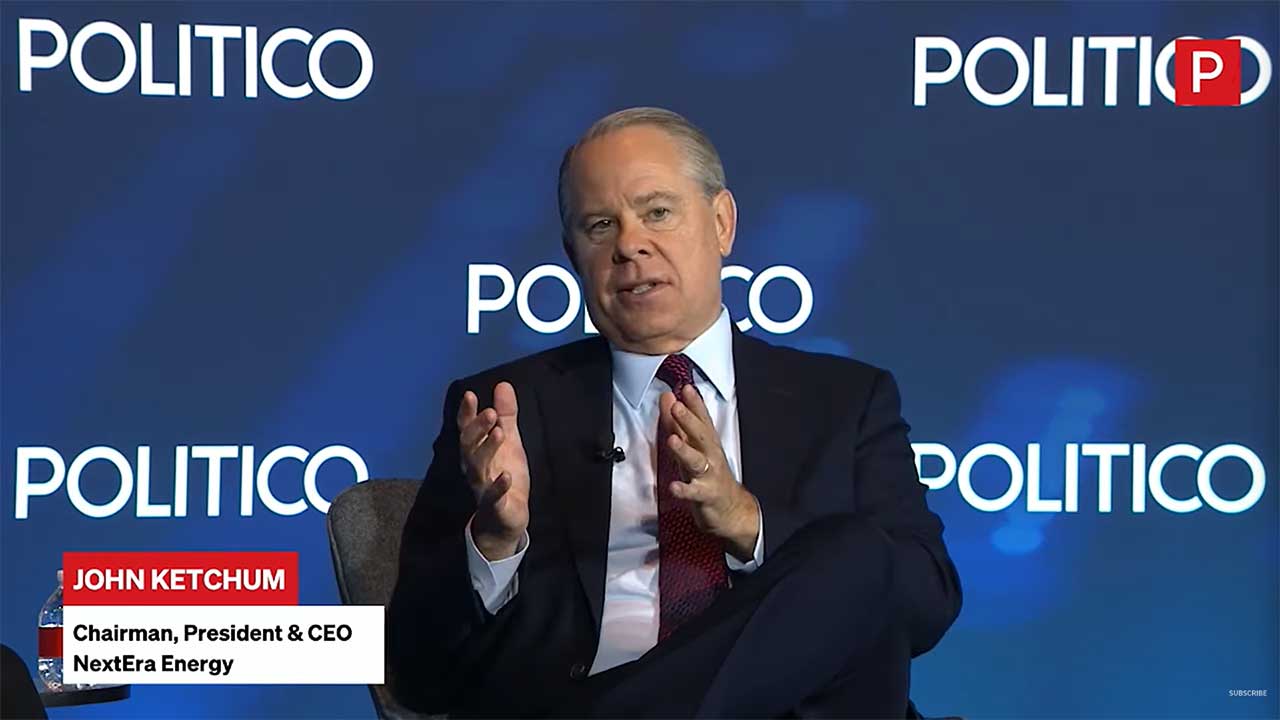

NextEra Energy is positioning itself at the center of a collision between the artificial intelligence boom and the limits of the U.S. power grid, and its chief executive is now openly weighing a bigger role for nuclear power to keep data centers running. The company is already one of the country’s largest clean energy developers, but the scale and speed of new digital demand are forcing a rethink of how much firm, around-the-clock generation it will need.
That shift is turning nuclear energy from a legacy asset into a potential growth engine, as hyperscale customers push for low carbon electricity that can be delivered at industrial scale. The stakes are high not only for NextEra’s shareholders but also for how the next wave of data infrastructure gets built across regions like Florida and the Midwest.
Data center surge forces a new power play
NextEra’s leadership has been explicit that the data center boom is reshaping its investment priorities, with CEO John Ketcham describing how the company is offering large customers a menu of options that now includes nuclear alongside renewables and gas. In recent remarks, he signaled that NextEra Energy, often identified by its ticker NEE, is actively evaluating whether to expand its nuclear footprint to serve this load, a notable shift for a company best known for wind and solar, and he framed the moment as part of energy’s new era of growth for digital infrastructure, according to John Ketcham. That willingness to put nuclear on the table reflects both the intensity of hyperscaler demand and the limits of building a data center strategy around intermittent resources alone.
The scale of the opportunity is already visible in the company’s home state. In Florida, NextEra has about 20 gigawatts of data center customers that have expressed interest in connecting to its system, and nearly half of those potential projects are clustered in a single region, underscoring how concentrated and grid straining this growth can be. That pipeline, described as “In Florida” with “Nearly” half in one area, highlights why the company is looking beyond incremental solar farms and battery projects toward more capital intensive but dependable options like nuclear, as reflected in its expanding data center pipeline. For hyperscalers that want to lock in multi decade power deals, that kind of firm capacity is increasingly non negotiable.
Nuclear moves from legacy asset to growth option
NextEra’s nuclear ambitions are not starting from scratch, and the company is already signaling that its existing fleet could be the foundation for a new phase of growth. Reporting on “Nuclear Expansion Plans” notes that NextEra Energy Considers Expanding Nuclear Fleet for Data Centers, with the company exploring how to leverage its current reactors and potentially add new capacity to serve long term digital customers that prize reliability and carbon free credentials. That strategy, described under the banner of Energy Considers Expanding Nuclear Fleet for Data Centers, would allow NextEra Energy to deepen relationships with hyperscalers while further expanding its market share in competitive power markets, according to the Nuclear Expansion Plans analysis.
The company’s nuclear pivot is also intertwined with a broader surge in its development backlog. NextEra Reports Sharp Growth in its Generation Portfolio and Backlog, with the company, referred to as Comp in that context, highlighting a wave of new projects across technologies that are being lined up to meet both traditional utility demand and the new wave of data center load. That Reports Sharp Growth in the Generation Portfolio and Backlog suggests that nuclear is being evaluated not as a standalone bet but as one piece of a much larger build out of clean and firm capacity, as detailed in the company’s generation portfolio. For investors, the question is how much of that backlog will ultimately tilt toward reactors rather than turbines and panels.
Google partnership turns nuclear into a hyperscaler test case
If nuclear is going to become a mainstream tool for data center decarbonization, it will likely be because large technology companies decide it fits their climate and reliability needs, and NextEra already has a marquee partner in that experiment. Google and NextEra Energy are teaming up to restart Iowa’s only nuclear facility, a project described as a Dive Brief that aims to boost clean energy generation for the tech giant’s operations in the region, with the Iowa plant expected to return as a key source of carbon free power for Google and Energy. That collaboration, framed as Google and Energy working together in Iowa, shows how a single large customer can justify the economics of reviving a dormant reactor, as outlined in the Iowa project.
The partnership is not limited to one facility. NextEra has also agreed to build 15 gigawatts of power generation for data centers by 2035, a commitment that explicitly includes projects for Google and reflects how deeply the two companies’ strategies are intertwined. That plan, described in detail as NextEra to build 15 gigawatts of power for data centers by 2035, underscores how much capital will be deployed into new plants that can serve hyperscale campuses, and it positions Energy as a preferred builder of large scale infrastructure for cloud providers, according to Energy. The company has not directly stated how many of the generation facilities for its Google projects will be gas, nuclear, or renewable, but it has acknowledged that this portfolio is part of the movement toward BYOG, or “bring your own generation,” where data center operators effectively underwrite their own power plants, as described in a detailed look at how Google is reshaping utility planning.
Florida, Iowa and the geography of nuclear demand
The geography of NextEra’s nuclear calculus is as important as the technology itself, and two states illustrate the stakes. In Florida, the roughly 20 gigawatts of interested data center customers, with nearly half concentrated in a single area, are colliding with a grid that already leans heavily on gas and renewables, which is why the company is openly discussing nuclear as a way to anchor new industrial clusters with firm power, as described in the report that highlights “In Florida” and “Nearly” half of the pipeline in one region, accessible through Florida demand. That concentration raises questions about transmission build out, local permitting and how quickly new reactors or uprates could realistically come online to match the pace of AI driven construction.
Iowa, by contrast, is emerging as a test bed for reviving existing nuclear assets rather than building from scratch. A video segment featuring kcrgtv9’s Jocelyn Picha details how Google and NextEra plan to reopen the Dway nuclear power facility, with the plant expected to restart in early 2029 as a key supplier of clean electricity for the region’s data center growth, according to Jocelyn Picha. The Dway project shows how older reactors can be repositioned as strategic assets in the digital economy, potentially offering a faster route to large scale, carbon free power than waiting for entirely new nuclear designs to clear regulatory and financing hurdles.
Competition, capital and the nuclear risk calculus
NextEra’s nuclear exploration is unfolding in a fiercely competitive landscape, where hyperscalers are increasingly willing to finance their own generation or partner directly with independent developers. Jan. 27 commentary by Carl Surran, identified as News Editor, notes that NextEra Energy, Inc, trading under the symbol NEE, is weighing nuclear power expansion to deliver to data centers and that the company is navigating a market where some projects may ultimately be sold to the highest bidder, a reminder that not every asset will stay on its balance sheet, as described in the Energy, Inc report. The reference to the figure 59 in that context underscores how closely investors are tracking the company’s stock performance as it leans into this strategy.
More from Morning Overview