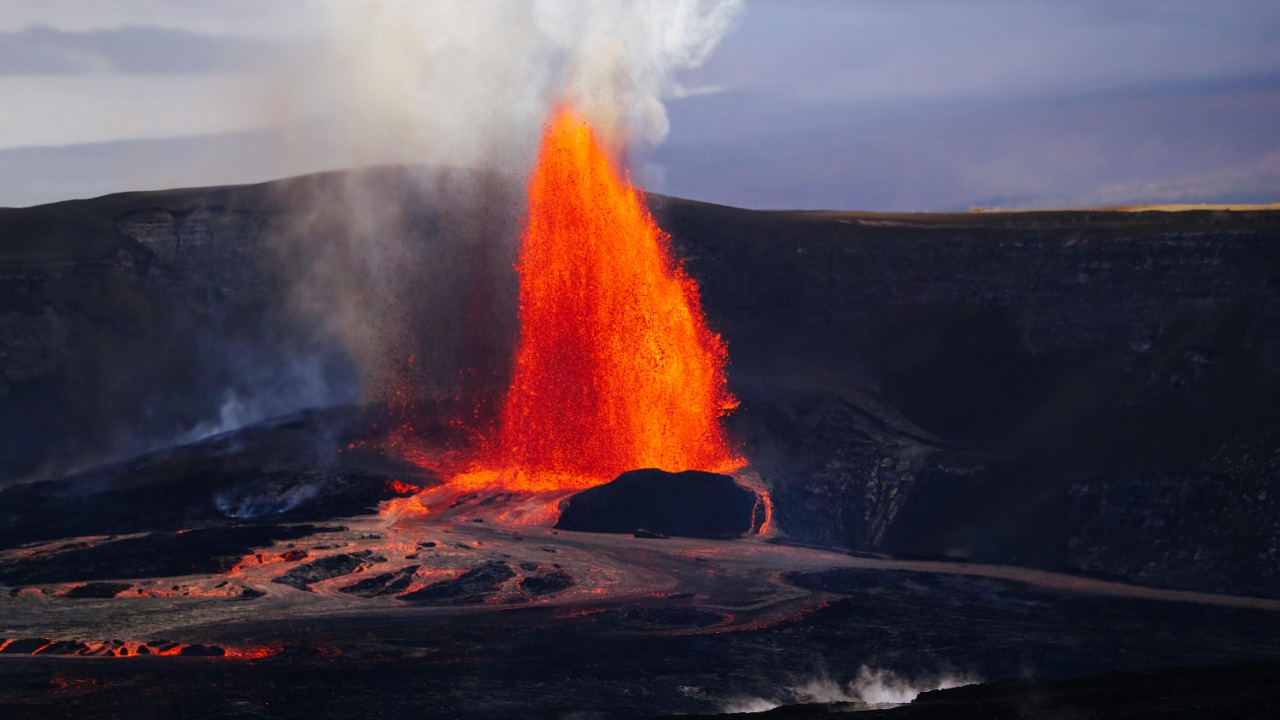

Deep beneath Kīlauea’s summit, a new pattern of shaking is rippling through the rock, replacing the dramatic lava fountains that drew crowds with a subtler but more telling signal. Instead of fire in the sky, the volcano is now speaking in clustered earthquakes, a reminder that its ongoing eruption is far from over and that the summit remains restless. I see these seismic swarms as a shift from spectacle to subtext, revealing how magma is pressurizing and cracking the crust even while most of the action stays hidden from view.
The change is unfolding inside Hawaiʻi Volcanoes National Park, where Kīlauea’s summit caldera and the Halemaʻumaʻu crater sit at the heart of a landscape shaped by centuries of eruptions. Visitors who once watched lava glow from overlooks above the crater are now standing over a zone where the ground itself is pulsing with small quakes, a reminder that this national park is also an active laboratory of Earth processes.
From lava fountains to clustered quakes
The current phase at Kīlauea began with vigorous lava fountaining at the summit, then pivoted into a quieter surface display as the fountains waned and earthquake swarms took over. I read that the latest bursts of shaking are concentrated beneath the summit area, following the end of the most recent fountaining episodes and marking a clear transition from visible eruption to mostly internal unrest. Scientists describe these events as volcano tectonic earthquakes associated with crack opening driven by magmatic pressure, a pattern that fits with magma forcing its way into new or existing fractures rather than racing toward the surface in a fresh breakout, as explained in coverage of how lava fountains end and seismicity begins.
What stands out to me is that this is not just a routine background tremor but a level of shaking that experts call Elevated compared with the rest of the eruption. Reports note that Elevated seismic activity of these intensities has not been seen at the summit since the start of the eruption in December 2024, underscoring that the volcano has entered a more energetic internal phase even as surface lava has calmed. That shift is documented in detailed updates on earthquake swarms that followed the end of summit fountains.
Three swarms beneath Halemaʻumaʻu
Within that broader pattern, the most striking development is a sequence of three distinct swarms beneath Halemaʻumaʻu crater, all confined inside Kīlauea’s summit caldera. I see this repetition as a sign that the same pocket of crust is being stressed again and again, likely as magma pulses into or pressurizes a shallow reservoir. Reports on the third swarm emphasize that All activity remains beneath the Big Island volcano’s caldera, with no evidence that magma is migrating into the rift zones that feed flank eruptions, a crucial reassurance for communities downslope that is laid out in coverage of the third earthquake swarm.
That same reporting notes that There is no observable evidence that magma is migrating away from the summit, a phrase that carries real weight in a region where past eruptions have sent lava flows racing toward neighborhoods and highways. By stressing that All of the current unrest is still trapped beneath the Big Island summit, scientists are effectively drawing a boundary around the hazard for now, even as they acknowledge that the system is more agitated than it has been since the eruption began. The focus on Halemaʻumaʻu as the epicenter of this shaking reinforces the idea that the summit magma system is reconfiguring itself rather than launching a new flank crisis.
What the instruments are seeing
Behind the scenes, a dense network of seismometers and deformation sensors is tracking every jolt and subtle tilt at Kīlauea’s summit. In a formal notice, the Hawaiian Volcano Observatory described how, on a recent Thursday, January 15, 2026, at 9:32 AM HST (19:32 UTC), instruments recorded a concentrated burst of shallow earthquakes beneath the summit of KILAUEA, identified by the volcano number VNUM #332010, a level of detail that shows how closely the system is being watched. I read that the notice highlighted the clustering of events and their shallow depths, a classic signature of magma pressurizing the upper crust, as laid out in the official update.
Geologists analyzing these patterns are candid about the uncertainty. In one account, Geologists said they are unsure if the swarm of earthquakes at Kilauea will impact the ongoing eruption, noting that the summit has already cycled through several fountaining episodes without a major change in vent location or output. That caution reflects how complex the plumbing beneath Kilauea can be, with magma sometimes shifting laterally or vertically without immediately breaking through to the surface, a nuance captured in reporting that quotes Geologists and highlights the role of repeated fountaining episodes at the summit.
Unrest, risk, and the view from the park
For people standing at the rim, the most visible sign of change is not lava but the steady stream of updates and advisories that shape access to overlooks and trails. Hawaiʻi Volcanoes National Park remains the stage for this activity, with managers balancing visitor access against the need to keep people away from unstable crater rims and areas that could be affected by rockfalls or sudden gas releases. The park’s own information on Hawaiʻi Volcanoes underscores that Kīlauea’s summit is both a protected landscape and an active volcanic system, a dual identity that shapes every management decision.
From the scientific side, the broader context is that Kīlauea’s Volcano Alert Level and Aviation Color Code remain at WATCH and ORANGE, respectively, signaling an eruption that is ongoing but largely contained. An earlier notice emphasized that All current and recent activity is within Hawai Volcanoes National Park, a phrase that both reassures communities outside the park and highlights that the primary risks are concentrated where visitors go to see the volcano. That framing appears in a formal Volcano Alert Level notice that spells out the WATCH and ORANGE status and the focus on Hawai Volcanoes National Park.
How this fits into the wider volcanic picture
To me, one of the most revealing aspects of Kīlauea’s current behavior is how it compares with other restless volcanoes. The Hawaiian Volcano Observatory regularly situates Kīlauea within a broader discussion of What is happening with Hawaiian volcanoes, noting that Kīlauea Volcano and Mauna Loa are monitored continuously for changes in seismicity, deformation, and gas output. That wider lens, described in the observatory’s media newsroom, shows that summit swarms at Kīlauea are part of a continuum of volcanic behavior across the Hawaiian chain rather than an isolated anomaly.
Even beyond Hawaiʻi, recent updates from the Cascades Volcano Observatory highlight how earthquake swarms can play out very differently depending on the system. A weekly summary noted that, over the past week, small earthquakes were detected at Mount St. Helens and Newberry, while a previous swarm at Mount Rainier involved about 1,350 earthquakes, the largest of which was magnitude 2.4, without any sign of magma movement. That comparison, shared in a post that also reminded readers that the eruption continues entirely within Hawai Volcanoes National Park and that USGS Hawaiian Volcano Observatory scientists are supporting visitors safely witnessing the incredible power of nature, underscores how swarms can be driven by water in a hydrothermal system rather than magma, a point laid out in the Cascades update.
More from Morning Overview